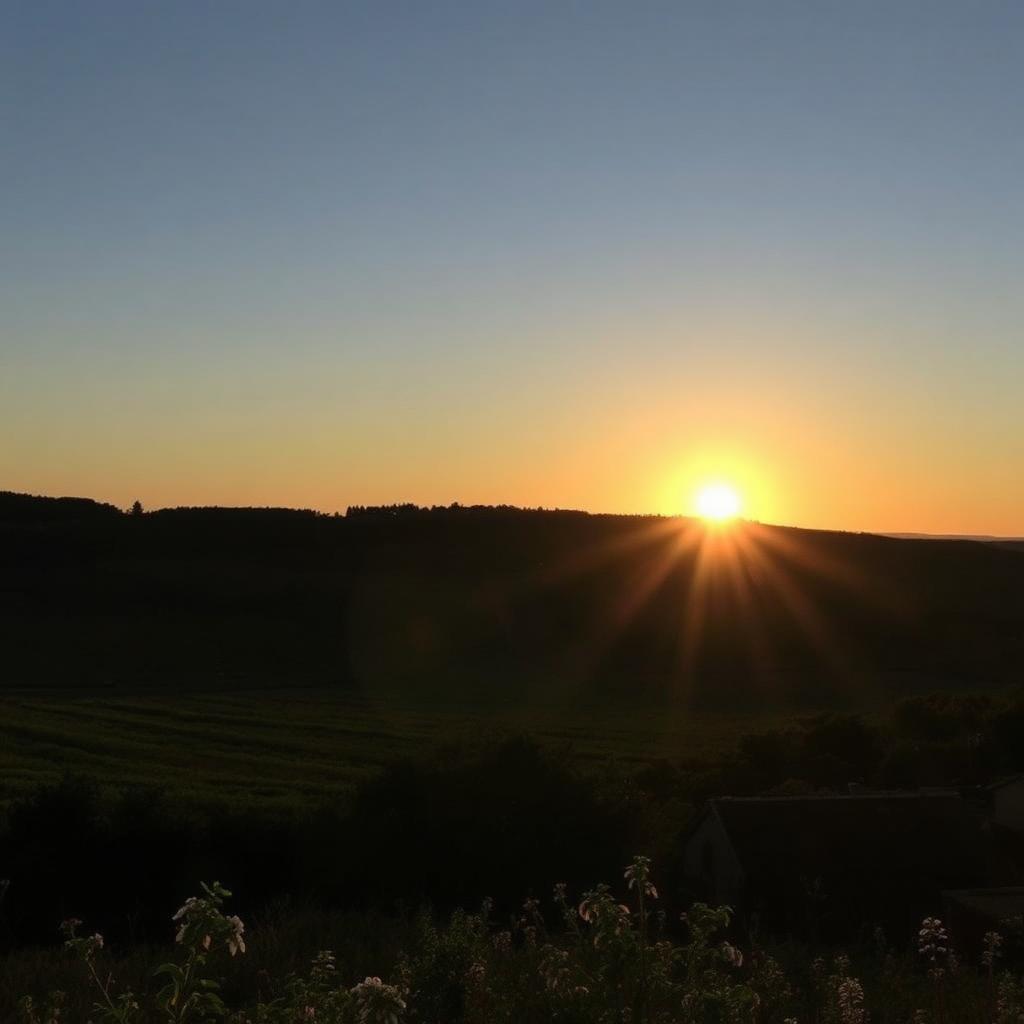
June 21, 2026, marks the summer solstice in the Northern Hemisphere. On this date, the Sun reaches its highest position in the sky at solar noon, and the length of the day becomes maximum. In metropolitan France, the day will exceed 16 hours of sunshine in the northern half of the country, with twilight extending into the late evening hours.
Why the Solstice Falls on This Date
The phenomenon is due to the tilt of the Earth's axis of rotation – about 23.4° – relative to the plane of its orbit around the Sun. At the summer solstice, the Northern Hemisphere is maximally tilted towards the Sun. Solar radiation strikes the Earth's surface at an angle closer to the vertical, increasing both the light intensity received per square meter and the daily exposure duration.
Solstice ≠ Hottest Day
This is one of the most persistent misconceptions: the solstice marks a maximum of sunlight, not a maximum of temperature. In practice, the peak heat of summer almost always arrives several weeks after June 21st – generally between mid-July and early August in metropolitan France. The reason lies in thermal inertia: it takes time for the atmosphere, soils, and especially the oceans, which store a vast amount of energy, to reach their maximum temperature.
Longest Day, Shortest Night
In the northernmost regions – Scandinavia, Iceland, northern Canada – the solstice results in the famous 'midnight sun': north of the Arctic Circle, the Sun simply does not set. Conversely, in the Southern Hemisphere, June 21st corresponds to the winter solstice, the shortest day of the year.
A Landmark Inherited from Ancient Civilizations
The summer solstice has been a universal calendar marker since the Neolithic period. The alignments of Stonehenge, in England, are oriented towards the sunrise on the summer solstice. Many civilizations – Celtic, Germanic, Slavic, Native American – associated festivals with it, some of which survive today, from the Scandinavian Midsummer to the Saint-Jean festivities celebrated in several regions of France on June 23rd and 24th.
And After June 21st
From June 22nd onwards, the days begin to shorten, first imperceptibly – by a few seconds – then more noticeably as we move away from the solstice. The decrease is slow at first, then accelerates until the September equinoxes, before slowing down again as the winter solstice approaches. A perfectly regular astronomical cycle, reminding us that celestial mechanics, itself, ignores heat waves.