
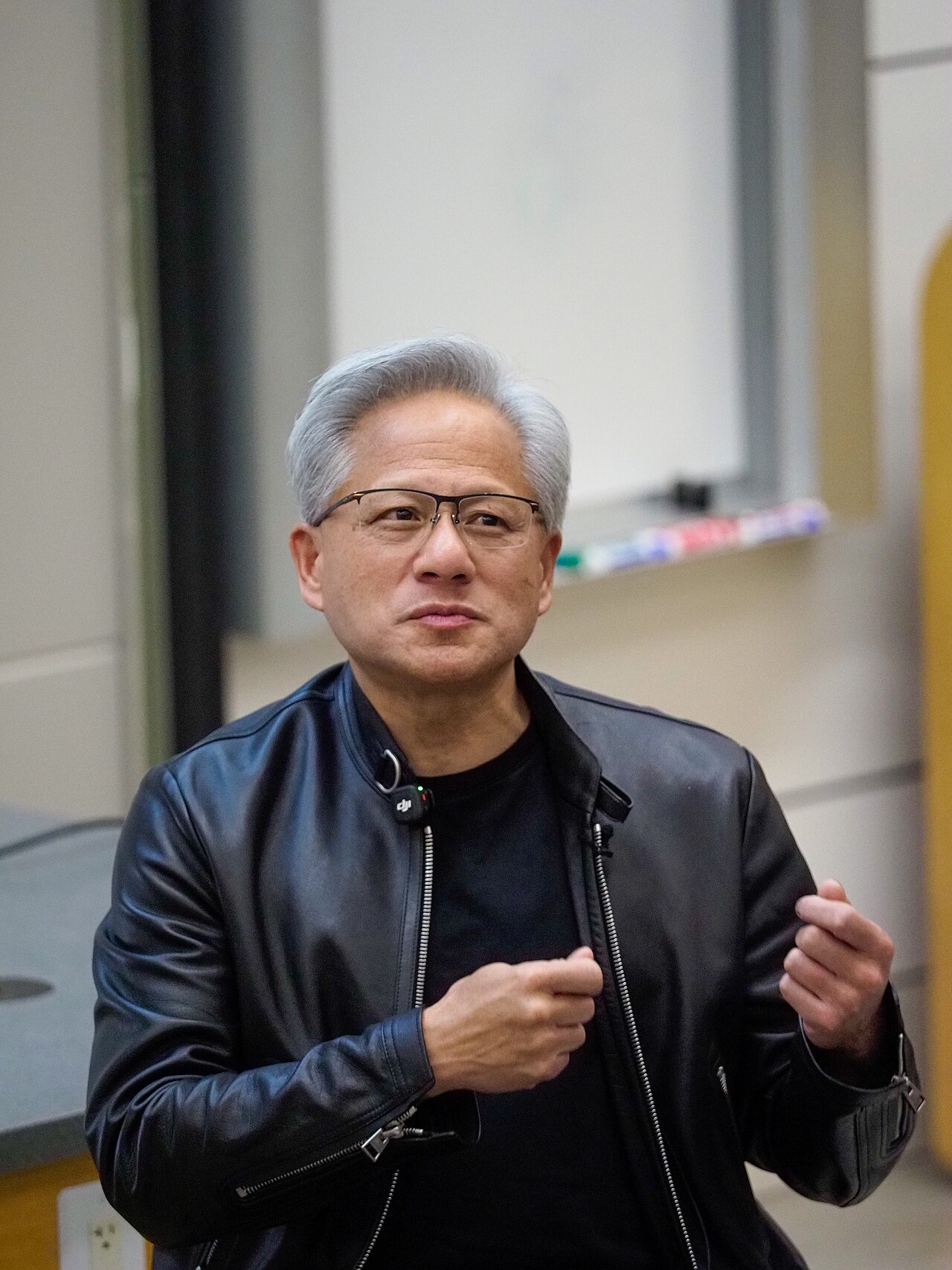
The essentials — Jensen Huang no longer leads Nvidia. On November 12, 2026, the board of directors announced his immediate departure as president, chief executive and a director. Colette Kress, the company’s chief financial officer, is serving as interim CEO, while Harvey C. Jones becomes its first board chair. Nvidia officially describes the departure as a resignation; Bloomberg reports that Jensen Huang was ousted by the directors. The decision follows several revelations and the launch of an independent investigation. At this stage, no verified public evidence establishes that Jensen Huang passed on trade secrets or took part in an espionage operation.
Nvidia confirms Jensen Huang’s immediate departure
The announcement brings to an end Jensen Huang’s thirty-three years at the helm of Nvidia, which he co-founded in 1993. In its November 12 statement, the board said he was leaving his positions as president, chief executive and a member of the board of directors with immediate effect.
Colette Kress has agreed to serve as interim CEO while retaining her responsibilities as executive vice president and chief financial officer. The board is simultaneously launching a search for a permanent successor and says both internal and external candidates will be considered.
Another major governance change: Harvey C. Jones has been appointed Nvidia’s first board chair. The company thanked Jensen Huang for his contribution to the group and the industry. The founder’s departure does not mean that the investigation is closed or that the questions raised in recent days have been resolved.
Resignation or ouster: what the sources actually say
The wording matters in this case. The statement issued on Nvidia’s behalf uses the term resignation. It does not detail the discussions preceding the departure or any conditions attached to it.
Bloomberg, by contrast, writes that Jensen Huang was ousted by the board of directors. Before the announcement, Reuters had reported that the directors met on November 11 to consider his future, while the Wall Street Journal said the board was preparing to remove him. These reports describe a decision made under pressure, but they do not justify rewriting the official statement.
The precise formulation is therefore as follows: Jensen Huang has left Nvidia with immediate effect; the company describes it as a resignation, while Bloomberg describes an ouster decided by the board.
Who is Colette Kress, the new interim CEO?
Colette Kress joined Nvidia in September 2013 as executive vice president and chief financial officer. She has helped oversee the company’s growth and the shift in its business toward data centers and artificial intelligence. Before Nvidia, she spent nearly twenty-five years in financial roles at major technology companies, including Cisco and Microsoft.
Her interim appointment provides immediate operational and financial continuity. She already knows the investors, leadership teams and key financial dynamics of the company. Temporarily combining the roles of chief executive and chief financial officer nevertheless represents a substantial responsibility during a crisis.
Her mandate is described as transitional. The appointment of a permanent CEO will depend on the search launched by the board. The statement provides no public timetable for a permanent appointment.
What revelations preceded this departure?
The case has two separate strands. The first concerns a relationship between Jensen Huang and a former executive at a Singapore-based technology company, reported by the New York Times. According to the newspaper, US authorities raised questions about that person’s links to Chinese intelligence. Reuters and Associated Press picked up these reports while emphasizing the uncertainties surrounding the case, and China disputes the allegations.
Reuters also reported that Jensen Huang had acknowledged an infidelity in a message to colleagues. The second strand concerns an alleged personal relationship with a Nvidia executive, reported on November 11 by the New York Times based on accounts from people who had worked at the company.
These revelations have raised questions about governance and possible conflicts of interest. They do not, on their own, constitute evidence of an offense. A personal relationship, an internal investigation and a criminal allegation are different concepts that should not be conflated.
What the departure does not tell us about the investigation
On November 8, Nvidia announced an independent investigation following reports that Jensen Huang may have been targeted by a foreign intelligence operation. A committee of independent directors, assisted by outside legal advisers, was to oversee the inquiry.
At the time, the board said it had no reason to believe that Nvidia’s secrets or US national security had been compromised. It also expressed support for Jensen Huang and his team. The announcement of his departure four days later marks a decisive change in the situation, but does not constitute a public conclusion to the investigation.
None of the official sources consulted establishes that Jensen Huang passed on trade secrets, collaborated with a foreign intelligence service or committed a criminal offense. Suspicions concerning other individuals and ongoing investigations must not be presented as facts established in court.
Why Wall Street is reacting so strongly
For some investors, Jensen Huang represented more than a chief executive. As Nvidia’s co-founder and longtime public face, he led its evolution from a graphics card manufacturer into a central supplier of artificial intelligence infrastructure.
Following the announcement of his departure, Nvidia shares fell more than 10% in premarket trading on Wall Street, according to Reuters and Bloomberg. The drop reflects, among other things, concerns about succession, strategic continuity and the company’s relationships with its partners.
The share price also depends on the outlook for investment in AI and data centers, as well as broader market conditions. A stock market decline therefore demonstrates neither personal wrongdoing nor an equivalent deterioration in the business. Nor does a decline in market capitalization correspond to an equivalent loss of cash for the company.
Who might benefit from a weaker Nvidia?
Nvidia operates in an intensely competitive environment. AMD develops accelerators for data centers, Google designs its own TPU processors, Amazon invests in Trainium and Microsoft is developing its Maia range. These companies are seeking, among other things, to diversify computing capacity and reduce dependence on a single supplier.
A poorly managed transition at Nvidia could encourage some customers to accelerate their own diversification strategies. It would, however, be misleading to infer that these competitors played a role in the media revelations or Jensen Huang’s departure.
No verified public evidence supports attributing the published information to an operation organized by a competitor, investor or political group. The distinction between the potential beneficiaries of a crisis and those who may be responsible for it remains fundamental.
Why is Washington interested in this case?
Advanced semiconductors hold a strategic position in the technological rivalry between the United States and China. For several years, US authorities have imposed export restrictions on certain advanced computing chips, including technologies that could be used to develop powerful artificial intelligence systems.
According to Reuters, lawmakers have requested explanations regarding potential national security risks and the enforcement of export controls. On November 11, Senators Elizabeth Warren and Chris Coons also requested the preservation of documents relating to Nvidia chip exports to China.
These actions illustrate the case’s geopolitical importance. They do not establish that Jensen Huang or Nvidia is responsible for any offense. Nor does the leadership change, on its own, resolve questions of compliance and export controls.
Can Nvidia continue to dominate AI without Jensen Huang?
Nvidia retains its graphics processor architectures, its CUDA software environment, its teams and its commercial relationships with major cloud providers and artificial intelligence developers. Its founder’s departure does not erase these technological and economic assets.
The immediate challenge lies in the unplanned succession of a leader who had embodied the company’s strategy since its inception. Colette Kress must reassure employees, customers and investors while the board searches for a permanent successor. The allocation of responsibilities and continuity in decision-making will be watched particularly closely.
The main risk is therefore one of governance and transition, rather than the sudden disappearance of Nvidia’s technological advantage. The strength of that advantage will also depend on competition, demand and the performance of the future leadership team.
OrChair analysis: a succession crisis becomes reality
The Jensen Huang case illustrates the vulnerability of companies closely associated with their founders. A longstanding leader can embody a long-term vision and deep technological knowledge. This concentration of power can, however, create a dependency when the leader’s future becomes uncertain.
At Nvidia, the appointment of an interim CEO and a first board chair brings concrete changes to the distribution of power. They open a phase in which the directors must demonstrate their ability to manage the transition and address questions of investigation, governance and strategy separately.
It would be premature to conclude that an espionage operation has been established or that a coordinated destabilization campaign has taken place. The established fact is Jensen Huang’s immediate departure. Responsibility and the precise circumstances must continue to be distinguished from hypotheses.
Conclusion: Nvidia enters a new era
Jensen Huang’s departure marks a historic break for Nvidia. After thirty-three years under its co-founder’s leadership, the company must organize its first succession in this role while navigating a governance crisis and a sharp stock market reaction.
Colette Kress provides an immediate but temporary solution. Harvey C. Jones takes over as board chair at a time when its decisions will be closely scrutinized. The search for a permanent chief executive becomes one of the company’s main challenges.
Nvidia’s technologies, teams and market position remain. The central question now is whether the company can preserve its strategy and its partners’ trust without the leader who had embodied them since its founding.
Key facts - Jensen Huang left Nvidia with immediate effect on November 12, 2026. - He no longer sits on the board of directors or holds the positions of president or chief executive. - Nvidia officially describes the departure as a resignation; Bloomberg reports an ouster by the board. - Colette Kress is serving as interim CEO while remaining chief financial officer. - Harvey C. Jones becomes Nvidia’s first board chair. - The search for a permanent successor is open to internal and external candidates. - The sources consulted establish no criminal espionage charge against Jensen Huang. - The share price decline constitutes neither evidence of wrongdoing nor an equivalent loss of cash.
Sources and editorial transparency — Nvidia, official statement on the leadership transition, November 12, 2026; Bloomberg, Jensen Huang’s ouster and Colette Kress’s appointment, November 12, 2026; Reuters, Jensen Huang’s departure and its implications for AI, November 12, 2026; Nvidia, board statement on the independent investigation, November 8, 2026; Reuters, board meeting on the chief executive’s future, November 11, 2026; Reuters, second alleged relationship reported by the New York Times, November 11, 2026; Associated Press, the available information and remaining uncertainties. Editorial update, November 12, 2026 — This article was rewritten following the official announcement of Jensen Huang’s departure and Colette Kress’s interim appointment. The previous version stated that no dismissal had yet been announced. Suspicions, witness accounts and ongoing investigations do not constitute judicial findings.