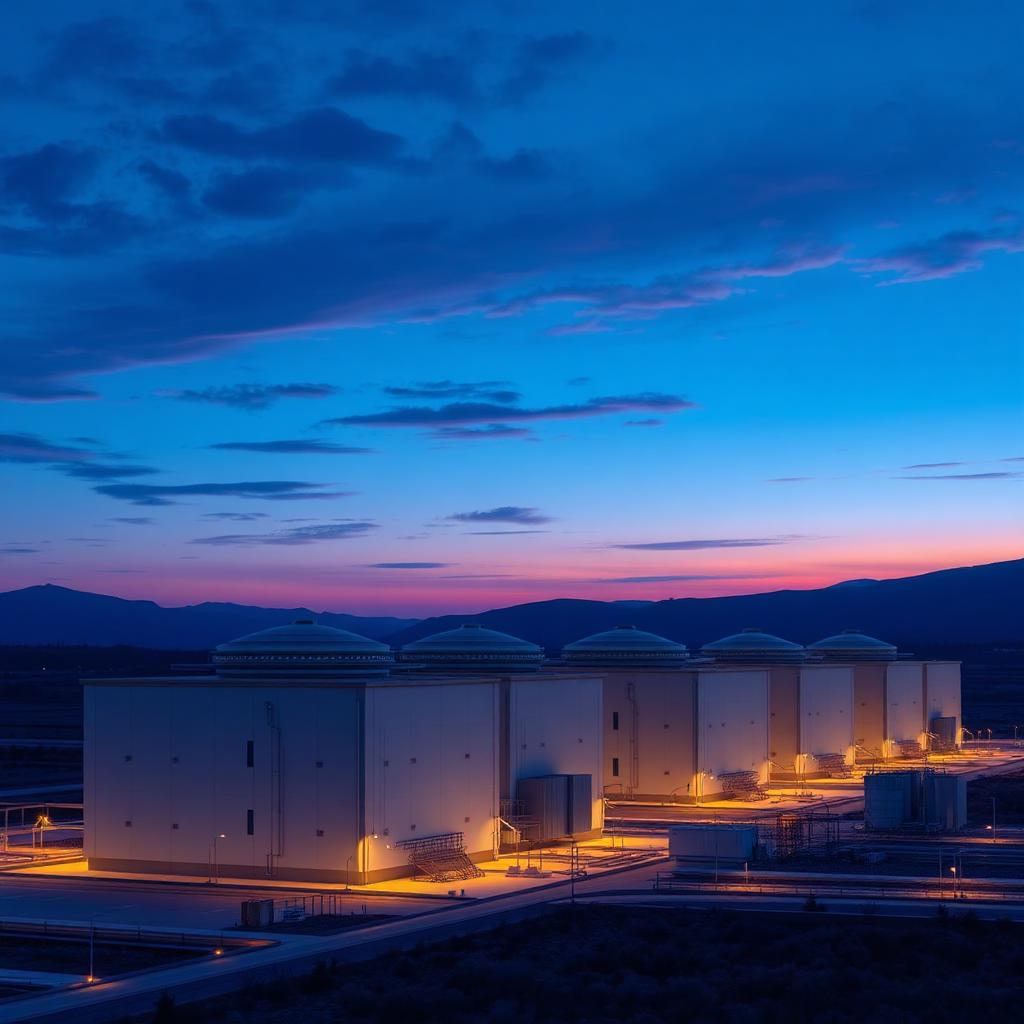
The Small Modular Reactors (SMRs) are an old promise. The concept – producing nuclear reactors with a reduced unit power (10 to 300 MW), manufactured in series in factories rather than being built site by site – was formulated as early as the 1950s. It has had several false starts. The specificity of 2026 is that it is finally entering a phase of commercial industrial deployment, under the dual pressure of decarbonization and the explosion of electricity demand linked to data centers.
Fifty Designs, A Few Finalists
The International Atomic Energy Agency's (IAEA) database currently lists over 80 SMR designs worldwide, with about fifty in active development. However, the short-term commercial market will focus on a handful of finalists: NuScale (USA, 77 MW per module, pressurized water technology), GE-Hitachi BWRX-300 (300 MW, boiling water), Rolls-Royce SMR (470 MW, more precisely at the SMR / medium reactor boundary), EDF Nuward (170 MW, pressurized water), BWXT mPower (USA), and several Canadian and Chinese designs.
The first commercial startups are expected: 2029 for GE-Hitachi's BWRX-300 in Ontario (OPG's Darlington project), 2030-2031 for Rolls-Royce SMR in the United Kingdom, 2032-2033 for Nuward in France. China is going it alone with its Linglong One (ACP100, 125 MW) design, already under construction in Changjiang on Hainan Island, with criticality announced for late 2026.
Key SMR Figures for 2026
- 80+: SMR designs listed by the IAEA worldwide.
- 10 to 470 MW: unit power range of SMRs.
- 2029: first commercial startup expected (BWRX-300, Ontario).
- $3 to $5 billion: cost of an SMR project (4 to 6 modules), compared to $12 to $20 billion for an EPR.
- 30%: target for cost reduction per MWh for SMRs through series effect in the long term.
- 50 GW: projected global SMR capacity by 2035 by the IEA (median scenario).
- France: €1 billion committed by the state to the Nuward project via France 2030.
Why Now — And Why Data Centers Are a Game Changer
The nuclear renaissance of 2024-2026 has two converging drivers. First driver: decarbonization. Net-zero commitments from states and large companies make 24/7 low-carbon electricity indispensable. Nuclear power, alongside hydroelectricity from dams and certain geothermal configurations, is one of the few technologies capable of offering this signature.
Second driver: demand from AI data centers. The explosion of electricity needs linked to the training and inference of AI models has positioned hyperscalers (Microsoft, Google, Amazon, Meta) as structural buyers of firm, low-carbon electricity. Microsoft signed a historic agreement in 2024 for the reopening of Three Mile Island Unit 1 (renamed Crane Clean Energy Center). Amazon invested in X-energy. Google signed with Kairos Power. SMRs offer an attractive promise: units of a few hundred megawatts deployable on or immediately adjacent to data center campuses, with an industrialization timeline compatible with the hyperscalers' trajectory.
Remaining Obstacles
Enthusiasm should not obscure the difficulties. First obstacle: actual cost. NuScale's pioneering project in Utah (UAMPS) was canceled in 2023 after projected costs spiraled to $89/MWh, deemed incompatible with the market. The expected economies of scale will only materialize with series of several tens of modules, which implies order books that are still largely uncertain.
Second obstacle: regulation. Nuclear safety authorities—the US NRC, French ASN (now ASNR in 2025), UK ONR—were not designed to process design dossiers in series. Standardization of designs and model approval procedures, currently being experimented with, are essential for truly industrial deployment.
Third obstacle: the fuel cycle. Several designs (BWRX-300, Nuward) use standard fuel, which is an advantage. Others (X-energy, TerraPower Natrium) require HALEU—uranium enriched to high concentrations (5 to 20%)—whose supply chain remains highly concentrated, historically Russian, and is now being relocated in the United States and Europe.
> “The question is no longer whether SMRs will exist. It is about who will deliver, on time, at a competitive cost. And how many designs will survive the industrial selection phase.” — *Rafael Mariano Grossi, Director General of the IAEA, February 2026.*
To Remember
- Over 80 SMR designs listed by the IAEA.
- First commercial startup expected in 2029 (BWRX-300, Ontario).
- France: €1 billion committed to the Nuward project (EDF), targeting 2032-2033 startup.
- Microsoft, Amazon, Google: three major commercial drivers from the data center side.
- 50 GW of projected SMR capacity by 2035 (IEA, median scenario).
- Obstacles: actual cost, regulatory harmonization, HALEU supply chain.