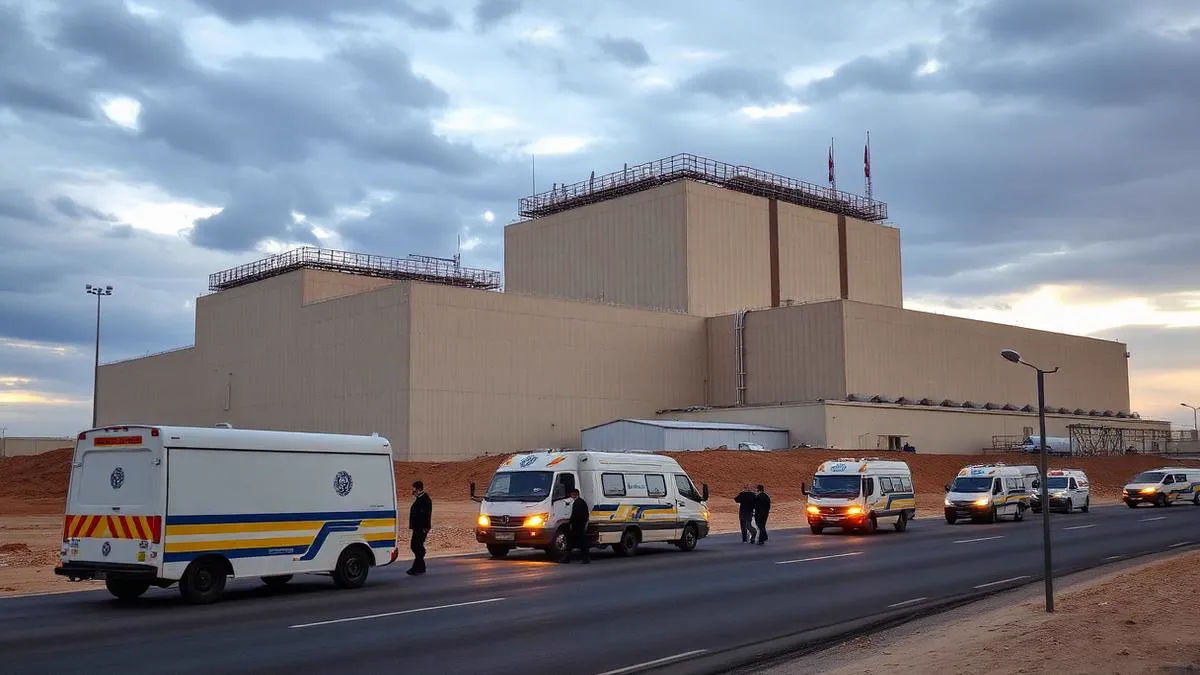
Russian nuclear corporation Rosatom began this Saturday the main phase of evacuating its personnel from the Bushehr nuclear power plant in southern Iran. A total of 198 Russian employees – engineers, technicians, and maintenance staff – are being repatriated by land to Turkey. "We sincerely hope that within two to three days, our colleagues will have safely crossed the border and returned home," said Alexey Likhachev, CEO of Rosatom.
The evacuation follows the impact of a projectile near the nuclear site, reported by the Atomic Energy Organization of Iran (AEOI). Although the plant itself was not hit, damage to surrounding infrastructure and the increase in airstrikes in Bushehr province made the security situation "untenable" for foreign personnel, according to a Rosatom official on condition of anonymity.
The Bushehr plant, Iran's only operational nuclear power plant, is a VVER-1000 pressurized water reactor with a capacity of 1,000 megawatts, built with Russian technical assistance and commissioned in 2011. Its operation depends entirely on Russian expertise for maintenance and fuel reloading. The departure of Rosatom personnel de facto means a programmed shutdown of the plant in the medium term.
The International Atomic Energy Agency (IAEA) expressed its "strong concern" and recalled that civilian nuclear facilities are protected by international humanitarian law. IAEA Director General Rafael Grossi requested immediate access to the site to verify the integrity of safety systems. Tehran has not yet responded to this request.
For observers of civilian nuclear power, the evacuation of Bushehr creates a dangerous precedent. "This is the first time in history that an operational nuclear power plant has been evacuated due to armed conflict – with the exception of Zaporizhzhia in Ukraine in 2022," emphasizes nuclear physicist François Géré, president of the French Institute for Strategic Analysis. The parallel with Zaporizhzhia, whose situation remains precarious, fuels fears of a radiological accident.