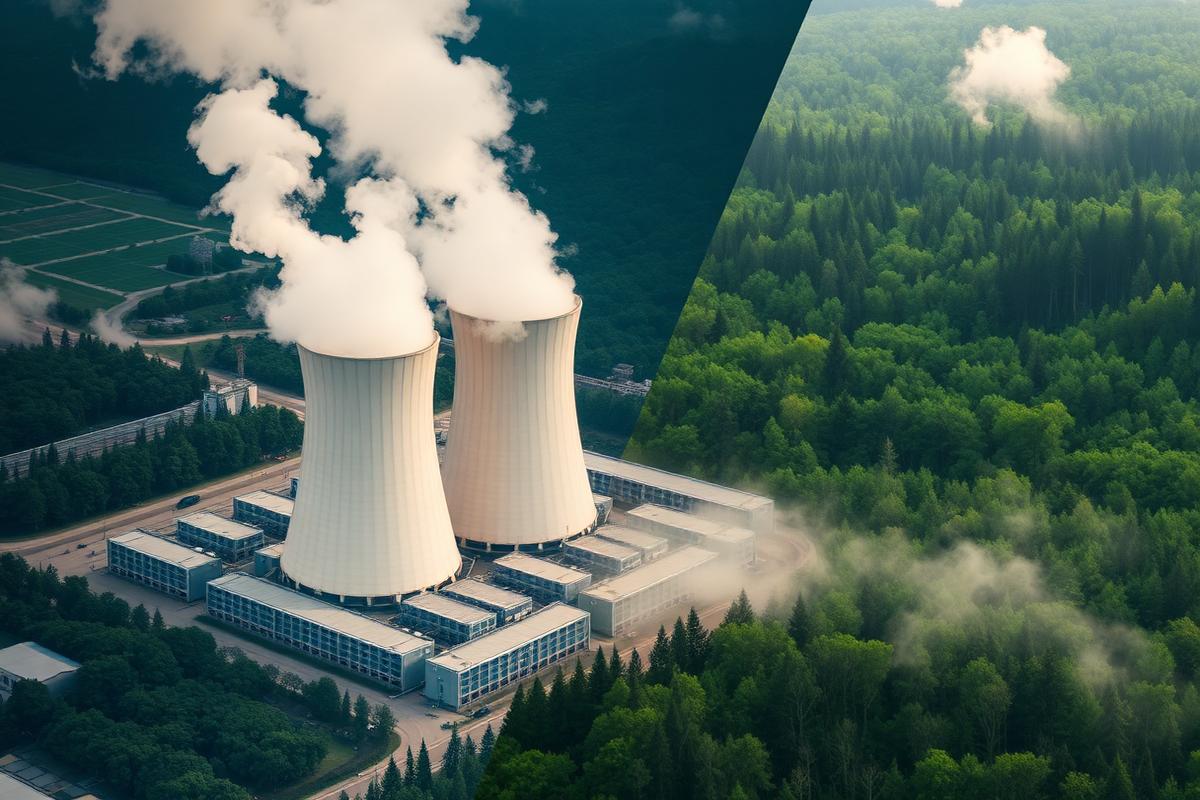
The figures are staggering and carefully avoided by the industry. According to a study published in March 2026 by the University of Massachusetts Amherst and MIT, training a single latest-generation large language model—like OpenAI's GPT-5 or Google's Gemini Ultra—emits around 626 tons of CO2, equivalent to the lifetime emissions of five average American cars, or a round-trip Paris-New York flight for 300 passengers. But this figure only covers initial training. Inference—meaning every query you send to ChatGPT, every image generated by Midjourney, every automatic translation—currently represents 90% of AI's total energy consumption, according to the International Energy Agency (IEA). In 2025, data centers worldwide consumed 1,300 TWh of electricity, more than Japan's total consumption.
Water is the other hidden side of the disaster. Data centers use colossal amounts of water to cool their servers. Microsoft acknowledged in its 2025 environmental report that its water consumption had jumped by 34% in one year, mainly due to the explosion in AI demand. Google reported a 20% increase. Globally, the cloud and AI sectors consume about 6.3 billion liters of fresh water per day—equivalent to the daily consumption of 2.5 million people. In regions already experiencing water stress—Arizona, Spain, Southern India—data centers are entering into direct competition with agriculture and domestic needs. In Talavera de la Reina, Spain, a Meta mega data center project sparked massive citizen outcry in 2025.
The irony is cruel: tech giants sell AI as the solution to the climate crisis—optimizing energy grids, modeling climate change, precision agriculture—while becoming themselves one of the factors accelerating the problem. Google, which had committed to achieving full carbon neutrality by 2030, quietly postponed this goal to "beyond 2035" in its latest report. Microsoft, despite its massive investments in carbon credits, has seen its total emissions increase by 29% since 2020. Amazon Web Services, which hosts a significant portion of global AI workloads, still refuses to publish granular data on its data centers' emissions. Opacity is the norm, not the exception.
Solutions exist, but they are slow to gain traction. Immersion cooling—submerging servers in a non-conductive dielectric fluid—reduces water consumption by 90% and electricity consumption by 30%. DeepMind has developed an AI system that optimizes Google's data center cooling, reducing their energy consumption by 40%. New-generation nuclear power is attracting tech giants: Microsoft signed a contract with Constellation Energy to restart the Three Mile Island plant, and Amazon is investing in small modular reactors (SMRs). Neuromorphic computing and specialized chips (like Google's TPUs or Groq processors) promise ten times greater energy efficiency than traditional NVIDIA GPUs.
But the fundamental question remains: do we need all this computing power? Each ChatGPT query consumes on average 10 times more energy than a classic Google search. Generating an image with DALL-E or Midjourney requires as much electricity as charging a smartphone. Autonomous "AI agents," which chain hundreds of queries in a loop, multiply the footprint by a factor of 50 to 100. Digital sobriety—using smaller models, optimizing prompts, avoiding frivolous uses—is a powerful lever but culturally difficult to impose in an industry that only swears by "bigger is better." The real challenge for AI in 2026 is not whether it can do everything, but whether the planet can afford it.