
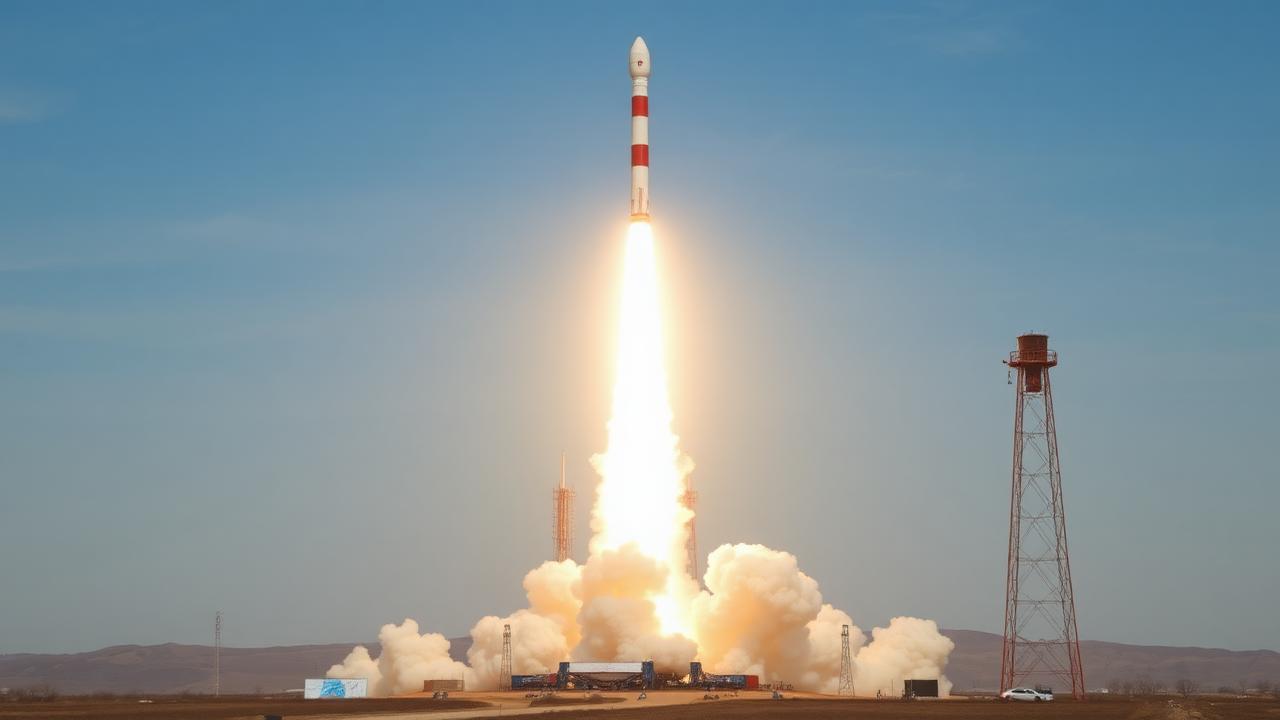
On Sunday, May 24, 2026, a Long March-2F rocket lifted off from the Jiuquan Launch Center in the Gobi Desert, carrying the Shenzhou 23 spacecraft and its three occupants towards the stars. A few hours later, at 2:45 AM Beijing time on May 25, the craft docked with the Tianhe core module of the Tiangong space station in a fully automated orbital rendezvous, according to reports from Xinhua, SpaceNews, and collectSPACE. At an altitude of 400 kilometers, China has added another step to a space program that has continued to accelerate in recent years.
A Symbolically Charged Crew
The crew consists of Zhu Yangzhu, mission commander, Zhang Zhiyuan, and Zhang Hongzhang. But it is the presence of a third individual — an astronaut native to Hong Kong — that draws attention: they become the first taikonaut from the Special Administrative Region to reach orbit, in an operation largely staged by Beijing. According to collectSPACE, this inclusion is explicitly presented by Chinese authorities as a message of Hong Kong's integration into the grand national narrative. For its critical observers, it is also a political message to a city whose autonomy has been substantially reduced since the 2020 National Security Law.
A Year-Long Mission: China Tests Human Limits
The other historic announcement concerns the duration. For the first time, one of the astronauts will remain in orbit for a full year, according to statements from the China Manned Space Agency (CMSA) reported by Reuters and Xinhua. Until now, Shenzhou missions lasted around six months. The stated objective is explicit: "to explore the limits of human adaptability and performance in long-duration spaceflight environments." The physiological data collected will directly feed the preparation for manned lunar missions, where the transit itself will exceed several weeks round trip.
Tiangong, Continuously Operational Station
With the arrival of Shenzhou 23, Tiangong momentarily hosted six astronauts simultaneously — the three new arrivals and the three members of the previous mission. The CMSA spoke of a "crew gathering in orbit" in line with the now routine rotations of the program. The station has been operating continuously since 2021, with regular crew changes and a permanent scientific program — a model reminiscent of the International Space Station, but entirely managed by Beijing, without cooperation with NASA, with whom partnership with China has been prohibited by U.S. law since 2011.
The Moon in Sight, Artemis Program Under Pressure
The mission is part of a much broader space agenda. China has officially declared its intention to send astronauts to the Moon before 2030, in direct competition with NASA's Artemis program, whose manned lunar landing date keeps slipping. The year-long mission on Tiangong is a direct preparatory step; in parallel, the new generation Mengzhou spacecraft — set to replace Shenzhou for lunar missions — is scheduled for an uncrewed orbital test flight at the end of 2026, according to SpaceNews. Beijing is also gradually internationalizing its program: the Shenzhou 24 mission, planned for autumn 2026, is expected to include a Pakistani astronaut for a short visit.
Editorial Opinion
China is no longer in the realm of simple imitation: it is now setting the pace for space exploration. Sending an astronaut for a year into orbit demonstrates an operational maturity that few programs have achieved — NASA and Roscosmos have done it, but no others. The presence of a Hongkonger on board adds a fascinating geopolitical layer to what is, above all, a scientific feat. In 2026, the Moon has once again become an issue of power, and Beijing is playing to win. NASA would do well to remember this.
Key Takeaways
- Shenzhou 23 launched on May 24, 2026, from Jiuquan, docked with Tiangong on May 25 at 2:45 AM Beijing time.
- Presence of the first astronaut native to Hong Kong in a Chinese space crew.
- One crew member will remain in orbit for a year, a first for China.
- Six astronauts simultaneously aboard Tiangong during the rotation.
- Official objective: Chinese manned lunar landing before 2030; Mengzhou lunar spacecraft to be tested in late 2026.
- Shenzhou 24 (Autumn 2026) is expected to include a Pakistani astronaut.