
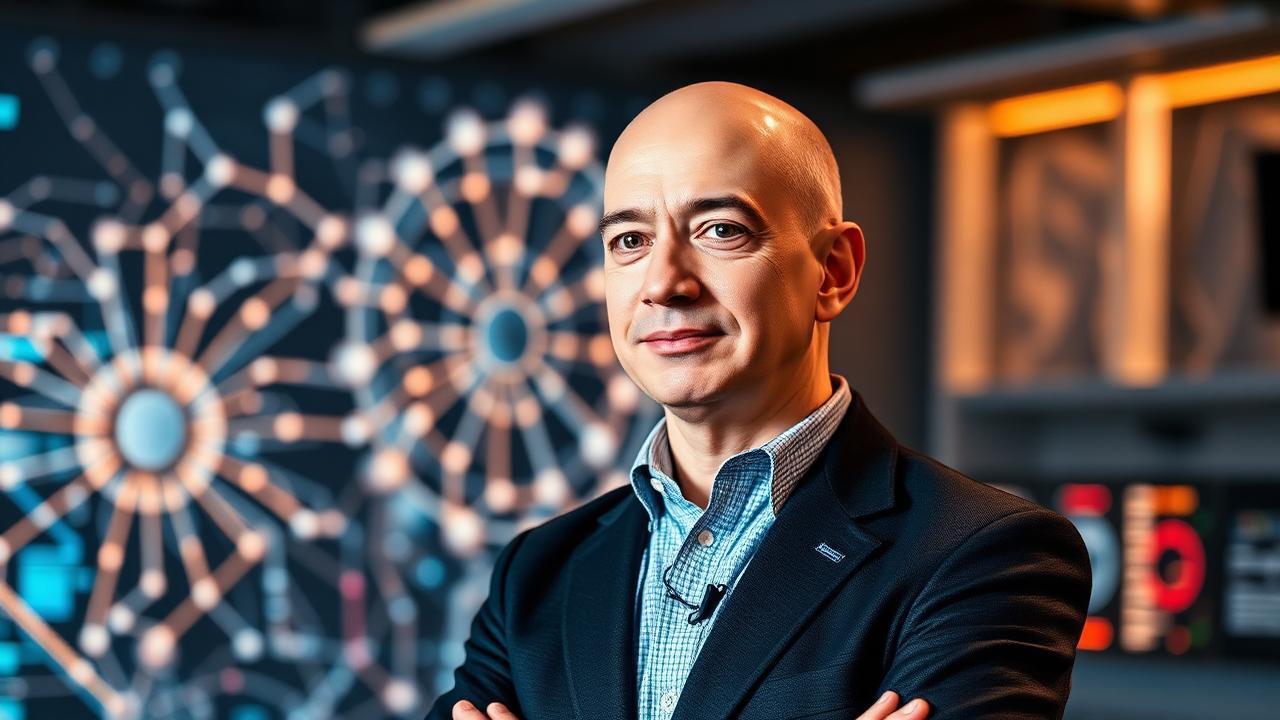
This is one of the most discreet—and potentially most transformative—financial operations of the decade. According to a Financial Times revelation published Monday evening and widely reported by Les Échos on Tuesday, April 21, 2026, Jeff Bezos is on the verge of finalizing a funding round of approximately $10 billion to finance Project Prometheus, his hitherto largely secret startup dedicated to industrial artificial intelligence. The Amazon founder, still heading the Seattle-based giant's board of directors, is reportedly leading this project in parallel with Blue Origin, his space company, and is supported by Kyle Kosic—formerly a co-founder of xAI and a defector from OpenAI—who was hired earlier this year.
A $100 Billion Ambition
The $10 billion mentioned by the Financial Times is said to be just the first step. According to Newsbit and Complete AI Training, who have confirmed the information through cross-referencing American and Asian sources, Jeff Bezos is simultaneously in talks with the world's largest wealth managers—Singapore, Abu Dhabi, Riyadh—to eventually raise a $100 billion fund. Its purpose: to acquire struggling American manufacturing companies, radically automate them using AI, and then resell them at a significantly higher valuation. This is, nothing more nor less, an industrial private equity strategy supercharged by artificial intelligence, on the scale of a mini-Vision Fund but entirely focused on physical production.
Why 'Prometheus'?
The choice of name is obviously not accidental. In Greek mythology, Prometheus stole fire from the gods to give to humankind—a thinly veiled parallel to Bezos's ambition to snatch artificial intelligence from the labs of Cupertino, Mountain View, and San Francisco to deploy it in the factories of Ohio, Michigan, and Pennsylvania. According to the specialized blog Nouvelles Technologies, the project has already recruited over 180 engineers in less than eight months, including about twenty former employees from OpenAI and Tesla AI Lab. The main offices are reportedly located in Seattle and Austin, with a secondary R&D center being set up in Tel Aviv. The estimated annual cost of the payroll already exceeds $400 million.
The Context: A Tense American AI Race
Project Prometheus is emerging within a fierce competition. OpenAI, which has just completed a funding round valuing the company at $850 billion, Anthropic—which received an additional $5 billion from Amazon on Monday, according to Techniques de l'Ingénieur—Mistral AI, xAI, and Meta are making frequent announcements. However, all these players share a common limitation: their models remain essentially software-based, and their impact on the real economy depends on the willingness of industrialists who are still hesitant to invest heavily. Bezos's value proposition is radically different: to control both the technology and the industrial asset, thereby bypassing resistance to change and dictating the pace of automation.
The Risks of Such a Bet
The obstacles, however, are immense. First, political: a $100 billion fund massively acquiring American factories to lay off workers risks triggering a bipartisan backlash in Washington, especially in an election year. Second, technological: industrial AI lags far behind generative AI, and fundamental models have not yet proven their ability to autonomously manage complex production lines. Finally, financial: the profitability of an industrial investment is assessed over seven to ten years, the opposite of the usual horizon for technology funds. According to 21 News, several sovereign wealth funds from the Gulf have reportedly expressed reservations about the capital lock-in period required by Bezos.
Editorial Opinion
Project Prometheus is arguably the most audacious bet in the AI ecosystem in 2026. Where most Silicon Valley giants are content with optimizing increasingly large language models, Jeff Bezos is targeting a much more strategic horizon: the automated reindustrialization of the United States. If the operation succeeds, it could redefine the very nature of American capitalism in the 2030s, consolidating control over both AI and physical production in the hands of a few tech players. If it fails, it will leave behind dozens of weakened factories and tens of thousands of displaced workers. In either case, this is one of the key dossiers to follow this decade.
Key Takeaways
- A $10 billion funding round is underway for Project Prometheus.
- Long-term goal: a $100 billion fund to acquire and automate factories.
- Kyle Kosic, former co-founder of xAI and ex-OpenAI, is in operational charge.
- 180 engineers already recruited, estimated annual payroll of $400 million.
- Major risks: political opposition, technological lag, long profitability horizon.