
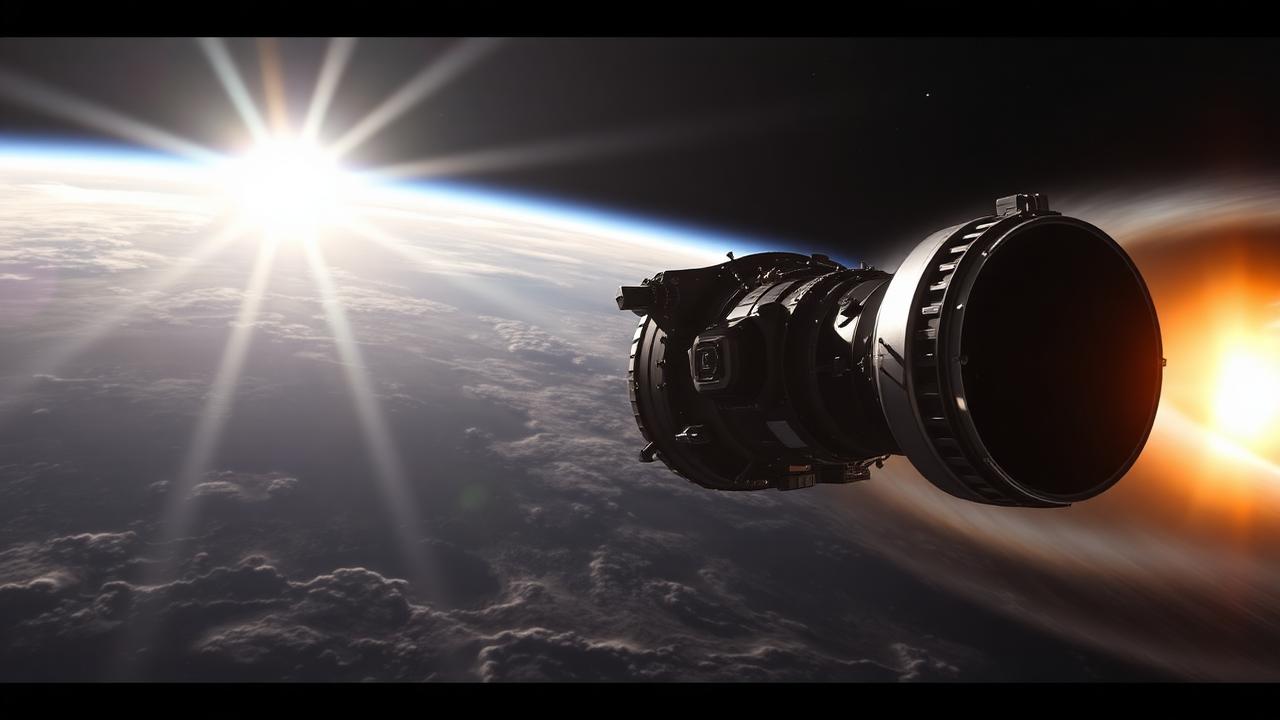
Humanity reconnected with crewed lunar exploration on Sunday, April 6, 2026. The four astronauts of the Artemis II mission — Commander Reid Wiseman, Pilot Victor Glover, Mission Specialist Christina Koch, and Canadian Jeremy Hansen — flew over the far side of the Moon aboard the Orion spacecraft, marking the first passage of humans close to our natural satellite since the Apollo 17 mission in December 1972. Launched on April 1st from the Kennedy Space Center in Florida, the astronauts traveled over 400,000 kilometers, shattering the distance record for a crewed flight set by Apollo 13 in 1970.
The most critical moment of the mission occurred during the trans-lunar injection on April 3rd, when Orion's main engine was fired for nearly six minutes to accelerate the spacecraft to 39,400 km/h – the threshold needed to escape Earth's gravitational pull. Commander Wiseman confirmed live that all systems were functioning nominally, an immense relief for the Houston control center teams who had rehearsed the maneuver hundreds of times in simulations. The Orion spacecraft then began its free-return trajectory around the Moon.
The lunar flyby itself, conducted at an altitude of approximately 130 kilometers above the surface, offered the astronauts a breathtaking view of the craters on the far side – a region only previously observed firsthand by the crews of Apollo 8 and 13. Christina Koch, the first woman to see the Moon this closely, described the spectacle as "absolute geological silence, a beauty that images cannot capture." Jeremy Hansen became the first non-American astronaut to fly around the Moon, a historic milestone for the Canadian Space Agency.
Artemis II represents the second stage of NASA's Artemis program, whose ultimate goal is to return astronauts to the lunar surface with the Artemis III mission, planned for 2028. The current 10-day mission aims to test all systems of the Orion spacecraft and the European service module under real trans-lunar flight conditions. The return to Earth is scheduled for April 11th, with a splashdown in the Pacific Ocean off the coast of San Diego. The data collected will determine the parameters for the lunar landing mission.
The success of Artemis II comes amid a tense geopolitical climate that lends the mission a particular symbolic dimension. While the war in Iran monopolizes global attention, the lunar flyby recalls humanity's capacity to pursue peaceful and scientific objectives despite terrestrial conflicts. The Artemis program is also a matter of space competition: China is preparing its own crewed mission to the Moon for 2030, and the American success strengthens NASA's position in this new space race.