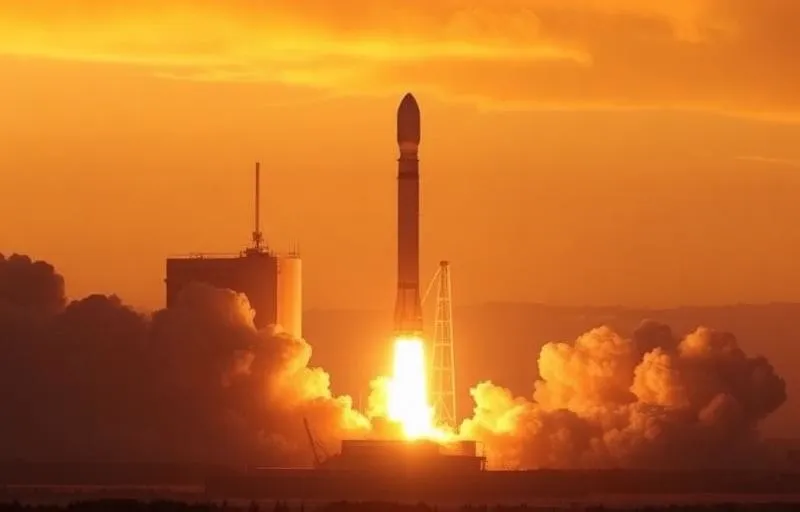
It's done. NASA's Space Launch System (SLS) rocket successfully lifted off from Launch Complex 39B at Kennedy Space Center in Florida on Wednesday, April 1, 2026, at 6:35 PM Eastern Time, carrying four astronauts to the Moon aboard the Orion capsule. For the first time since Apollo 17 in December 1972 – over 53 years ago – humans are heading to our natural satellite. The launch proceeded without major incident, despite weather conditions that had nearly forced a postponement. (
The Artemis II crew consists of Commander Reid Wiseman and Pilot Victor Glover (NASA), Mission Specialist Christina Koch (NASA), and Mission Specialist Jeremy Hansen of the Canadian Space Agency. Victor Glover becomes the first African American astronaut to travel beyond low Earth orbit, and Christina Koch the first woman to leave Earth's orbit. Jeremy Hansen is the first Canadian to undertake a lunar flight. (
The Artemis II mission is a ten-day lunar flyby on a free-return trajectory. The Orion capsule will approach the Moon to about 10,000 kilometers (6,200 miles) from its surface – without orbiting or landing on it – before returning to splash down in the Pacific Ocean around April 11, 2026. This is the first crewed flight of the Orion spacecraft and the second flight of the SLS rocket after Artemis I (an uncrewed mission in 2022). (
A few hours after liftoff, NASA confirmed that the crew had successfully passed the mission's initial critical milestones: separation of the solid rocket boosters, separation of the SLS core stage, translunar injection, and deployment of Orion's solar arrays. The four astronauts are in good health and have begun initial checks of the spacecraft's systems. (
Artemis II paves the way for Artemis III, scheduled for 2027, which aims to land two astronauts on the lunar surface in the South Pole region. The Artemis program's goal is to establish a sustainable human presence on the Moon through the Gateway space station and prepare for future missions to Mars. The cumulative cost of the Artemis program is estimated at $93 billion by the NASA Office of Inspector General. (
The liftoff of Artemis II occurs amidst a tense geopolitical climate – launch images were broadcast split-screen with strikes in Iran on American news channels. But for the scientific community, this mission marks a turning point: humanity is reconnecting with crewed lunar exploration, and for the first time, the crew reflects the diversity of society. A page of space history is being written. (