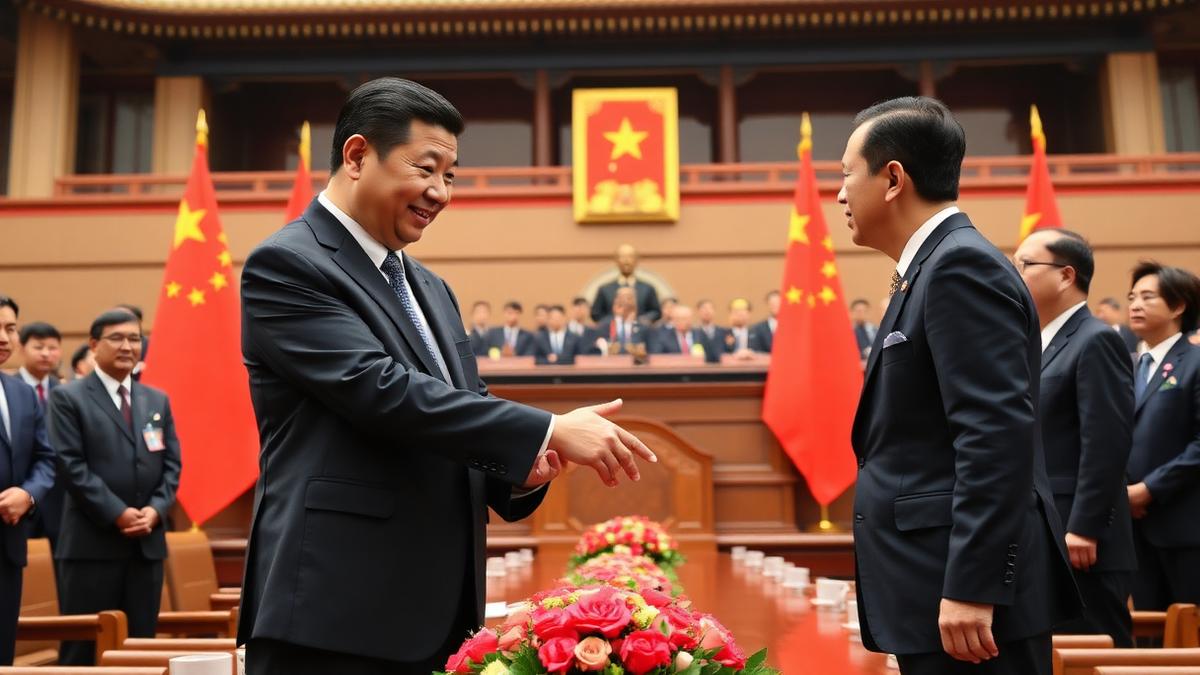
Chinese Communist Party General Secretary Xi Jinping received a delegation from the Kuomintang (KMT)—Taiwan's main opposition party—led by its chairwoman Cheng Li-wun at the Great Hall of the People in Beijing on Friday, April 10. This meeting, the first between Xi and the new KMT leader, comes against a backdrop of tense geopolitical conditions, including the war in Iran, Sino-US trade tensions, and increasing pressure from Washington on Taipei to bolster its defense capabilities.
During their talks, Xi Jinping highlighted global conflicts—particularly in the Middle East and Ukraine—to contrast them with the stability Beijing claims it wants to maintain in the Taiwan Strait. "The people on both sides of the Strait are one family," Xi stated, according to the official Xinhua agency. Cheng Li-wun responded by calling for "bridging the hearts" of people on both sides of the strait. Both parties expressed their common opposition to "Taiwan independence"—an absolute red line for Beijing.
For analysts, this meeting is a calibrated signal from Beijing to Washington and the ruling Democratic Progressive Party (DPP) government in Taipei. By receiving the Taiwanese opposition with honors, Xi Jinping demonstrates that he has interlocutors on the island and that he favors—at least on the surface—the political path over the military one. "This is a classic soft power exercise," analyzes Bonnie Glaser, director of the Asia Program at the German Marshall Fund. "Beijing wants to prove that peaceful coexistence is possible, but only within the framework of the 1992 Consensus."
On the Taiwanese side, the visit provoked mixed reactions. The DPP government described the meeting as a "political show" that does not represent the will of the Taiwanese people. Several thousand protesters gathered in Taipei to demonstrate against what they consider a "symbolic capitulation" by the KMT. Conversely, Taiwanese business circles, highly dependent on the Chinese market, welcomed the visit positively, hoping for a commercial détente.
This meeting is part of a broader strategy for Beijing: to maintain pressure on Taipei while avoiding a military escalation that could provoke direct US intervention. With Taiwanese legislative elections scheduled for 2028, the KMT hopes to capitalize on this diplomatic outreach to reposition itself as the party of peace and economic prosperity, in contrast to the DPP, which is accused of "provoking" Beijing. The Taiwan issue remains one of the most explosive dossiers in global geopolitics.