
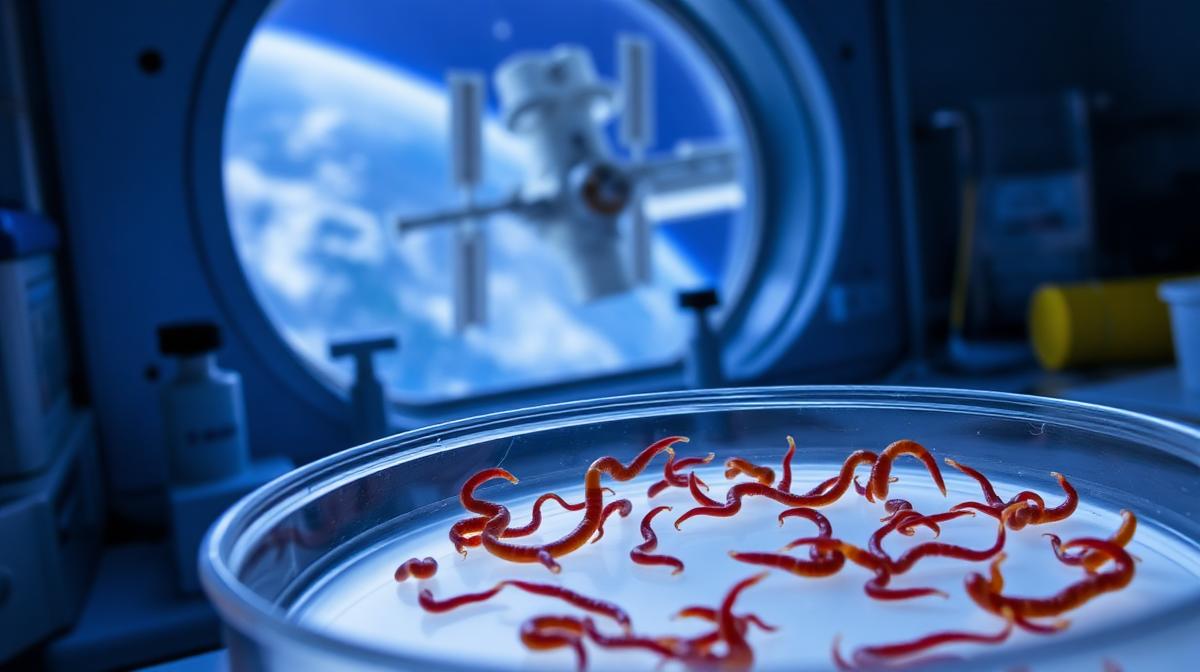
Microscopic worms are now traveling in space. According to the BBC (April 14, 2026), scientists from the University of Nottingham, funded by the UK Space Agency, have sent Caenorhabditis elegans nematodes to the International Space Station (ISS) from the Kennedy Space Center in Florida.
Why worms?
C. elegans is a model organism in biology: despite its microscopic size (about 1 mm), it shares many genes with humans. Researchers want to understand how these worms react to the extreme conditions encountered by astronauts — microgravity, cosmic radiation, oxidative stress. "If we understand the protection mechanisms of these organisms, we can develop countermeasures for long-duration crewed missions," explains Professor Nathaniel Szewczyk, head of the project.
Heading for Mars
This experiment is part of the preparation for crewed missions to Mars, planned for the horizon of 2035-2040. NASA and ESA are collaborating on several programs to understand the biological effects of interplanetary travel. The results of the British experiment are expected in six months, after the samples return to Earth.
A scientific tradition
This is not the first time nematodes have traveled in space: in 2003, C. elegans survived the disintegration of the space shuttle Columbia, proving the extraordinary resistance of these organisms.