As Vladimir Putin solemnly announces a unilateral truce for May 8-9 on the occasion of the 81st Victory Day anniversary, Russian missiles and drones struck Ukraine on the night of May 5-6, killing at least 22 civilians. Volodymyr Zelensky speaks of "absolute cynicism" and counters Moscow with his own ceasefire, immediate and with no time limit.
A Hollow Diplomatic Announcement, Very Real Bombs
There is something profoundly revealing in the sequence of events that unfolded in recent hours between Moscow and Kyiv. The Russian Ministry of Defense announced, via the state application MAX, a ceasefire for May 8-9, 2026 — the two days commemorating the Soviet victory over Nazism — "hoping that the Kyiv regime will do the same." Vladimir Putin had mentioned this truce during a phone call with Donald Trump. The phrasing was calculated: seemingly diplomatic, hollow in reality.
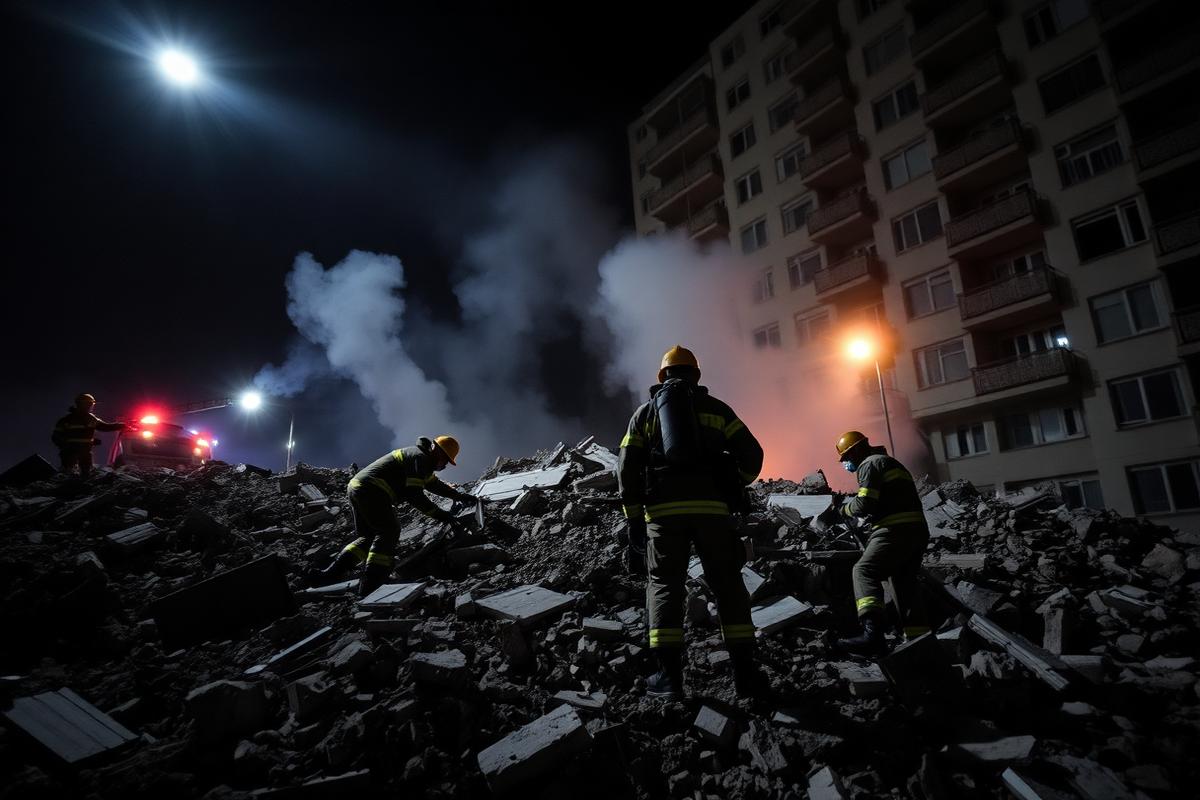
Because at the same time, during the night of May 4-5 and then throughout May 5, waves of Shahed drones and Russian ballistic missiles rained down on at least six Ukrainian cities. In Kramatorsk, Zaporizhzhia, and Chernihiv, guided bombs struck civilian areas. The official Ukrainian toll is stark: at least 22 dead, over 80 wounded. The city of Poltava was targeted a second time while rescuers were working on the rubble of the first impact — a tactic that Zelensky described as "particularly vile."
Two Parallel Truces, Zero Trust
Kyiv's response was immediate. Volodymyr Zelensky, on a visit to Bahrain where he was meeting King Hamad bin Isa Al Khalifa to propose a defense partnership against drones, announced on X that Ukraine would observe its own ceasefire starting at midnight on the night of May 5-6 — before the Russian truce. "Russia could stop the fighting at any moment, and that would end the war and our responses. Peace is needed, concrete actions are needed to achieve it," he wrote. No time limit.
Ukrainian Prime Minister Yulia Svyrydenko was even more direct: Russian proposals "remain mere declarations." For his part, UN Secretary-General António Guterres said he "welcomed" the unilateral truces while reiterating his call for a "full, immediate, unconditional and lasting" ceasefire. UN words, in this conflict, have long since lost their practical resonance.
The Humiliation of the Parade Without Tanks
This diplomatic-military sequence occurs in an unprecedented context: the Russian Ministry of Defense confirmed that the May 9 parade in Moscow would be held without heavy military equipment. The unofficial reason is obvious — Russia fears that Ukrainian drones could fly over Red Square, the ultimate symbol of Putin's power. "They cannot afford military equipment — and they are afraid that drones will buzz over Red Square," commented Zelensky from Yerevan, during the European Political Community summit. A first in decades.
In response to the Russian strikes, Ukraine continues its long-range drone campaign on Russian territory. Kyiv has targeted oil facilities in the Urals, including the Lukoil-Permnefteorgsintez refinery in the Perm region, more than 1,500 kilometers from the Ukrainian border. F-5 Flamingo cruise missiles also struck military-industrial complexes in Cheboksary, over 1,400 kilometers away, according to Zelensky. Ukraine wants to economically asphyxiate the Russian war machine, refinery after refinery.
Trump, Absent Mediator
American diplomatic efforts remain sterile. Putin's proposal to Trump for a ceasefire around May 9 produced, according to Kyiv, no formal document transmitted to Ukraine. Zelensky openly questioned: "Is this a few hours of security for a parade in Moscow, or something more substantial?" The question remains unanswered. More than four years after the full-scale invasion of February 24, 2022, the war remains a frozen conflict in defiance, where truce announcements are mainly used to diplomatically cloak the continuation of bombings.
The pattern repeats: truce for Orthodox Christmas, truce for Orthodox Easter, truce for May 9. Each time, the strikes continue — or resume immediately after. This time, they continued during the announcement of the ceasefire itself. The mechanics of the Russian war do not bother with rhetorical coherence.
Editorial Opinion
This "announced" ceasefire does not deserve the name. Moscow is orchestrating diplomatic communication intended for Trump and international opinion, while maintaining maximum military pressure on Ukrainian cities. The removal of heavy equipment from the May 9 parade is, implicitly, an admission: Ukraine has succeeded in transforming the regime's most sacred symbol into a strategic vulnerability. This is a significant psychological victory. But on the ground, 22 civilians dead in one night are a reminder that this war is counted in lives, not symbols.
To Remember
- At least 22 Ukrainian civilians killed in Russian strikes on May 5, despite the announcement of a truce on May 8-9.
- Zelensky proclaimed his own unilateral ceasefire, effective at midnight on May 5, with no time limit.
- The May 9 parade in Moscow will be held without heavy military equipment, a first in decades.
- Ukraine continues its long-range strikes in Russia, targeting refineries and military industrial sites.
- US negotiations have produced no formal agreement transmitted to Kyiv.