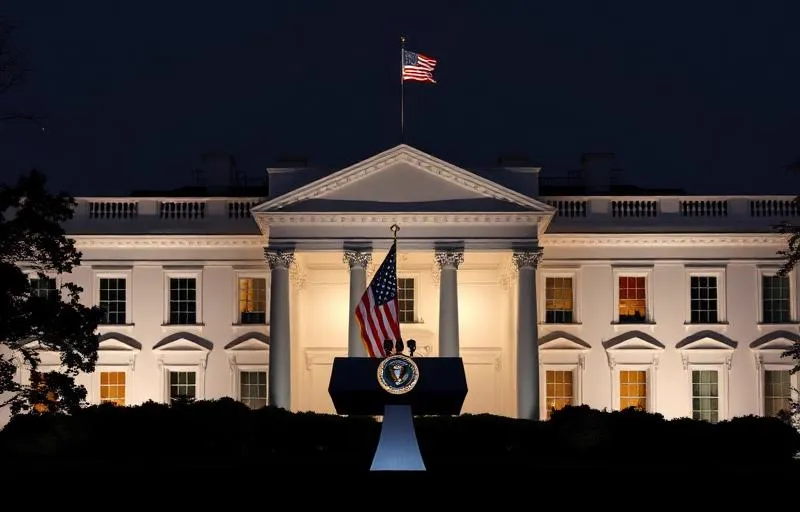
President Donald Trump addressed the American nation on Wednesday, April 1, 2026, at 9 p.m. (ET), in his first prime-time solemn address since military operations against Iran began on February 28. From the Oval Office, he declared that Iran "is no longer a threat" to the United States and that the war is "in the process of being finished." (
"Our fundamental strategic goals are all but achieved," Trump asserted, adding that U.S. forces would "finish the job" and hit Iran "extremely hard" over the next two to three weeks. He vigorously defended the war, assuring that Iran could "never possess a nuclear weapon" and that its program was "in tatters." (
The president claimed that Iran's "interim leader" had requested a ceasefire, an allegation immediately denied by Tehran. The Iranian Foreign Ministry spokesperson called the statement "war propaganda." Trump conditioned any ceasefire on the reopening of the Strait of Hormuz, a vital oil artery through which about 20% of the world's oil passes. (
During Trump's speech, new U.S. and Israeli strikes hit military sites near Isfahan and the city of Karaj, a suburb of Tehran. Residents of Karaj told the BBC that the city was "bombarded." BBC-verified footage shows massive secondary explosions at a missile base near Isfahan. Iran retaliated by striking Kuwait City airport and a tanker off the coast of Qatar. (
The U.S. Embassy in Iraq urged all U.S. citizens to leave the country immediately, citing the threat from armed groups aligned with Iran. The security situation is deteriorating across the region. In Lebanon, at least 7 people were killed in Israeli strikes near Beirut. The conflict, now in its second month, has caused thousands of civilian casualties, according to the UN. (
Diplomatic repercussions are mounting: Trump alluded to a possible NATO withdrawal, British Prime Minister Keir Starmer proposed hosting talks on the Strait of Hormuz in London, and the UN denounced the "hardening of state repression" in several countries in the region exploiting the war context. Markets are oscillating between hope for de-escalation and fear of escalation. (