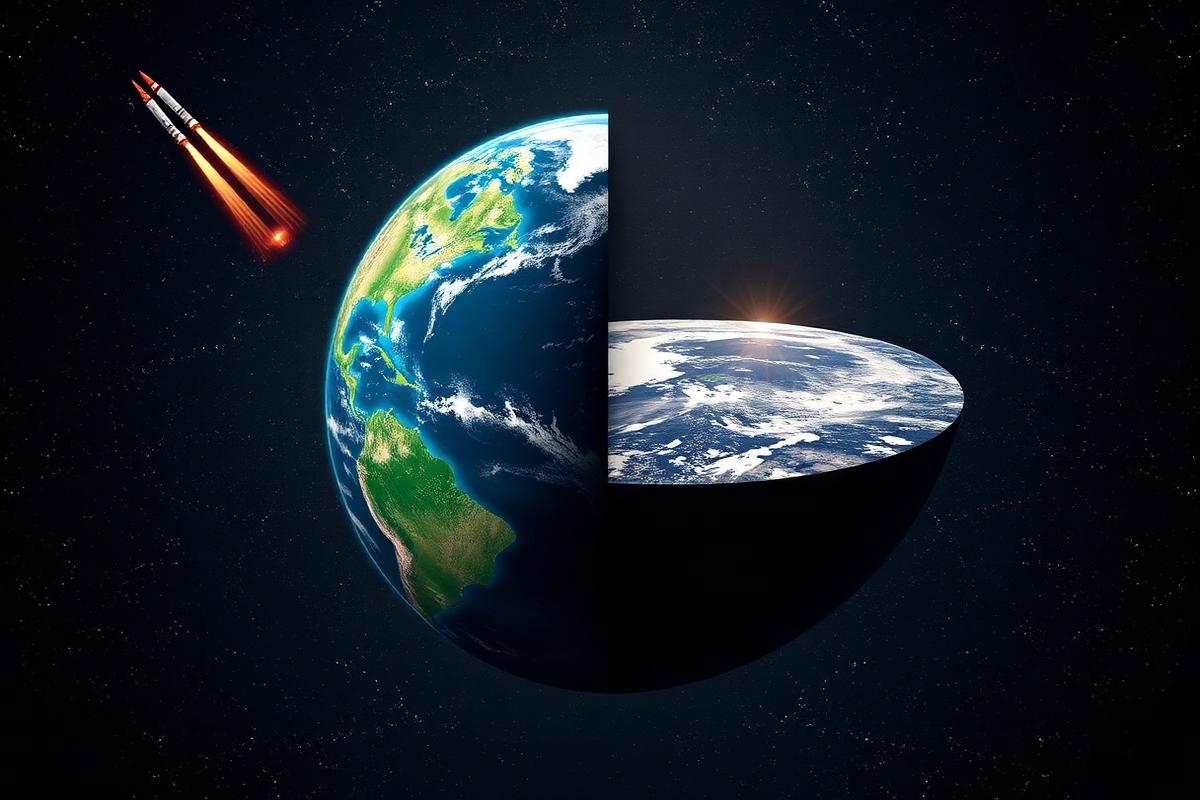
In 2026, as Artemis II has just flown around the Moon with a human crew and SpaceX prepares its first Martian missions, a significant fraction of the world's population remains convinced that it's all a vast deception. According to a YouGov poll conducted in January 2026 among 15,000 people in 12 countries, 11% of Americans, 9% of Brazilians, and 7% of French declare to have "serious doubts" about the spherical shape of the Earth. The figure rises to 16% among 18-24 year olds in America—a generation nevertheless born with the Internet and instant access to all human knowledge. The Flat Earth movement is not a medieval relic; it's a modern, expanding phenomenon, and profoundly revealing of our dysfunctional relationship with truth.
Space conspiracy theories are not limited to the flat Earth. They form a coherent ecosystem of interconnected beliefs. First pillar: the Apollo missions were faked. Stanley Kubrick supposedly filmed the moon landing in a studio—a theory born in the 1970s and revived by the documentary "Room 237." Second pillar: the International Space Station (ISS) doesn't really exist, and the zero-gravity videos are filmed in free-falling planes or using cables. Third pillar: SpaceX is a pyrotechnic show funded by the American government to justify secret military budgets. Elon Musk is allegedly an "actor"—literally—in service of the military-industrial complex. Each of these theories has its "proofs": YouTube videos analyzed frame by frame, "inconsistencies" in NASA photos, testimonies from former employees presented as whistleblowers.
What makes these theories fascinating to sociologists is that they don't thrive despite information, but thanks to it. The mechanism is paradoxical: the more evidence there is for the Earth's roundness, the more conspiracy theorists see it as confirmation of a massive conspiracy. Every satellite photo is "photoshopped." Every astronaut's testimony is from "an actor under contract." Every fundamental physics experiment is "a manipulation by the elites." Sociologist Gérald Bronner, author of "L'Apocalypse cognitive" (The Cognitive Apocalypse), describes this phenomenon as "confirmation bias supercharged by the internet": YouTube and TikTok algorithms trap individuals in self-reinforcing bubbles of conspiratorial content, where every video watched suggests ten more radical ones.
Current space exploration poses an existential challenge to conspiracy theorists—and they respond with remarkable creativity. When Artemis II flew around the Moon in March 2026 with four astronauts on board, Flat Earth forums immediately produced "analyses" demonstrating that the images were AI-generated. The 72-hour live stream broadcast by NASA? "Real-time deepfake, the technology exists." The radio conversations picked up by independent radio amateurs worldwide? "Pre-recorded frequencies broadcast by military satellites." The argumentative ingenuity is impressive—even if it rests on an absurd premise. The problem is that refuting these arguments point by point is a Sisyphean task: for every "proof" dismantled, three new ones appear.
Should we laugh or worry? Both. On one hand, the vast majority of "flat earthers" are harmless individuals, often driven by understandable anti-authoritarian skepticism in a world where institutions have indeed lied—about weapons of mass destruction in Iraq, about mass surveillance revealed by Snowden, about Volkswagen's polluting emissions. Mistrust is not irrational in itself; it's its target that is. On the other hand, space conspiracy theories are part of a dangerous continuum that leads from "the Earth is flat" to "vaccines are poison" and "elections are rigged." The remedy is not mockery—which reinforces feelings of persecution—but education in critical thinking, radical transparency from scientific institutions, and perhaps, above all, direct experience. The day space tourism becomes accessible, when thousands of people see the Earth's curvature with their own eyes, the Flat Earth movement will fade. Or it will find another explanation. Bets are open.