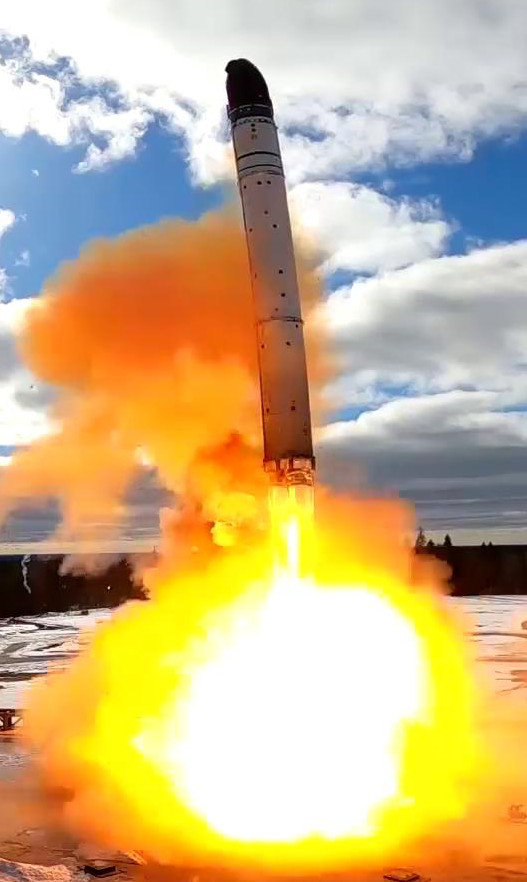
On Tuesday, May 12, 2026, in the late Moscow morning, the Russian Ministry of Defense announced the successful test launch of a new RS-28 Sarmat-family intercontinental ballistic missile from the Plesetsk Cosmodrome in northern Russia. A few hours later, Vladimir Putin appeared via videoconference from the Kremlin alongside the commander of the Strategic Missile Forces, Colonel General Sergei Karakaev, to publicly congratulate the engineers and announce operational deployment by the end of the year.
Missile Heralded as 'Most Powerful in the World'
Speaking to the cameras, the Russian president did not mince words: 'This is the most powerful missile in the world, with no equivalent, and it will remain so for a long time.' According to official figures released by the Kremlin, the Sarmat boasts an announced range of 35,000 kilometers—nearly the circumference of the Earth. Putin specified that the weapon can follow a classic ballistic trajectory or adopt a sub-orbital path, theoretically allowing it to circumvent missile defense systems deployed by the United States in the Northern Hemisphere by attacking from the South Pole.
The Sarmat is a MIRV (Multiple Independently targetable Reentry Vehicle) capable of carrying about ten individually guided nuclear warheads, as well as Avangard-type hypersonic gliders. In its heaviest version, its payload exceeds that of the venerable Soviet R-36M ('Satan' in NATO code), which it is intended to replace. First announced as operational in 2023, the program has experienced several setbacks, including a failed test in Plesetsk in late 2023 that damaged a silo. Tuesday's successful launch is therefore as much a technological statement as a political one.
A Timing That Is No Accident
It is difficult not to see strategic staging in this launch. At the precise moment Donald Trump was flying to Beijing for his summit with Xi Jinping and France was announcing its UN initiative on the Strait of Hormuz, Moscow reminds the world that it remains the world's leading nuclear power in terms of deployable warheads. Vladimir Putin, whose domestic approval ratings are suffering from the economic consequences of the war in Ukraine and the surge in energy prices linked to the Iranian conflict, finds nuclear deterrence to be his most politically profitable lever.
The context makes it particularly sensitive. The New START treaty, the last bilateral Russian-American agreement limiting strategic nuclear weapons, has been suspended since 2023 and will definitively expire in February 2026. To date, no replacement framework is under negotiation. The operational deployment of the Sarmat before the end of 2026 would mark the first commissioning of a new generation of ICBMs by a major power in thirty years, without any conventional constraints.
Western Reaction: Caution and Concern
In Washington, the Pentagon reacted with measured restraint: the Department of Defense spokesperson indicated that intelligence services had been 'monitoring the preparations for the launch for several weeks' and were not surprised by its success. The White House, meanwhile, released no official statement—Trump was in flight to Beijing at the time of the announcement.
In Brussels, the NATO Secretary General denounced 'a calculated provocation at a time of extreme tension,' recalling that the Alliance is maintaining its own nuclear modernization schedule, particularly through the American Sentinel program and the upcoming deployment of B61-13 bombs in Europe. In Paris, the Ministry of Armed Forces stated that French deterrence, based on the sea-based leg of its nuclear missile-carrying submarines, was 'in no way called into question' by this announcement.
A Ready Sarmat: What For?
Arms control specialists point out that a missile capable of striking any point on the globe in less than half an hour does not change the deterrence equation: mutual assured destruction has already existed for fifty years. The intercontinental range and the capacity to carry ten warheads do not make the Sarmat a 'new' weapon in principle; what it brings is renewed technological credibility to the Russian arsenal at a time when it had been presented as aging after Russia's difficulties in Ukraine.
The real stakes are therefore less military than diplomatic. By placing strategic deterrence at the heart of the global agenda just before the Trump-Xi summit, Putin indirectly invites himself to the Beijing table. No global agreement in the Middle East can be concluded without Moscow finding its interests met—historical supplier of Iran with civilian nuclear technology via Bushehr, defender of a multipolar architecture of international relations, and a privileged strategic partner of Beijing.
Editorial Opinion
The Sarmat launch is neither a technical surprise nor a strategic revolution: it is a calling card. Vladimir Putin, isolated in Ukraine, marginalized in the Iranian dossier, knows he cannot afford to be absent from the Beijing summit. Failing to be invited, he invites himself via an intercontinental missile. This diplomacy of nuclear demonstration, inherited from the Cold War, works as long as no one takes it too seriously. The real danger is not the Sarmat itself—it is the complete absence of conventional safeguards after the expiration of New START in nine months. Without a new treaty, without a new framework, without a new generation of diplomats capable of speaking as well to engineers as to generals, the world is entering an era this year where nuclear deterrence becomes a playground again. And it is this, more than Tuesday's launch, that should worry us.
Key Takeaways
- On Tuesday, May 12, 2026, Russia successfully test-fired a new Sarmat intercontinental ballistic missile from Plesetsk.
- Vladimir Putin announces its operational readiness before the end of 2026.
- Announced range: 35,000 km. Capacity: about ten MIRV nuclear warheads plus Avangard hypersonic gliders.
- The program had experienced several setbacks, including a failed test in 2023 that damaged a silo.
- The New START treaty will expire in February 2026 with no replacement framework negotiated.
- NATO denounces 'a calculated provocation'; French deterrence states it is 'in no way called into question.'