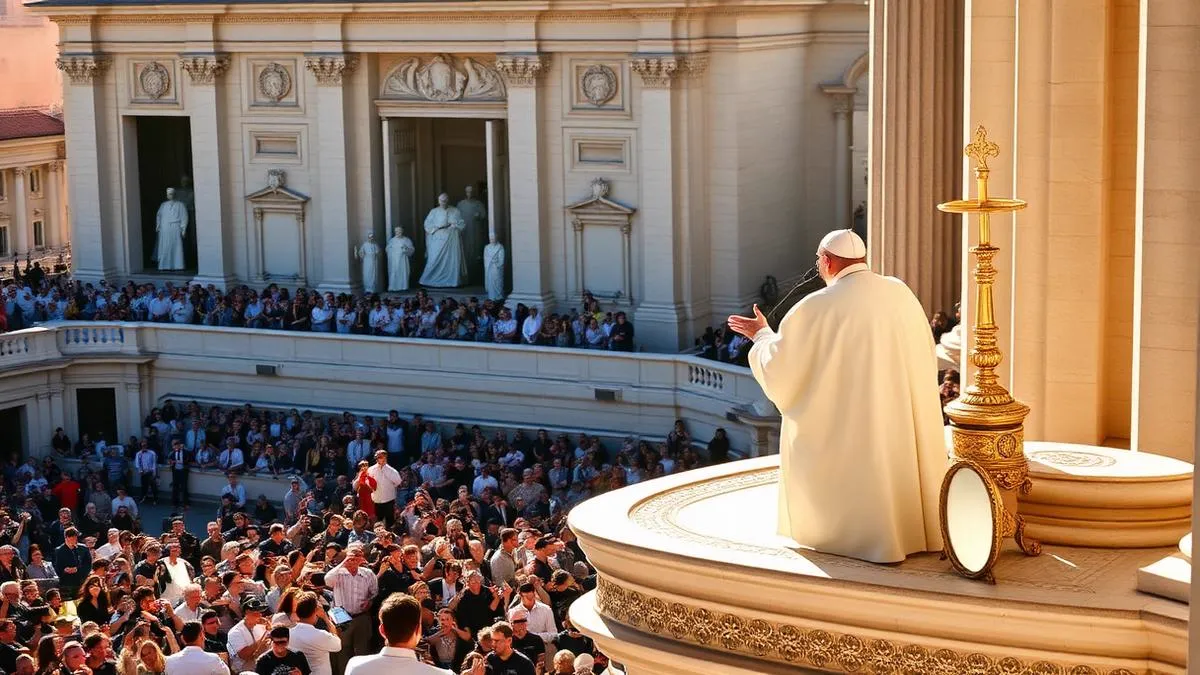
Rome, St. Peter's Square, Easter Sunday. Under a spring sun, Pope Leo XIV appeared on the balcony of the basilica's central loggia to deliver his very first "Urbi et Orbi" – "to the city and the world" – message. In front of some 80,000 faithful from all continents, the American pontiff delivered a discourse of unusual gravity, focused on the conflict in Iran and the suffering of civilian populations.
"On this day when Christians celebrate the Resurrection, bombs are falling on cities, families are fleeing, children are dying. I ask, in the name of the Risen Christ and in the name of the common humanity that binds us all – believers and non-believers alike – for an immediate, total, and unconditional ceasefire," said Leo XIV in an appeal delivered in English, Spanish, Arabic, and French.
The Pope specifically named Iran, Ukraine, Sudan, and Myanmar in his address – breaking with Vatican diplomatic tradition, which generally avoids naming parties to conflicts. "The time for diplomatic caution is over. Silence in the face of death is complicity," he added, drawing a prolonged ovation from the crowd.
The message was met with mixed reactions. Washington made no comment, while Tehran hailed the pontiff's "voice of reason." Ukrainian President Volodymyr Zelensky thanked the Pope on social media, while recalling that "a ceasefire must be accompanied by the withdrawal of occupying troops." UN Secretary-General António Guterres called the papal appeal a "powerful moral signal."
For Vatican observers, this first Urbi et Orbi confirms the style of Leo XIV's pontificate: direct, engaged, without diplomatic filters. "This is an American pope speaking like a street preacher, not like a diplomat from the Secretariat of State," analyzes Andrea Tornielli, editorial director of the Vatican's Dicastery for Communication. The pontiff will celebrate the closing Mass of the Easter Triduum this Monday at St. Peter's Basilica.