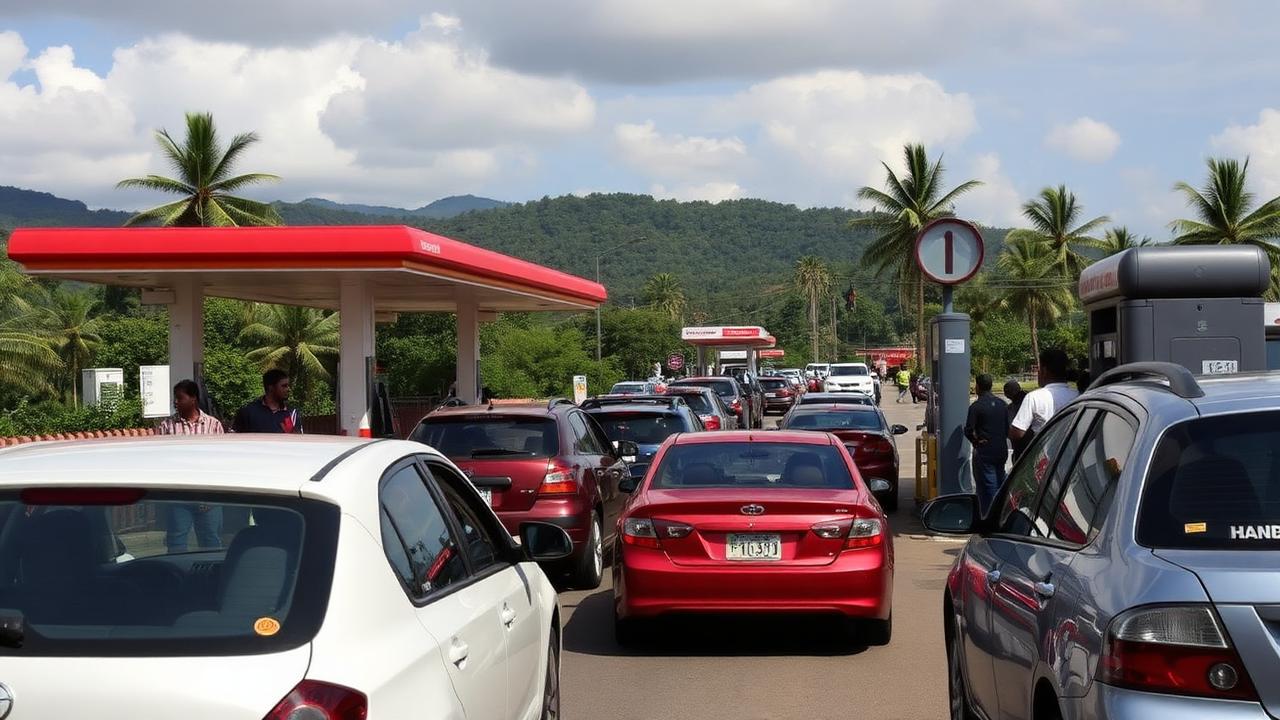
The Malagasy Council of Ministers, meeting in an extraordinary session on Tuesday, April 7, 2026, declared a state of energy emergency throughout Madagascar for a period of fifteen days. This exceptional measure, announced in an official statement, responds to a "deep crisis" in fuel and electricity supplies, directly caused by the war in the Middle East and the recurrent closure of the Strait of Hormuz. Madagascar, an island in the Indian Ocean with a population of 30 million, is a net importer of fuel, most of which comes from Oman, located just south of the strait.
The situation on the ground is critical. The announcement of the state of emergency has triggered scenes of panic at gas stations in Antananarivo and the country's main cities. Hours-long queues have formed, with some stations being overrun and emptied within hours. The government has assured it has "strategic reserves for several days" and has announced organized rationing of fuel distribution. Power outages, already frequent in Madagascar under normal circumstances, have intensified: some districts of the capital are experiencing more than twelve hours of power cuts per day.
Madagascar is not an isolated case; it is an indicator of the cascading effects of the war in the Middle East on the most vulnerable countries. The closure of Hormuz has disrupted the maritime routes that supply East Africa and the Indian Ocean with hydrocarbons. Other island and coastal countries in the region – Comoros, Seychelles, Mozambique – are facing similar tensions, although Madagascar is the first to declare a formal state of emergency. The International Energy Agency (IEA) had warned in its March report that low-income countries heavily dependent on oil imports would be "the first collateral victims" of a prolonged conflict in the Gulf.
The Malagasy government has taken several emergency measures: capping fuel prices, requisitioning private stocks, and appealing for international solidarity. France, a former colonial power and major economic partner, has announced the dispatch of "logistical support" via the military base in La Réunion, without specifying details. The African Union has called for a "coordinated response" for the countries on the continent most affected by the energy shock. The World Food Programme (WFP) has warned that the energy crisis risks exacerbating food insecurity in southern Madagascar, already hit by chronic droughts.
This crisis illustrates a reality often overlooked in geopolitical analyses focused on Washington and Tehran: the consequences of a conflict between major powers are felt most severely in countries that have no control over events. For Madagascar, the war in the Middle East is not an abstract foreign policy issue – it is a matter of daily survival: turning on the lights, filling up the tank, feeding the family. Madagascar's state of energy emergency is a brutal reminder that in an interconnected world, there is no such thing as a "distant" conflict. Sources and links: - BBC News: https://www.bbc.com/news/articles/cgj0dzwgzq5o - AFP / NAMPA: https://www.nampa.org/text/22904904 - RFI: https://www.rfi.fr/fr/afrique/20260408-madagascar-l-état-d-urgence-énergétique-décrété-en-raison-du-conflit-au-moyen-orient - Témoignages.re: https://www.temoignages.re/international/madagascar-grande-ile/madagascar-etat-d-urgence-energetique-pour-une-duree-de-15-jours - Infobae (EFE): https://www.infobae.com/america/agencias/2026/04/07/madagascar-declara-estado-de-emergencia-frente-a-escasez-energetica-por-la-guerra-de-iran/