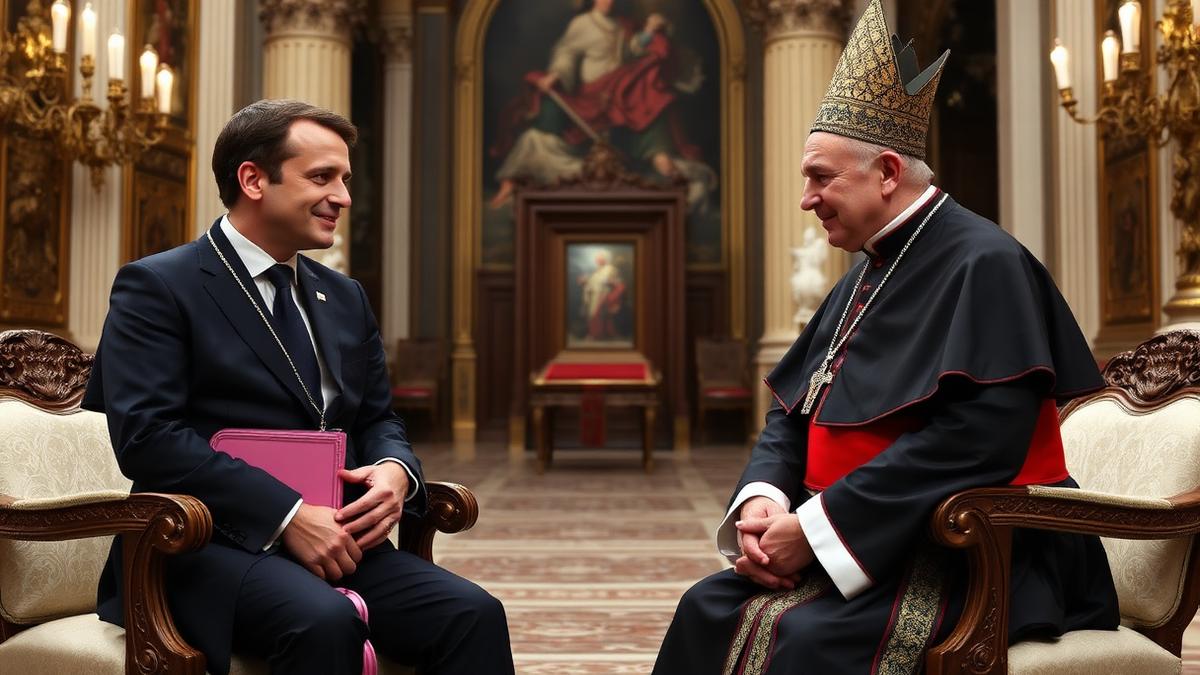
Emmanuel Macron was received at the Vatican on Friday, April 10, by Pope Leo XIV – the first American pope in history – for a private interview followed by an expanded meeting with diplomatic teams. This first encounter between the two leaders comes nearly a year after the surprise election of Robert Francis Prevost to the Chair of Saint Peter, and amid the war in the Middle East. The two men share a "very strong similarity in their approach to diplomacy," according to an Élysée advisor quoted by 20 Minutes.
The Israeli-Palestinian conflict and the war in Iran dominated the discussions. Pope Leo XIV, who has repeatedly called for peace since his election, and Emmanuel Macron, who advocates for a multilateral diplomatic solution, displayed a rare convergence of views between a head of state and a pontiff. Macron reiterated the French position in favor of a lasting ceasefire in the Gulf and a relaunch of the Israeli-Palestinian peace process based on the two-state solution.
The war in Ukraine was also at the heart of the discussions. Pope Leo XIV, like his predecessor Francis, maintains a line of dialogue with all parties – including Moscow – which sometimes draws criticism from Kyiv and the Baltic states. Macron, who has hardened his stance on Russia as the conflict has progressed, nevertheless found common ground with the pontiff on the need to prepare the conditions for future negotiations, once the military balance of power has stabilized.
Beyond geopolitics, the two leaders addressed societal issues on which their positions diverge: bioethics, end-of-life care (a bill for which is under discussion in the French National Assembly), and artificial intelligence. On AI, the Vatican published a document in 2024 calling for an "ethical and human-centered use" of these technologies – a stance that Macron, a proponent of AI as a driver of growth, approaches with more nuance.
This meeting is part of a long diplomatic tradition between France and the Holy See. The French Republic, despite being secular, maintains historical ties with the Vatican – it even has a dedicated embassy, separate from the one to the Italian Republic. For Macron, this visit is also a signal to the French Catholic electorate, at a time when his popularity remains fragile. For Leo XIV, receiving the French president reinforces his stature as an indispensable interlocutor in global crises.