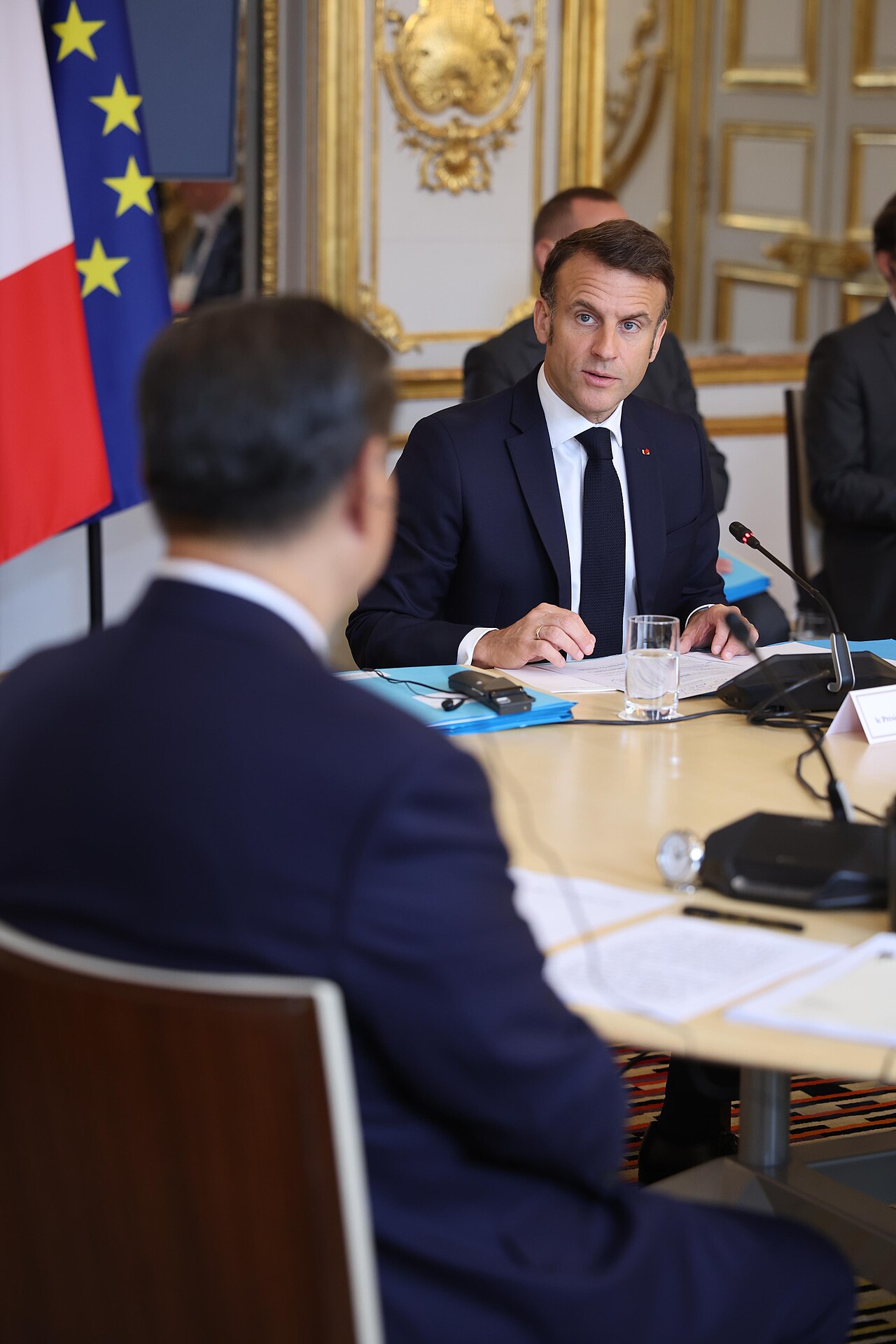
It was from Nairobi, on the sidelines of the Franco-African summit's closing on Tuesday, May 12, 2026, that Emmanuel Macron made the most political announcement of the week. Addressing an audience of international journalists invited to a one-hour interview, the French president stated that Paris would "take an initiative at the United Nations" to propose a formal framework for securing the Strait of Hormuz. France and the United Kingdom, at the head of a maritime coalition of non-belligerent countries, will submit a draft resolution to the Security Council in the coming days to establish a "totally neutral and peaceful mission".
A response to 75 days of blockade
The Strait of Hormuz has been closed since March 4, 2026, when Iran retaliated against the American and Israeli strikes of "Operation Epic Fury" by laying mines and imposing a maritime blockade on this route, which normally transports 25% of the world's oil. Since April 13, Washington has overlaid its own naval blockade of Iranian ports. The result: approximately 1,600 civilian ships are trapped, ten sailors have died, and the price of a barrel has repeatedly exceeded $120. All bilateral diplomatic attempts have failed: the Muscat talks in March, the Pakistani mediation in April, the American proposal of May 7. The "Project Freedom" launched by Trump to escort merchant ships was suspended after two days with only two ships freed.
"We must obtain the reopening of Hormuz without conditions, without tolls," Macron insisted from Nairobi, deploring "an escalation in the statements" from both sides. For Paris, the idea is clear: to move away from a confrontation logic by interposing a multilateral force that does not belong to any belligerent.
The proposed mechanism: three conditions, one coalition
The French project, refined over three weeks at the Élysée Palace and the Ministry of Foreign Affairs, rests on three pillars. First, a simultaneous and coordinated lifting of both blockades, supervised by the UN. Second, the deployment of a multinational maritime mission composed of vessels from explicitly non-belligerent countries: France, the United Kingdom, India, Indonesia, Brazil, Egypt, South Africa — the list is yet to be finalized. Third, a strict mandate of surveillance and civilian escort, without autonomous offensive capabilities.
The initiative is based on the "maritime coalition of non-belligerent countries" formed at the end of April on the initiative of Paris and London. The United Kingdom, through its Prime Minister, confirmed its full support for the French text on Tuesday evening. Several European capitals – Berlin, Rome, Madrid – have already indicated they would vote in favor. China, discreetly contacted, has not raised a fundamental veto, which is in itself a diplomatic victory.
The gamble: forcing Trump and Tehran to sit down
The French strategy is clear-sighted: neither Washington nor Tehran can politically block a UN resolution supported by almost the entire Security Council without exposing themselves to significant diplomatic costs. By proposing a force that threatens neither Iran nor the United States, Macron offers both sides an honorable way out. Tehran could lift its maritime blockade without admitting a retreat; Washington could suspend its blockade without renouncing its military pressure on the nuclear program.
The timeline is tight. The draft resolution must be submitted by the end of the week, in parallel with the Trump-Xi summit in Beijing. The stated objective: for the Sino-American joint communiqué of Friday, May 15, to explicitly mention the French framework as a credible way out. If Beijing publicly supports the text, Washington will have great difficulty opposing it.
The Lebanese and African backdrop
In the same interview, Macron broadened the scope. He advocated for a "fully respected ceasefire" in Lebanon, calling the continuation of Israeli strikes in violation of the April 17 truce (380 deaths since that date) "unacceptable." He also recalled, on the sidelines of the Nairobi summit, that "resolving global crises without Africa is a mistake," a message aimed at Washington as much as at Beijing. France is thus playing its part as a middle power capable of bringing together Europeans, Africans, and emerging economies around a multilateral framework, where major powers are trapped in their head-to-head confrontations.
On the French side, the opposition offered half-hearted praise for the initiative. Former Foreign Minister Jean-Yves Le Drian, now the President's special envoy to Lebanon, however, denounced in an interview with France Info "the failure of peace through force": "Both sides have an interest in stopping, but no one will say it, everyone is bluffing," he stated.
Editorial opinion
The French initiative is technically sound and politically astute. It has the rare merit, in these times of polarization, of proposing a solution that requires no one to lose face. But let's not kid ourselves: on the ground in Hormuz, it is not a UN resolution that will open the strait; it will be the economic exhaustion of one of the two belligerents, or a secret agreement negotiated in Beijing this week. Macron's gamble is a diplomatic cover: to offer Trump and Tehran the multilateral setting for an honorable exit that they are actually negotiating elsewhere. It is useful. It is even precious. But it is not, yet, peace. Peace will come the day the first sailor climbs, alive, onto the deck of a freed cargo ship.
Key takeaways
- On May 12, 2026, from Nairobi, Macron announced that France would approach the UN for a "neutral and peaceful" mission in Hormuz.
- The initiative is jointly led with the United Kingdom, at the head of a coalition of non-belligerent countries.
- Three pillars: simultaneous lifting of Iranian and American blockades; multinational maritime force; strictly defensive mandate.
- The strait has been closed since March 4, 2026; approximately 1,600 ships are blocked, ten sailors have died.
- The draft resolution will be submitted by the end of the week, on the sidelines of the Trump-Xi summit in Beijing.
- Berlin, Rome, Madrid, and London have already confirmed their support; Beijing has not raised a fundamental veto.