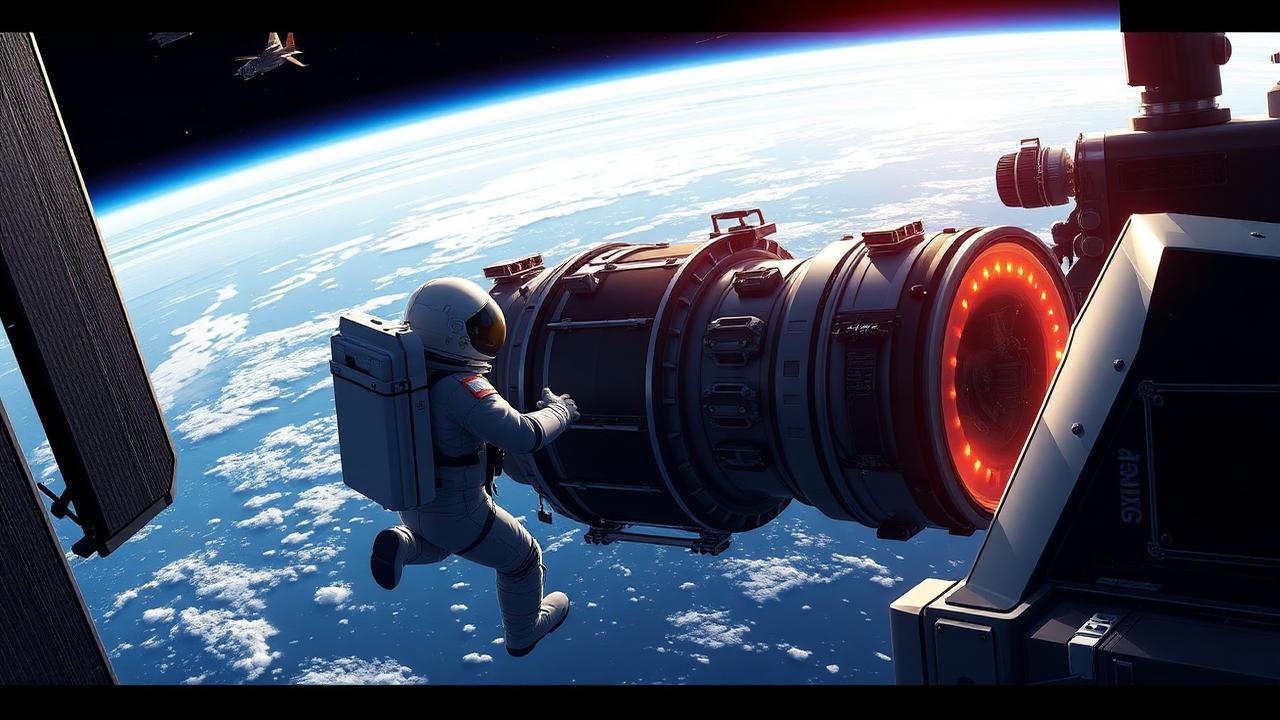
Friday, June 5, 2026, 9:04 AM Eastern Time. The Houston control center sends one of the most serious orders possible to the International Space Station crew in orbit: immediately put on pressurized suits, return to the docked Crew Dragon spacecraft, and stand by for emergency evacuation. The reason cited: a sudden worsening of the air leak in the PrK transfer tunnel of the Zvezda module, the Russian segment of the station.
Five Astronauts in Maximum Safety Position
The four members of the Crew-12 mission — American Commander Jessica Meir, Pilot Jack Hathaway, French ESA astronaut Sophie Adenot, and Russian cosmonaut Andrey Fedyaev — along with NASA astronaut Chris Williams spent approximately two hours in maximum safety positions aboard the Crew Dragon, ready to undock if pressure continued to drop in the Russian segment. No actual evacuation to Earth was ultimately triggered.
A Crack Known Since 2019, But Worsening
The crack affecting the PrK module is not new: it has been monitored since 2019, when the first pressure anomalies were detected in the Russian segment of the station. Roscosmos had until now managed the problem with occasional operational measures, using temporary sealants. But on Monday night into Tuesday, the leak rate abruptly doubled, increasing from approximately 450 grams to nearly 900 grams of air per day — a threshold that automatically triggers an emergency response on the American side.
NASA and Roscosmos: Cooperation Under Strain
NASA spokesperson Bethany Stevens clarified that Roscosmos had decided to undertake a more extensive structural repair operation than previous sealants this Friday, which justified the preventive alert for American and European astronauts. "Cracks in the Russian segment are a concern that NASA monitors very closely," she stated in a press release on X. At 11:04 AM Eastern Time, two hours after the alert was triggered, Mission Control transmitted the all-clear: repair operation temporarily suspended, situation stable, crew authorized to return to the living modules.
Orbital Infrastructure at the End of its Rope
The incident highlights the growing fragility of a station now in service for over a quarter of a century. NASA and its partners plan for its deorbiting around 2030, an operation entrusted to SpaceX via a dedicated vehicle. Until then, each incident in the Russian segment — the maintenance of which is exclusively the responsibility of Roscosmos — serves as a reminder of the complexity of space cooperation that is managing, somehow, to survive the diplomatic rupture between Moscow and Western capitals since 2022.
Sophie Adenot, First French Woman Since Pesquet
Onboard, Sophie Adenot continues her mission, the first French astronaut to stay on the ISS since Thomas Pesquet in 2021. Her presence in the crew placed on alert this Friday was followed minute by minute from Paris, with CNES releasing several statements throughout the morning to reiterate that the incident had at no time directly threatened the lives of the occupants.
Editorial Opinion
Two hours in pressurized suits on a station that the whole world flies over without thinking about it: the ISS is aging, and the West does not yet have its successor ready. This Friday's incident is a warning that space agencies can no longer treat as a footnote in their press releases — especially since cooperation with Roscosmos, the sole master of the Russian segment, becomes more difficult to assume as a given each year.
Key Takeaways
- 5 astronauts placed on evacuation alert at 9:04 AM Eastern Time on June 5th.
- Air leak worsened in the PrK tunnel of the Russian Zvezda module: flow rate increased to ~900 g/day.
- Alert lifted approximately two hours later; no evacuation to Earth.
- French ESA astronaut Sophie Adenot is part of the affected crew.
- ISS deorbiting planned around 2030; tensions around the aging Russian segment.