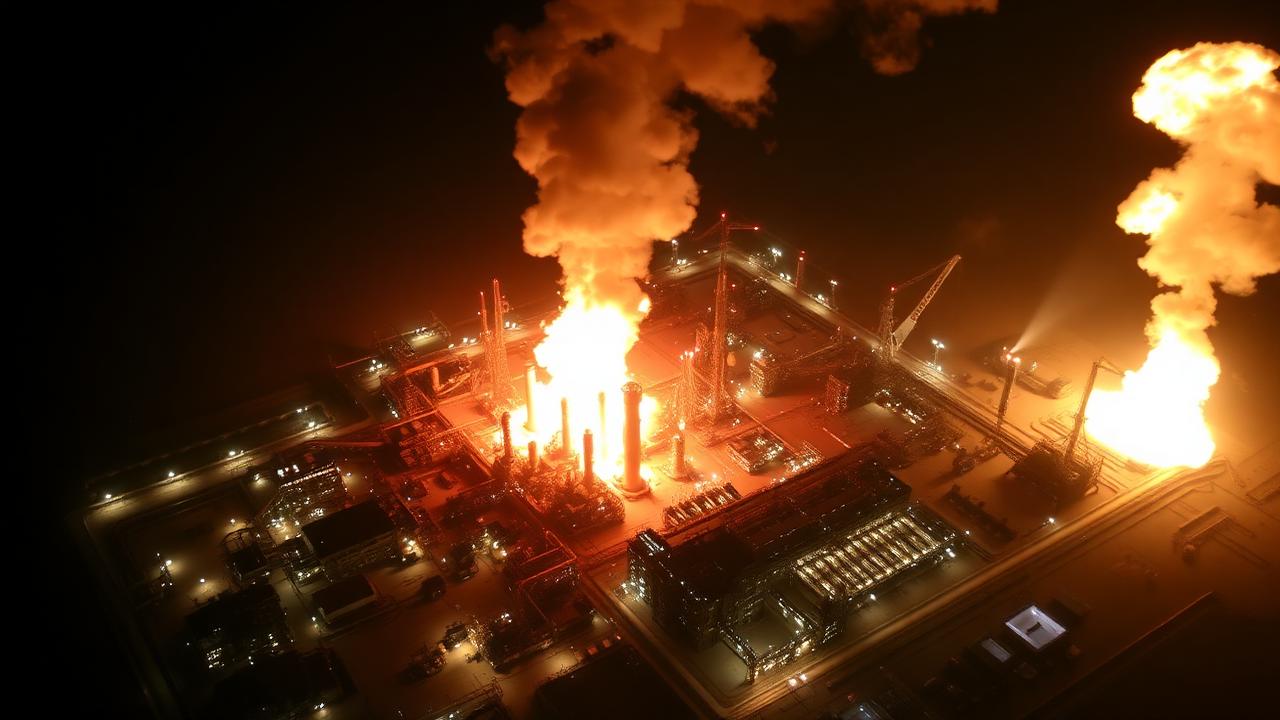
The Israeli military crossed a strategic threshold on the night of April 5-6, 2026, by bombing the South Pars petrochemical complex, located in Bushehr province in southern Iran. This site, adjacent to the world's largest gas field shared with Qatar, is at the heart of Iran's energy industry. According to the IDF, the strike destroyed "several refining and storage units," significantly reducing the complex's production capacity. Satellite imagery analyzed by open-source intelligence agencies shows massive fires visible tens of kilometers away.
This attack is part of Israel's strategy of "methodical degradation" of Iran's economic and military capabilities. Since the start of the conflict, the IDF claims to have eliminated several senior officials of the Islamic Revolutionary Guard Corps, including the head of intelligence, and vows to "hunt down Iranian leaders one by one." The strike on South Pars, however, represents a qualitative escalation: for the first time, a major civilian energy facility has been targeted, blurring the line between military and economic objectives.
Iran's response was swift. The Defense Minister denounced a "barbaric attack on vital civilian infrastructure" and announced that "proportionate retaliation" would target Israeli energy facilities, particularly the offshore gas terminals of Leviathan and Tamar in the eastern Mediterranean. The Commander-in-Chief of the Revolutionary Guards reiterated the threat of a complete closure of the Strait of Hormuz "as long as the bombing of Iranian soil continues."
The consequences on the global energy market are immediate. Asian liquefied natural gas (LNG) prices jumped by 7% at the market open on Monday, while Brent crude settled above $117 a barrel. Goldman Sachs analysts estimate that the destruction of South Pars removes about 1.2 million barrels of oil equivalent per day from the market, exacerbating the supply deficit already caused by the closure of Hormuz. Qatar, which shares the gas field with Iran, has expressed its "deep concern" regarding the risks of collateral damage to its own facilities.
On the legal front, the strike on South Pars revives the debate on international humanitarian law and the distinction between military and civilian objectives. The UN Secretary-General condemned "attacks on energy infrastructure that deprive civilian populations of essential resources" and called for urgent referral to the Security Council. International jurists point out that the South Pars complex, although partially used for military purposes, also supplies the Iranian civilian power grid, which could constitute a violation of the Geneva Conventions.