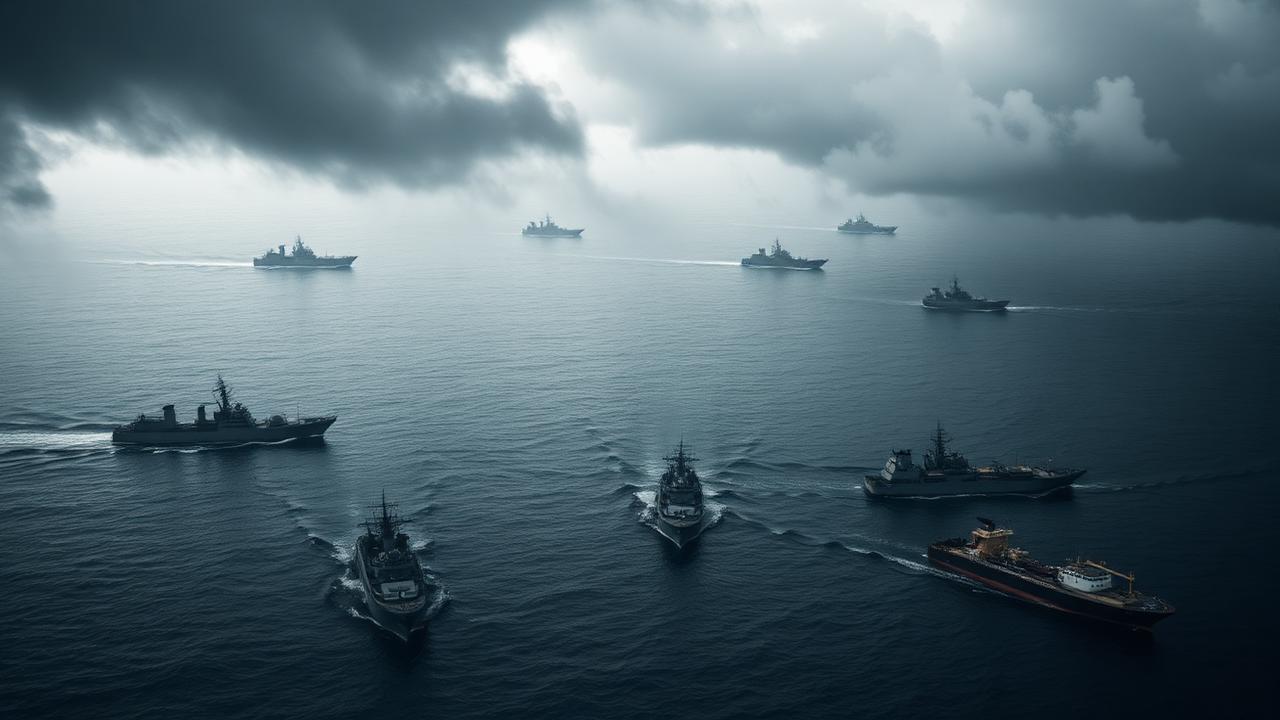
The ceasefire between the United States and Iran, announced in the night of April 7th to 8th, has in practice lasted only a handful of hours. On Wednesday, April 9th, Tehran announced the immediate reclosure of the Strait of Hormuz – the strategic maritime passage through which approximately 20% of the world's oil transits – in response to new Israeli strikes targeting Hezbollah positions in the southern suburbs of Beirut and in southern Lebanon. The spokesperson for the Iranian Supreme National Security Council stated that 'the resumption of Zionist aggressions against our allies constitutes a flagrant violation of the spirit of the ceasefire.' Israel, for its part, claims that the truce 'does not cover the Lebanese front' and that its operations against Hezbollah fall under legitimate defense.
This escalation highlights the structural fragility of the agreement negotiated under Pakistani mediation. As early as Tuesday evening, observers had identified a major grey area: the ceasefire text does not explicitly mention either Lebanon or Hezbollah, leaving Israel free to interpret its commitments restrictively. Pakistan, which had convinced Washington and Tehran to sit at the negotiating table in Islamabad, expressed 'deep concern' over the events. The Pakistani Prime Minister called for 'immediate clarification of the scope of the ceasefire.' US Vice President JD Vance, who was scheduled to lead the peace talks, postponed his departure for Islamabad 'pending clarification.'
On the markets, the reclosure of Hormuz caused an immediate shock. Brent crude rose to $118 a barrel after briefly falling below $105 in the post-ceasefire euphoria. European stock indices opened sharply down: the CAC 40 lost 2.1% in the first hour of trading, the DAX 1.8%. Shipping companies have again suspended transits through the strait, adding considerable logistical pressure to global hydrocarbon supply chains. The French Minister of the Armed Forces, Sébastien Lecornu, confirmed the maintenance of fuel price controls announced the previous day.
The international community oscillates between frustration and helplessness. UN Secretary-General António Guterres urged 'all parties to exercise maximum restraint and respect the spirit of the truce.' The European Union has convened an emergency meeting of foreign ministers for Friday. China called on the United States to 'exert real pressure on Israel' for the ceasefire to regain credibility. Russia denounced a 'diplomatic staging' intended to 'allow Israel to continue its offensive in Lebanon under the guise of peace.'
For analysts, the most likely short-term scenario is that of a 'zombie' ceasefire: formally in effect between Washington and Tehran, but stripped of its substance by the continuation of Israeli hostilities in Lebanon and Iranian reprisals on the maritime front. The issue of the Strait of Hormuz remains Iran's most powerful leverage – and as long as Tehran believes its regional allies are under attack, it will not hesitate to use it. The next crucial deadline is April 22nd, the theoretical end of the two-week truce. Until then, everything can change – in either direction.
Sources and links: - CTV News: https://www.ctvnews.ca/world/mideast-conflict/article/us-israel-and-iran-agree-to-a-2-week-ceasefire-but-attacks-resume-in-iran-and-gulf-arab-countries/ - Le Monde: https://www.lemonde.fr/international/article/2026/04/09/l-iran-revendique-maintenir-son-controle-sur-le-detroit-d-ormuz_6678541_3210.html - France Info: https://www.franceinfo.fr/monde/iran/guerre-entre-les-etats-unis-israel-et-l-iran/les-etats-unis-et-l-iran-s-accordent-pour-un-cessez-le-feu-de-deux-semaines-avec-une-reouverture-du-detroit-d-ormuz_7923467.html - BBC News: https://www.bbc.co.uk/news/articles/cwyvp55xrlro - DW: https://www.dw.com/en/what-s-next-after-the-us-iran-ceasefire/a-76706834 - RFI: https://www.rfi.fr/fr/moyen-orient/20260408-en-direct-guerre-au-moyen-orient