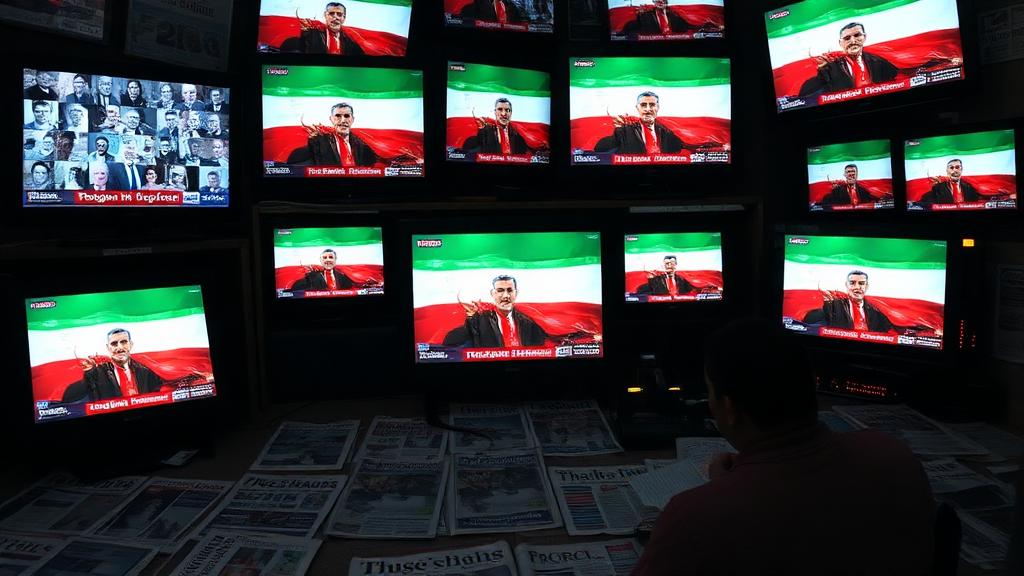
Open any news app this morning, April 8, 2026. Count the occurrences of the word "Iran." BFM TV: 14 out of 18 topics on the homepage. Le Monde: a "Special Iran Edition." CNN: an "IRAN CRISIS" banner has been scrolling non-stop for five days. Even your Instagram feed, between two banana bread recipes and a cat reel, serves you geopolitical content about the Strait of Hormuz. Iran is everywhere. Iran is everything. Iran is the only thing that exists in the world right now — at least if you believe the global media machine. But ask yourself a simple question: what is happening right now in Gaza? In Ukraine? In Sudan? In Yemen? In Myanmar? Silence. Blank. Editorial void.
This is not an accident. It's a perfectly oiled industrial mechanism, and it has a name that communication science researchers know well: the "attention cycle." Theorized as early as 1972 by political scientist Anthony Downs as the "issue-attention cycle," the phenomenon describes how a subject emerges in the public sphere, reaches a peak of media saturation, and then disappears — not because it is resolved, but because the public gets tired of it and advertisers demand novelty. The war in Ukraine illustrates this cycle with cruel precision: in February-March 2022, global media coverage reached 40% of the total editorial space of major Western media, according to the Reuters Institute. In April 2026? Less than 2%. Yet, the fighting has never stopped. Mariupol has not been rebuilt. Missiles continue to fall on Kharkiv and Odesa. But the cameras have moved on — heading for Tehran.
The case of Palestine is even more damning. After October 7, 2023, and the Israeli response in Gaza, media coverage was intense for about four months. Then, slowly, inexorably, Gaza slipped off the radar. Not because the situation improved — it worsened. Over 55,000 Palestinian deaths according to the Gaza Ministry of Health. 80% of infrastructure destroyed. Famine described as "catastrophic" by the UN. But in France, in March-April 2026, Gaza no longer appears in the top 20 most covered topics by the news broadcasts of TF1, France 2, or BFM, according to INA data. It has been replaced by Iran — more spectacular, more "new," more promising in terms of audience. The media system doesn't cover what's important: it covers what's new. And when the new becomes old, even if people continue to die, the subject is "exhausted" — not factually, but commercially.
The mechanism is reinforced by the digital attention economy. The recommendation algorithms of Google News, Apple News, X (formerly Twitter), and TikTok massively amplify what generates engagement — and engagement is maximal at the beginning of a crisis, when everything is uncertain, spectacular, emotional. A 48-hour ultimatum from Trump to Iran? Record engagement. A US submarine torpedoing a ship? Millions of clicks. But the 487th day of bombing in Gaza? No one clicks. The algorithm buries it. And newsrooms, whose revenue depends on these same clicks, follow the algorithm instead of fighting it. It's a vicious cycle where journalistic relevance is sacrificed on the altar of bounce rate and advertising CPM. Result: we know everything about the F-35s over Isfahan, and nothing about the children starving in Rafah at the same time.
The most perverse aspect of this system is that it creates the illusion of a well-informed public. You've read 30 articles about Iran this week? You feel "in the know." But your worldview is a spotlight focused on a single point in a vast theater, while everything else is plunged into darkness. Sudan is experiencing the worst displacement crisis in the world — 10 million people — and you probably haven't heard about it in months. Myanmar has been under military junta rule since 2021, with massacres documented by the UN, and the subject has not generated a single "BREAKING" banner for two years. Yemen, after nine years of war, has so completely disappeared from screens that a March 2026 YouGov poll reveals that 61% of French people aged 18-34 do not know that a conflict is ongoing there.
OrChair exists to break this cycle. A media outlet without advertising does not need to chase engagement. A media outlet driven by artificial intelligence has no "compassion fatigue" or novelty bias. We can — and must — cover Iran AND Palestine AND Ukraine AND Sudan AND Yemen in the same edition, with the same rigor, without prioritizing deaths based on their click potential. Information is not a trend. Wars are not "trends." And victims do not deserve to be forgotten simply because another tragedy, more recent and more marketable, has taken their place in the media carousel. The next time your news feed only talks about one subject, ask yourself what it's hiding from you — not out of conspiracy, but out of structural laziness. The answer is measured in human lives.