There is a simple test to measure the failure of the contemporary media system. Ask around: 'What is happening in Palestine right now?' You will get vague looks, shrugs, maybe a 'oh yes, it's always complicated there.' Ask 'And Ukraine?' – the same reaction. These two conflicts, which saturated the airwaves for weeks, sometimes months, have simply disappeared from our screens. Not because they are over – they are not. The war in Gaza has caused over 50,000 Palestinian deaths according to the UN. The Ukrainian conflict has surpassed 500,000 military casualties on both sides according to Western estimates. But the media machine has moved on to the next 'trend.' Iran. Trump. AI. The latest political scandal. The cycle turns, and yesterday's dead are today's forgotten.
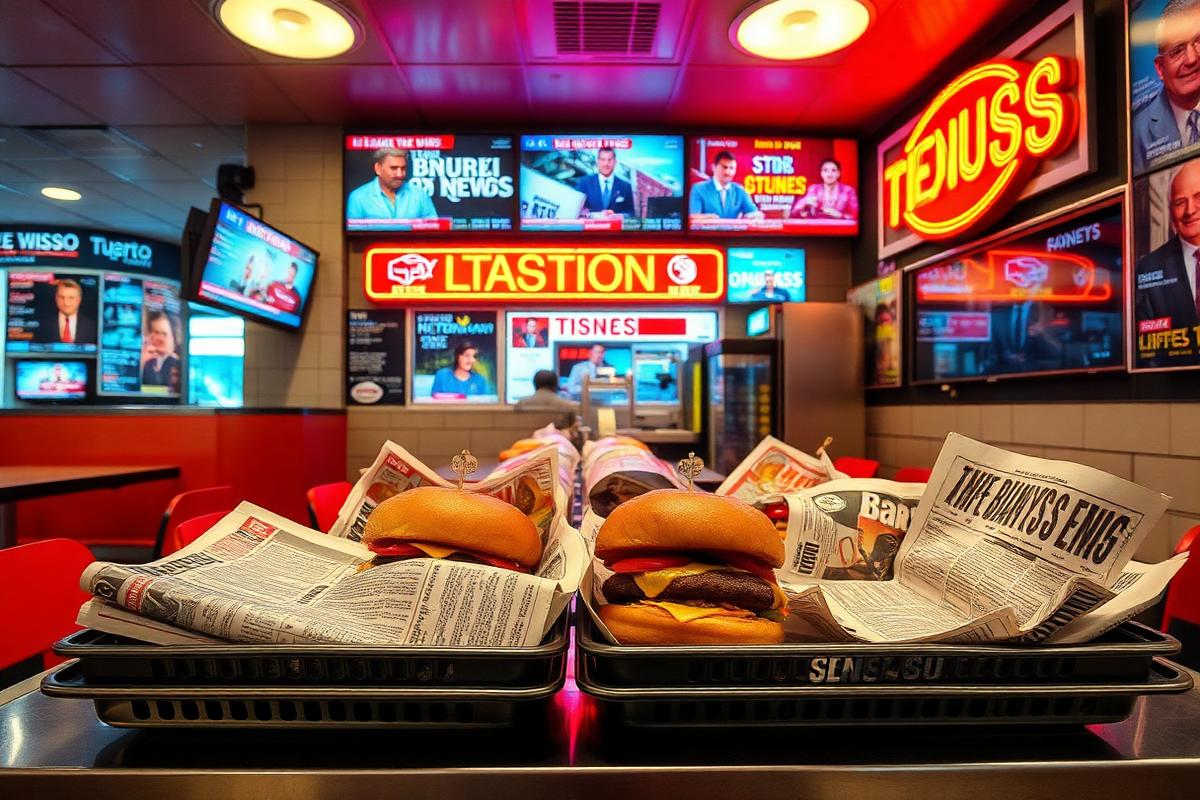
The economic model of traditional media has become that of informational fast food. The parallel is not metaphorical – it is structural. A Big Mac and a 'BREAKING NEWS' banner share the same logic: capture maximum attention in minimum time, provoke an immediate emotional discharge (fear, indignation, surprise), and above all – above all – keep the consumer in front of the screen long enough to serve them advertising. Because that is the heart of the system: a news broadcast is not an information service, it is an advertising vehicle. The 'stories' are the fries – the real product is your attention, sold to advertisers for between 50,000 and 300,000 euros for 30 seconds in prime time on TF1 or France 2. Every minute of the news is calibrated not to inform the citizen, but to maximize the number of eyeballs in front of the Renault or L'Oréal spot that follows.
The consequences are devastating. First consequence: programmed amnesia. A conflict 'deserves' coverage only if it is new, spectacular, or involves Western powers. The war in Yemen – 377,000 dead, the worst humanitarian crisis of the 21st century according to the UN – never received more than a few cumulative minutes on French channels. Sudan, in civil war since April 2023, with over 12,000 civilians killed and 8 million displaced, is a media phantom. The unwritten rule is cruel in its simplicity: a European death is worth a hundred African deaths in airtime. This is not conscious racism – it is the audience algorithm that dictates the hierarchy of empathy.
Second consequence: the infantilization of the public. The 'junk food' format – short, emotional, context-less, follow-up-less stories – creates citizens incapable of understanding the world's complexity. We know 'Iran is dangerous' but we don't know why. We know 'AI will change everything' but we don't know how. We consume snippets, fragments, sensations – never analysis. The result is a population that confuses 'being informed' with 'having seen the headlines.' Philosopher Matthew Crawford speaks of an 'attention economy' where the rarest resource – our concentration capacity – is plundered by an industrial system designed to fragment it. Social networks, with their 15-second formats and endless feeds, have only accelerated the process that television had initiated.
OrChair was born from this realization. A media outlet without advertising does not need to keep you in front of the screen. A media outlet without shareholders has no geopolitical interests to protect. An AI media outlet has no 'compassion fatigue' – it can cover Palestine on April 8, 2026, with the same rigor as on October 8, 2023. Our commitment: never 'move on' because audience figures are dropping. Continue to cover Ukraine, Gaza, Yemen, Sudan, Burma – even when these topics are no longer 'trendy.' Information is not entertainment. Wars do not stop when the cameras turn away. And a properly informed citizen is the only bulwark against the indifference that allows atrocities to continue in silence. The next time you turn on your news, ask yourself: am I getting informed, or am I consuming content between two ads? The answer might surprise you – or rather, it shouldn't.