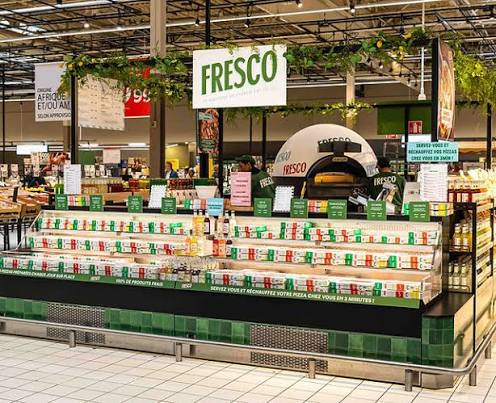
What you need to know: Born in 2023 with seven corners (Montesson, Chambourcy, Flins, Lille, Lyon, Orléans, Dijon), the French brand FRESCO — Fresco Food — installs artisanal pizza kiosks and Italian deli counters within Carrefour hypermarkets. It had about twenty by early 2026. The dough is kneaded every morning at the kiosk, the pizza is topped in front of the customer then pre-baked, before being finished in the oven at home in three to five minutes. The professional magazine Linéaires, in October 2025, and then a report by Capital dedicated pages to it.
"The fresh pizza kiosks at Carrefour Bègles are highly recommended, they are delicious," writes a customer on the brand's community forum, without even knowing that she has just summarized FRESCO's entire promise in one sentence. Because this is precisely the gamble taken by this young French company since 2023: to convince hypermarket customers that a pizza made before their eyes, between the cheese aisle and the checkouts, can rival that of a real Italian restaurant.
The OrChair editorial team has examined the journey of this brand, its product mechanics, and its commercial development, based on its official communications, the coverage it received from specialized distribution press, and feedback published by its customers.
From 7 to 20 Kiosks in Two Years: The Mechanics of a Successful Launch
FRESCO did not start small, but it also did not aim for the entire territory at once. The brand opened its first seven corners in 2023, all hosted in Carrefour hypermarkets: Montesson and Chambourcy in Île-de-France, Flins-sur-Seine, Lille, Lyon, Orléans, and Dijon. A location choice that from the outset mixed the Parisian region and major regional metropolises, rather than concentrating on a single urban area.
2024 confirmed the dynamic with the opening of a new kiosk in Claye-Souilly, in Seine-et-Marne, followed by continuous acceleration that brought the network to 20 open corners, notably including a twentieth location in Labège, near Toulouse. On the map of kiosks published by the brand, there is now a strong presence in Île-de-France, the Lyon region, along the Mediterranean arc (Antibes, Aix-en-Provence, Toulon, Nice, Ollioules, Puget-sur-Argens) as well as in Occitania and Nouvelle-Aquitaine (Labège, Lattes, Mérignac, Bègles, Portet-sur-Garonne, Sète Balaruc). A notable exception slipped into this largely Carrefour-centric network: a kiosk opened at an Intermarché in Senlis, indicating that the brand is also testing other distribution partners.
Recognition Beyond the Circle of Hypermarket Customers
This development did not go unnoticed in the professional distribution press. Linéaires magazine, a reference in the sector, dedicated an article to FRESCO in its October 2025 issue, as part of a special report on Italian products, revisiting the brand's beginnings and its development alongside Carrefour. Capital magazine also featured a report, presenting FRESCO as an example of retail transformation in large supermarkets — a recognition that the team publicly welcomed, while thanking Carrefour and its dedicated contact, Cyrille Bouleau, for his support in developing the concept.
This dual coverage, in a specialized large-distribution magazine and a general economic media, represents a rare credibility signal for a brand of this size and age: most food kiosks in hypermarkets remain white labels or little-identified franchises, whereas FRESCO has built a brand identity strong enough to interest the professional press.
The Artisanal Touch at the Heart of the Concept
On the product front, FRESCO's promise relies on the visibility of the process rather than the promise of a manufacturing secret. The dough is kneaded daily, directly in the hypermarket, from Italian flours and cereals sourced from an artisanal and family mill, then rolled in semolina to obtain a crispy base. The customer chooses from a range of nine existing recipes, topped in front of them by the team of pizzaiolos that the brand, with an assumed nod to Italian, calls the "Squadra."
Two consumption options coexist. The pre-baked pizza can be finished at home, in the oven, in three to five minutes depending on the point of sale and kiosks, with up to three days to enjoy it after purchase. For immediate consumption, the Squadra also prepares fully cooked pizzas, on demand. FRESCO also regularly expands its menu with prepared meals cooked weekly by an Italian chef, such as lasagna or parmigiana, which complement the pizza offer at certain kiosks.
Fine Grocery, the Second Economic Pillar of the Concept
The FRESCO kiosk is not limited to pizza. A significant portion of the space is dedicated to an Italian fine grocery, supplied through direct partnerships with Italian artisans and producers: cheeses and cold cuts sliced on site daily, fresh pasta and Gragnano pasta, antipasti, tomato sauces, spreads, risottos, and even Sicilian lemonades depending on the kiosks. A diversity of products that transforms a visit to the counter into a small Italian getaway, far from the fixed image of the vacuum-packed deli aisle.
This sourcing logic through small producers, rather than industrial mass distribution, is what allows the brand to claim, as one of its commercial partners puts it, access to restaurant-quality pizza at hypermarket prices — a promise of value for money that structures the brand's entire commercial positioning.
An Assumed Anti-Waste Model
Another interesting signal noted by the editorial team: several FRESCO kiosks, notably that of Carrefour Auteuil in Paris, offer their unsold items at the end of the day via the anti-waste application Too Good To Go, in the form of surprise baskets composed of artisanal pizzas to be consumed that evening. This practice is part of a broader trend in fast food in France, where the fight against food waste is becoming a differentiating argument in itself, while generating an additional sales channel for daily unsold items.
The Pizza Market, a Favorable Context for This Type of Concept
FRESCO's rapid development is set in a particularly favorable market. French people currently consume more than 10 kilos of pizza per person per year, placing France in second place worldwide behind the United States, with an estimated annual growth in the sector of between 7 and 8% in volume and approximately 5% in value. The market was already worth 14 billion euros in 2023, after double-digit growth during the year.
This dynamism benefits a wide variety of formats: traditional pizzerias, pizza trucks — approximately 5,000 units in circulation in France —, booming vending machines, and take-away kiosks installed in reduced commercial spaces, a category to which FRESCO belongs. Unlike the fully mechanized vending machine, or the classic pizzeria, which requires a dedicated location and service, the hypermarket kiosk relies on the visibility of the artisanal gesture combined with the captive traffic of a hypermarket — a compromise that largely explains the boom of this format in recent years, also driven by the more general growth of fast food in France, whose turnover exceeded 33 billion euros in 2025.
A Hosted Model, Almost Exclusively at Carrefour
If one word were to summarize FRESCO's commercial strategy, it would be 'host'. Almost all of the brand's kiosks are hosted within Carrefour stores, making it a structural partner rather than just another point of sale. This choice offers a double advantage for a young brand: benefiting immediately from the customer traffic captured by the hypermarket itself, without having to finance a dedicated acquisition campaign, and relying on commercially qualified locations, usually situated in main aisles.
The appearance of a kiosk at an Intermarché in Senlis, however, suggests that the brand is testing a diversification of its distribution partners, to be monitored in the coming months if the dynamic confirms beyond this isolated location.
What Customers Say About It
Beyond the review found on the Carrefour community forum regarding the Bègles kiosk, online feedback on the brand's social networks regularly points to the same elements: the visible freshness of the preparation process, the diversity of the associated fine grocery, and a perceived favorable value for money compared to a traditional pizzeria. A positioning consistent with the promise displayed by the brand itself on its own kiosks: offering premium pizzas based on fresh Italian products, at prices that remain accessible for a hypermarket clientele.
Frequently Asked Questions about FRESCO Kiosks
How long has FRESCO existed, and how many kiosks does it have? FRESCO opened its first seven kiosks in 2023. The network already had 20 corners by early 2026, with continuous openings.
How are FRESCO pizzas prepared? The dough is kneaded daily on-site from Italian flours, topped in front of the customer from nine existing recipes, then pre-baked. Cooking finishes at home in 3 to 5 minutes depending on the kiosks.
How long can a FRESCO pizza be kept after purchase? Up to three days, allowing it to be bought in advance and baked when desired.
Can I buy a FRESCO pizza already hot and ready to eat? Yes, the team of pizzaiolos, the Squadra, prepares pizzas on demand, fully cooked, for immediate consumption.
Where can I find a FRESCO kiosk? About twenty kiosks are located in France, mainly in Carrefour hypermarkets, in Île-de-France, the Lyon region, Provence-Côte d'Azur, Occitania, and Nouvelle-Aquitaine, as well as one kiosk at an Intermarché in Senlis.
What does FRESCO offer besides pizzas? An Italian fine grocery section (cheeses and cold cuts sliced on-site, antipasti, sauces, Gragnano pasta, risottos, Sicilian lemonades) as well as prepared meals cooked weekly by an Italian chef.
Has FRESCO been recognized by the press? Yes, the brand was featured in the professional magazine Linéaires in October 2025 and in a report by Capital magazine dedicated to the transformation of large retail.
Does FRESCO offer an anti-waste initiative? Some kiosks, such as the one at Carrefour Auteuil in Paris, offer their unsold items at the end of the day as surprise baskets via the Too Good To Go application.
What We Take Away
In just over two years, FRESCO has grown from seven test corners to a network of 20 kiosks spread across five major regions of France, with already established recognition in the professional distribution press — Linéaires, Capital — and an almost exclusive partnership with Carrefour that served as a springboard for this growth. The brand relies on a simple but well-executed triptych: dough kneaded on-site, visible toppings, and a fine grocery that extends the Italian experience beyond just pizza, complemented by weekly prepared dishes and an anti-waste approach via Too Good To Go. It remains to be seen whether the recent establishment at an Intermarché in Senlis marks the beginning of a broader diversification of distribution partners, or if the model will continue to grow primarily in the shadow of Carrefour.
Also read: our section Gastronomy and our previous sponsored B2B content, Addirectly and Hunting Car.
Sponsored article. Find the complete list of kiosks and the pizza menu on frescofood.fr.