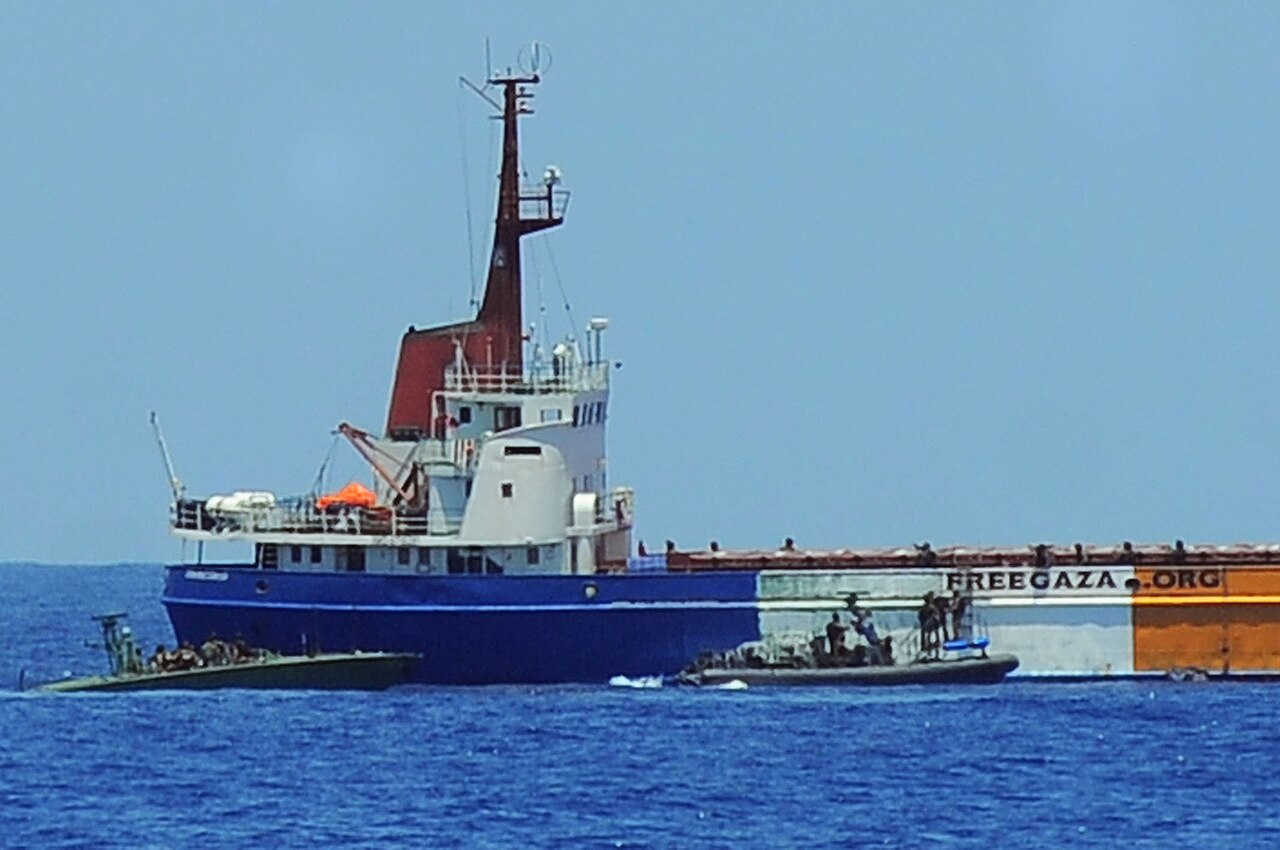
It was around 4 a.m. local time when the first boats of the « Global Sumud » flotilla were boarded by Israeli navy commandos, several hundred nautical miles off the Greek coast. According to the Israeli Ministry of Foreign Affairs and the organizers themselves, approximately 211 activists were on board the dozen vessels making up the expedition. All were arrested and taken to the Israeli port of Ashdod, where they are to be identified, questioned, and likely deported. Among them were 15 French nationals, confirmed mid-morning by the French Ministry of Foreign Affairs, which stated that "an elected official from the Paris Council" was among the group.
An Operation Outside Israeli Territorial Waters
This is, legally, the most sensitive point. The interception took place, according to the organizers, about 350 nautical miles from the Israeli coast, well outside territorial waters. The Israeli navy relies on the naval blockade of Gaza, in force since 2007, which Israel considers a legal security measure. However, several international jurists – including the London-based organization Lawyers for Palestinian Human Rights – vigorously contest the legality of boarding operations conducted in international waters on civilian vessels flying various flags (Spanish, Turkish, Malaysian, Irish). An international commission of inquiry had already criticized the boarding of the Mavi Marmara in similar circumstances in 2010.
Diplomatic Reactions in Cascading Waves
Italy, Spain, Ireland, and Turkey summoned their Israeli ambassadors on Thursday morning to demand explanations. In Paris, Catherine Colonna, the Minister of Foreign Affairs, issued a statement on X, demanding "respect for international law, the guarantee of dignified treatment, and the swift release of French nationals." The Mayor of Paris, Anne Hidalgo, immediately called for "the immediate release" of the arrested Paris councilwoman. In Brussels, the spokesperson for the European External Action Service spoke of "an operation that raises questions about respect for international maritime law" and announced the convening of an emergency meeting of European diplomatic advisors for Friday, May 1st. Israel, through its Foreign Minister Israel Katz, justified the operation as "strictly legal and necessary for the state's security."
What Did « Global Sumud » Intend to Deliver?
The organizers – a collective of NGOs and pro-Palestinian movements based in Europe and Latin America – claim the flotilla was carrying approximately 5,700 tons of humanitarian cargo: medicines, infant formula, medical equipment, bags of rice, blankets. Their objective, they stated, was not military but symbolic: to force Israel to allow aid entry amid a deteriorating humanitarian situation in the Gaza Strip, which the UN has decried as "catastrophic" since the fall of 2025. The Israeli army, in a statement, indicated that the cargo would be inspected in Ashdod, and that "genuinely humanitarian supplies would be delivered to Gaza through official channels" – a formulation that, in practice, often means a delay of several weeks.
Political Shockwave in France
In France, the arrest of the 15 nationals – whose precise list has not yet been made public – caused strong emotion. Several left-wing elected officials, including Manuel Bompard (LFI) and Marine Tondelier (EELV), announced a rally at Place de la République in Paris on Thursday evening. The UN Special Rapporteur on the situation in Gaza, Francesca Albanese, posted a message on X denouncing "an interception in international waters contrary to the Montego Bay Convention." On the right, several voices – Olivier Marleix (LR), Marion Maréchal (Identité-Libertés) – conversely criticized the "political" and "media" nature of the expedition, accusing the activists of seeking "provocation rather than concrete aid."
Editorial Opinion
The interception of « Global Sumud » is a revealing moment, in more ways than one. On a strictly humanitarian level, the Israeli operation further complicates access to Gaza, where the UN estimates 2.3 million people suffer from acute food insecurity. Legally, it poses a major question that the international community has avoided for fifteen years: can a naval blockade extend beyond the territorial waters of the country imposing it, without UN validation? Politically, finally, it places France – and Europe – in a dilemma: verbal protests will no longer suffice if European nationals regularly become the target of Israeli operations on the high seas. Our conviction: this affair will set a precedent. Either Europe organizes itself to demand a clear maritime framework (perhaps through a convoy under European naval escort, as Spain is already calling for), or it accepts that freedom of navigation in the Eastern Mediterranean is now conditioned by Israel. The coming days will show which of these two options Brussels is prepared to assume.
Key Takeaways
- 211 activists arrested, including 15 French nationals and an elected official from the Paris Council.
- Interception at ~350 nautical miles off Greece, in international waters.
- ~5,700 tons of humanitarian aid on board the dozen ships.
- Quai d'Orsay demands respect for international law; EU calls emergency meeting.
- Israel justifies the operation by the naval blockade of Gaza in force since 2007.