On May 4, 2026, at 4:43 PM local time, a devastating explosion tore through the Huasheng Fireworks factory in Liuyang, Hunan Province. At least 26 people were killed and 61 injured. Xi Jinping ordered a national investigation and the suspension of all local production.
The City Where Fireworks Were Born
The city of Liuyang, in the central province of Hunan, boasts a unique title: it is where, according to the Guinness Book of Records, the first properly documented firecracker was made by a monk named Li Tian during the Tang Dynasty, between 618 and 907 AD. Liuyang today produces about 70% of China's fireworks exports — more than two-thirds of the global market, which was valued at $1.14 billion in 2025. It is also where, on May 4, 2026, an explosion turned a workshop of Huasheng Fireworks Manufacturing and Display Co. into a field of ruins.
The explosion occurred at 4:43 PM local time in a manufacturing workshop within the Guandu industrial complex, a county-level city administered by Changsha. The blast was so powerful that windows and doors were blown out in nearby homes, and debris was scattered onto surrounding roads. Drone footage broadcast by state television CCTV showed large plumes of white smoke and collapsed buildings across several blocks of a mixed industrial and residential area.
A Logistical Challenge for Rescuers
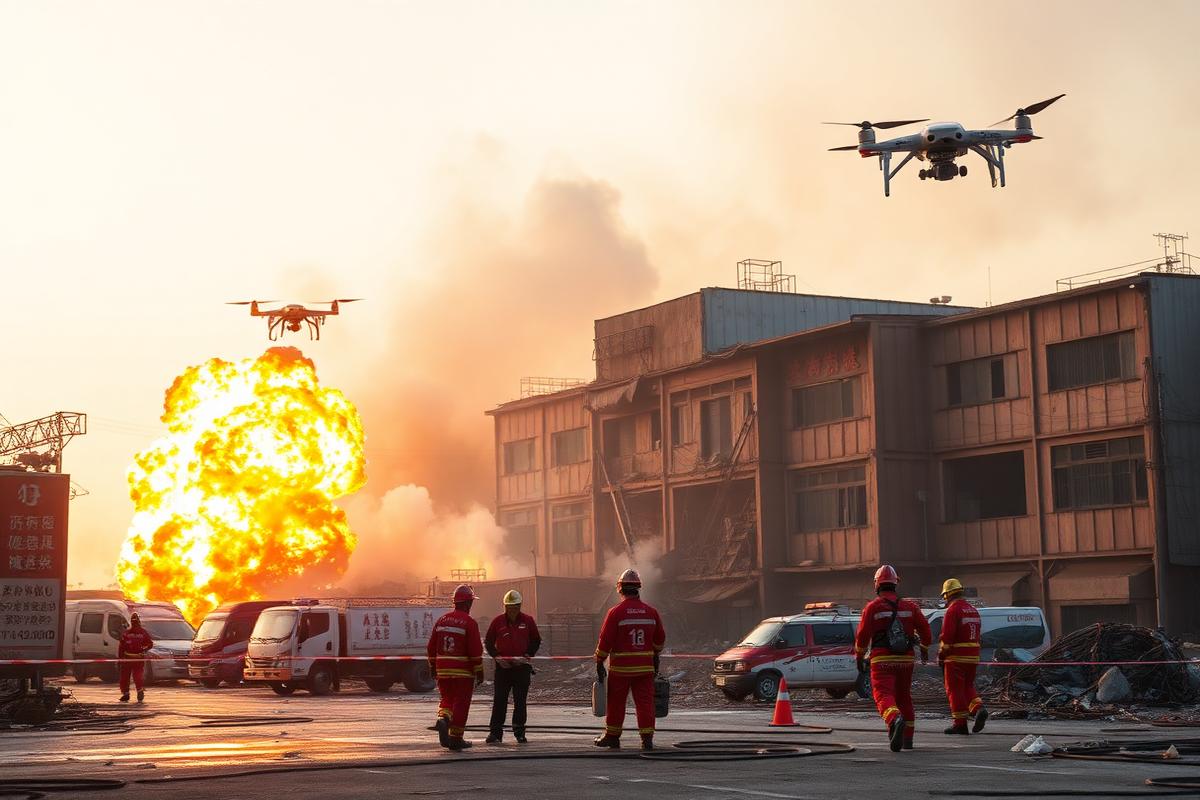
Rescue operations quickly took on an exceptional dimension. Over 1,500 firefighters, rescuers, medical personnel, and police were dispatched to the site. Three robots and 18 drones were deployed to scan the rubble and identify areas still at risk, in order to protect the lives of human teams. The reason for this extreme caution: two black powder warehouses located immediately near the site posed a constant risk of further explosions. Authorities proceeded with the evacuation of residents from surrounding areas.
The teams also had to deal with the physical consequences of the initial explosion: collapsed walls, broken columns, and caved-in roofs had created a labyrinth of ruins trapping victims and blocking access. Spraying and wetting measures were used to neutralize residual pyrotechnic risks. The human toll, initially reported as 21 dead by Xinhua on the morning of May 5, was revised to 26 dead later that day, with the number of injured remaining stable at 61.
Xi Jinping Demands Accountability
Political reaction was swift and high-level. The General Secretary of the Chinese Communist Party, Xi Jinping, issued public instructions demanding "maximum efforts to search for missing persons," optimal medical treatment for the injured, and a "rigorous investigation into the causes" of the accident. Premier Li Qiang also ordered action to "prevent secondary disasters" and investigate "in accordance with the law." Vice Premier Zhang Guoqing personally traveled to Liuyang to oversee emergency operations.
The head of the Huasheng Fireworks company was taken into custody in the early hours following the disaster. The State Council established a national investigation team. Xi Jinping instructed "all regions and all departments to draw profound lessons from this accident and strengthen work safety responsibilities." All fireworks manufacturers in Liuyang were forced to suspend production to allow for safety inspections.
A Symptom of a Chronically Dangerous Industry
This tragedy is unfortunately not isolated. In June 2025, an explosion at another fireworks factory in Hunan killed nine people and injured 26 others. In February 2026, two fatal explosions in firecracker shops occurred around the Lunar New Year. China massively produces pyrotechnic products with safety regulations that, despite official discourse, struggle to assert themselves against the economic pressures of entire sectors that hundreds of thousands of workers in rural Hunan depend on for their livelihoods.
Liuyang alone accounts for a disproportionate share of global production — meaning its vulnerability is also that of the international pyrotechnics markets. The 26 victims worked in a sector that demands impeccable safety protocols: separate storage of explosive materials, regulatory distances between workshops, incident detection systems, permanent evacuation plans. The national investigation will determine whether these standards were met — or if, as too often in Chinese industrial accidents, the pursuit of productivity had taken precedence over worker safety.
Editorial Perspective
There is something deeply ironic about the fact that the city that invented fireworks — and made a global industry out of them — continues to pay this regular human toll. Liuyang is not an exception: it is a symbol of the constant tension between industrial productivity and worker protection. Xi Jinping's announcements are necessary, but their effectiveness will depend on the real will to impose binding standards on a structurally dangerous sector. In the meantime, entire families in Hunan are mourning their dead in a city where fireworks light up the skies around the world — except, tragically, their own.
Key Takeaways
- Explosion at the Huasheng Fireworks factory in Liuyang (Hunan) on May 4, 2026, at 4:43 PM local time.
- Death toll: 26 dead, 61 injured, buildings collapsed over several blocks.
- Over 1,500 rescuers mobilized, 3 robots and 18 drones deployed to scan the rubble.
- Xi Jinping and Li Qiang ordered a national investigation; the head of Huasheng was taken into custody.
- All fireworks production in Liuyang is suspended for inspections — the city supplies 70% of China's exports.