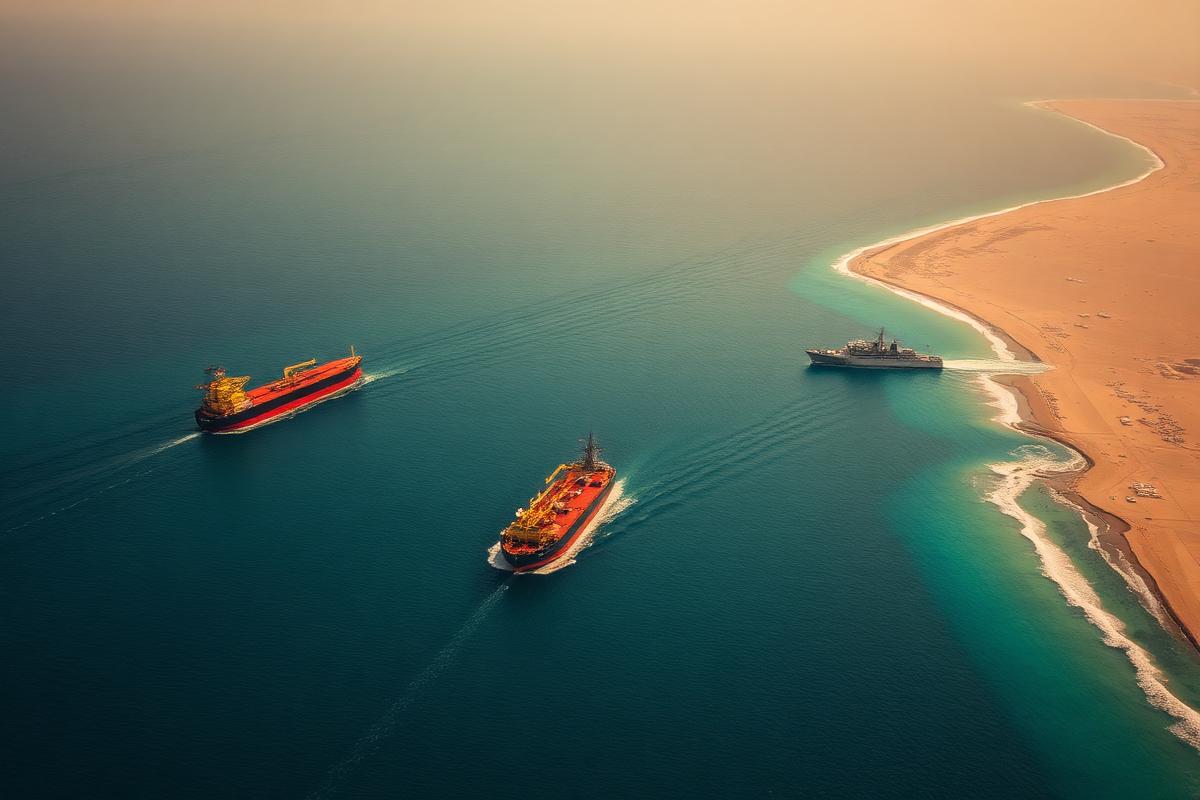
Since February 28, 2026, the Strait of Hormuz — through which 25% of the world's oil transits — has been at the heart of an unprecedented geopolitical crisis since the Gulf War. Trump launched and then suspended a military escort operation dubbed "Project Freedom." The barrel has been durably exceeding $100. Iran has set the next reassessment of the situation for May 8, 2026.
A crisis born from "Epic Fury"
On February 28, 2026, the United States and Israel launched coordinated strikes on Iran — "Epic Fury" operation — targeting military installations, nuclear sites, and Iranian leadership. Supreme Leader Ali Khamenei lost his life in these attacks. Iran responded with missile barrages on Israeli cities and American bases in the Gulf. Since that day, the Strait of Hormuz, a 56-kilometer-wide waterway between Iran and Oman, has become the front line of a global economic war.
The Islamic Revolutionary Guard Corps (IRGC) declared the strait "closed," seizing and attacking merchant ships, and planting naval mines. In April, a double attempt to reopen passage was met with Iranian intransigence: Tehran had briefly accepted a ceasefire but conditioned ship passage on payment of transit fees exceeding one million dollars per vessel — a form of state-sponsored maritime racket.
Project Freedom: rhetorical victory, practical failure
On April 13, Washington established a blockade of Iranian ports, creating an unprecedented "double blockade" situation: Iran blocking the Gulf via the strait, and the US Navy blocking Iranian exports. It was in this context that Trump launched "Project Freedom": a military operation to escort merchant ships through the strait under American protection. On the first day, only two American ships could pass. Experts immediately pointed out the impossibility of "scaling" such a deployment for the hundreds of tankers normally in transit.
The situation shifted at the beginning of the week. Exchanges of fire occurred between American and Iranian forces in the strait, and a South Korean ship was damaged in an explosion. Iranian Foreign Minister Abbas Araghchi called the operation "Project Deadlock," warning that "Project Freedom" was in reality "Project Quagmire." "There is no military solution to a political crisis," he insisted from Beijing, where he went to seek China's support.
Trump suspends the operation
On Tuesday evening, Donald Trump announced the suspension of "Project Freedom." During a White House address presented as "an important update on Iran," he stated that other nations must "take the lead" in reopening the strait. "We will be helpful, but they must lead," he said, asserting that the strait could also "reopen naturally." A phrase that sounds more like a veiled disengagement than a coherent strategy. He nevertheless maintained his threats: Iranian forces would be "wiped off the face of the Earth" if they attacked American ships.
On April 17, during a brief lull related to the Islamabad negotiations — which ultimately failed — Iran had announced the reopening of the strait to trade for the duration of the truce. But the situation remains unstable. Since April 13, it has been described as a "dual blockade" by The Guardian. Result: approximately 25% of global oil trade has been paralyzed for three months.
A global economy in overheating
Markets reflect the scale of the shock. Crude oil barrels have been durably exceeding $100. The price of gasoline in the United States has reached $4.46 per gallon — the highest level in nearly four years — and some experts predict it could surpass $5 if the strait remains blocked. Shipping companies have suspended operations. Maritime insurers have multiplied risk premiums by three or four. Schools in the Emirates and Qatar switched to distance learning during the initial strikes. China, which imports massive amounts of Iranian oil, is under US pressure to act as a mediator — without success to date. Iran indicated that the situation would be "re-evaluated on May 8, 2026."
Editorial Opinion
The Hormuz crisis is a perfect example of a military escalation producing immediate and lasting global economic consequences. Trump launched a military operation ("Project Freedom") without securing either an exit strategy or the support of his allies. Its suspension reveals the limits of ultimatum diplomacy when faced with an Iran whose leverage over the global economy is considerable. The question is no longer "how to reopen the strait?" but "who pays the bill for this impasse?" The answer, alas, is every car owner, every consumer, every oil-dependent economy on the planet.
To Remember
- The Strait of Hormuz has been blocked since February 28, 2026 — 25% of the world's oil is no longer circulating freely.
- Trump launched and then suspended "Project Freedom," the military escort operation for commercial vessels.
- Crude oil barrels exceed $100; American gasoline reaches $4.46/gallon, its highest level in four years.
- Iran and the United States are engaged in a "double blockade" — an unprecedented situation since the Gulf War.
- The next Iranian reassessment is set for May 8, 2026.