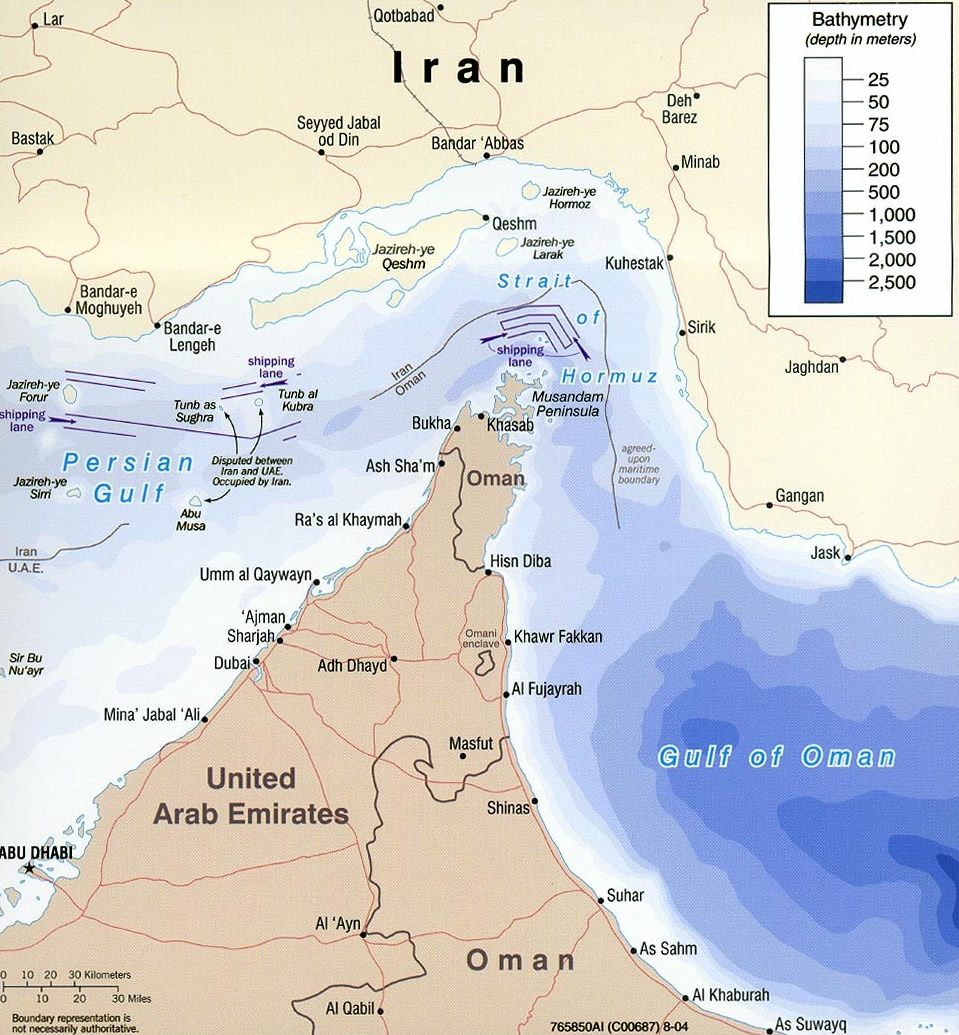
This historic Monday, President Donald Trump officially launched 'Operation Project Freedom,' an unprecedented military and humanitarian initiative aimed at reopening the Strait of Hormuz to commercial shipping. The announcement, made Sunday evening on Truth Social, immediately sent shockwaves through global markets and provoked a firm backlash from Tehran. We are at the heart of the most tense geopolitical crisis since the Gulf War of 1991.
A Standoff Over 20% of World Oil
The Strait of Hormuz, a 33-kilometer-wide maritime corridor connecting the Persian Gulf to the Indian Ocean, is the transit point for nearly 20% of the world's oil and an equivalent share of liquefied natural gas. Since the outbreak of armed conflict between the United States and Iran on February 28, 2026, Tehran has imposed near-total control, blocking dozens of oil tankers and commercial cargo ships belonging to countries completely neutral in this conflict. Thousands of sailors have been trapped for weeks, their ships running low on food and fuel. It is precisely on this humanitarian issue that Trump has based the political legitimacy of his operation.
In his Truth Social post, the American president justified the operation in terms of compassion: 'Countries around the world, almost all with no connection to the conflict, have asked if we can help free their ships, blocked in the Strait of Hormuz over a dispute that absolutely does not concern them. They are simply innocent and neutral bystanders.' The tone is humanitarian; the means deployed are clearly military.
15,000 Troops, 100 Aircraft: The Arsenal of 'Project Freedom'
US Central Command (CENTCOM) detailed the operational deployment: Arleigh Burke-class missile-destroying destroyers, over 100 carrier-based and land-based aircraft, and 15,000 U.S. military personnel engaged in the mission. Admiral Brad Cooper, commander of CENTCOM, called this initiative a 'defensive mission essential to regional security and the global economy.' A reinforced security corridor has been established south of the usual shipping lanes, in Omani territorial waters, where ships are invited to concentrate under U.S. coordination.
Early Monday morning, Middle East local time, CENTCOM announced that two U.S.-flagged commercial vessels had successfully transited the strait. A strong signal of Washington's resolve. But at the same time, the semi-official Iranian news agency Fars News, close to the Revolutionary Guards, claimed that two Iranian missiles had struck a U.S. destroyer off the port of Jask. CENTCOM categorically denied this: 'This is propaganda, pure and simple.'
Tehran Threatens, Macron Calls for Restraint
Tehran's response was swift. General Ali Abdollahi, chief of the joint staff of the Iranian armed forces, issued an unambiguous statement: 'We warn that any foreign armed force—and especially the aggressive American military—will be attacked if it attempts to approach or enter the Strait of Hormuz.' Iran also considers any U.S. military intervention in the strait a violation of the ceasefire in effect since April 8, 2026.
The United Kingdom, through its Maritime Trade Operations Centre (UKMTO), maintained a 'critical' threat level for navigation in the strait. The agency now advises shipowners to use Omani territorial waters. For his part, President Emmanuel Macron distanced himself during a European summit in Yerevan, Armenia: 'What we want above all is a reopening coordinated by the United States and Iran—that is the only solution.' Paris and London refuse to join the U.S. operation until a political agreement is signed.
Peace Negotiations at a Standstill — But Not Broken
In parallel with the military crisis, diplomatic discussions continue through Pakistani mediators. Iran has submitted a fourteen-point plan providing for a permanent ceasefire within thirty days, gradual opening of the strait, gradual lifting of the U.S. naval blockade on Iranian ports, and a mutual non-aggression mechanism including Israel and regional actors. The nuclear issue is deliberately deferred to a later stage of negotiations.
Trump responded with characteristic ambivalence: on Saturday, he wrote that he could 'not imagine the Iranian proposal being acceptable, because they have not yet paid a high enough price.' On Sunday, he stated that his representatives were having 'very positive discussions' with Tehran. Special envoy Steve Witkoff, present at the Doral golf club, confirmed to CNN: 'We are in conversation.'
Oil Surges: Towards $5 a Gallon?
The economic impact is already devastating. According to AAA, the average price of gasoline in the United States has surged from $2.98 per gallon before the conflict to $4.46 this Monday—a 49.3% increase in less than three months. Andy Lipow, president of Lipow Oil Associates, warns that if the strait remains closed for another month, prices could reach $5 per gallon, rivaling the all-time record of $5.02 in June 2022, after the Russian invasion of Ukraine. Diesel is already breaking records in several states: $6.01 per gallon in Michigan, $6.00 in Illinois.
July Brent crude was trading at $108.97 a barrel in early trading, after a brief dip on the announcement of Project Freedom, before traders resumed a wait-and-see posture. Trump's announcement is not perceived as a game-changer by the markets, which remain focused on the risk of direct military escalation. Every statement from Tehran or Washington causes prices to fluctuate by several dollars.
Conflict Overview as of May 4, 2026
According to preliminary figures compiled by Al Jazeera, the conflict has caused at least 3,375 deaths in Iran, 2,509 in Lebanon—where Hezbollah exchanged fire with Israel despite a fragile ceasefire—and 28 casualties in the Gulf states. The American-Israeli coalition maintains a naval blockade that has already resulted in the interception or diversion of 39 ships since April 13, according to Pentagon figures. Secretary of War Pete Hegseth announced last week that the blockade 'is going global,' sending shockwaves as far as China, which imports 70% of its oil by sea.
Editorial Opinion
'Project Freedom' is a double-edged maneuver. From a humanitarian standpoint, it is difficult to dispute the necessity of freeing sailors trapped at sea for weeks. Strategically, however, the operation carries considerable risk: every ship transiting under U.S. escort becomes a potential target for the IRGC. Trump is playing a chess game where every move could trigger uncontrollable escalation. The refusal of France and the United Kingdom to join the operation is not insignificant: our European allies believe this initiative is premature without a political agreement. The oil markets, for their part, have not been convinced. The only real solution remains a negotiated peace—and it will be a long wait.
Key Takeaways
- Trump launched 'Project Freedom' on Sunday, May 3, to escort commercial vessels through the Strait of Hormuz.
- Deployment: 15,000 U.S. troops, 100+ aircraft, Arleigh Burke destroyers, secure Omani maritime corridor.
- Iran threatens to attack any foreign force; Fars News claims strikes denied by CENTCOM.
- Paris and London refuse to join the operation without a prior peace agreement.
- Brent at $108.97/barrel; U.S. gasoline at $4.46/gallon, a record of $5 anticipated.
- Casualties: 3,375 dead in Iran, 2,509 in Lebanon, 28 in the Gulf, according to Al Jazeera.