This is the most strategic choke point on the planet: 54 kilometers wide, 20% of global oil. On Monday, May 4, 2026, the United States attempted to force it. Iran responded by bombing the United Arab Emirates. The April 8 truce officially still holds. In reality, the powder keg is burning.
A vital corridor that Iran closed in February
Since February 28, 2026, the date of the first US-Israeli strikes on Iran, Tehran has imposed a de facto closure of the Strait of Hormuz to international commercial shipping. This strait — 167 kilometers long, narrowing to 39 kilometers at its tightest point — is, however, the only maritime route connecting the Persian Gulf to the open ocean. In 2024, 25% of global hydrocarbon maritime trade passed through it daily, equivalent to 17 million barrels of oil per day. This is not a trade route: it is the jugular vein of the global economy.
The closure immediately triggered a global energy crisis. Europe, Japan, South Korea, and India — which depend heavily on Gulf oil — saw their energy bills skyrocket. In the United States, the price of a gallon of gasoline crossed the $4.46 mark on Tuesday, its highest level in almost four years. Some market analysts are now mentioning the $5 threshold if the blockade persists. The pressure on the Trump administration to act had become unbearable.
Project Freedom: two ships pass, six Iranian boats sunk
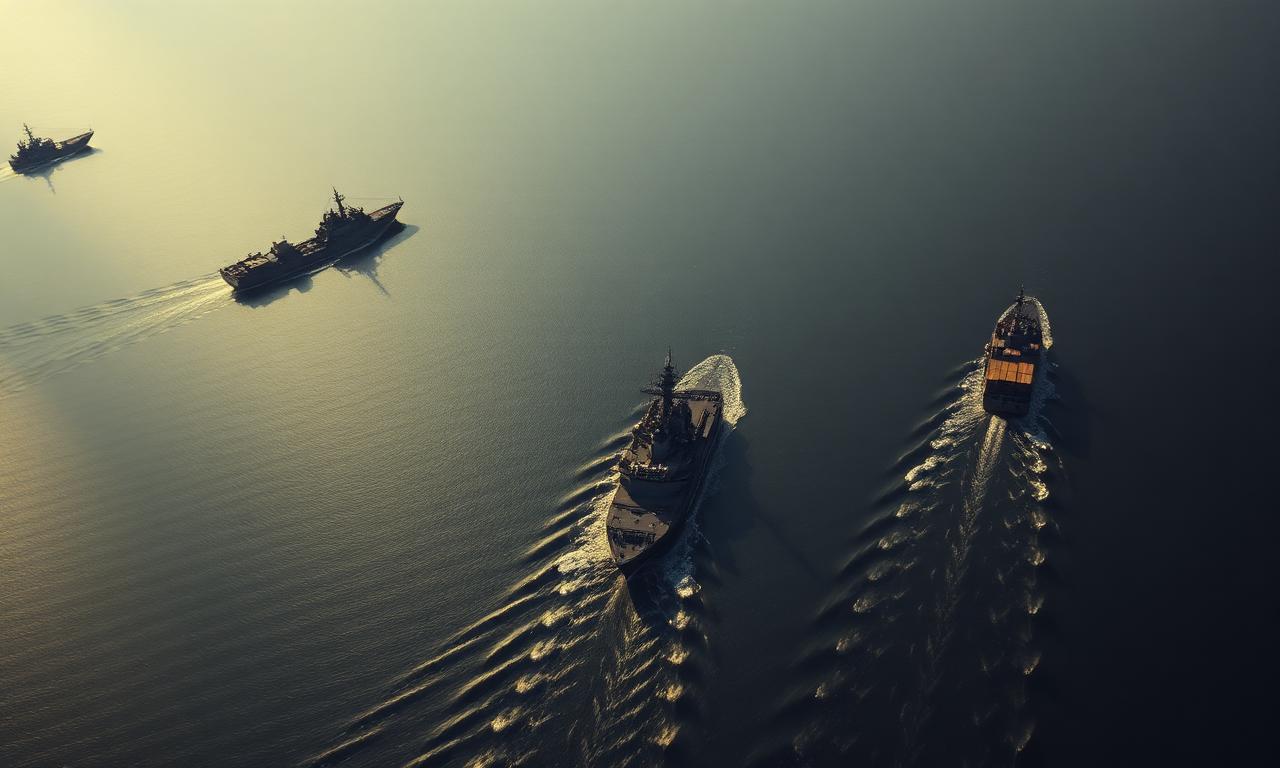
It was in this context that Donald Trump announced the launch of "Project Freedom" on Monday — a US military escort mission intended to guide commercial cargo ships through the strait despite Tehran's threats. The first test by fire: two vessels flying the American flag successfully transited. But the price paid was immediate. The US Navy engaged Iranian forces and sank six speedboats targeting civilian vessels. A tactical victory, but an incident that raises the fundamental question: can a strait be reopened against the will of a state that possesses thousands of naval mines ready to be deployed?
Iran's response was not long in coming. During the day, Tehran opened a second front by launching a massive attack on the United Arab Emirates — a key ally of Washington and so far spared the direct hostilities since the April 8 ceasefire. UAE missile defense systems intercepted 15 missiles and 4 drones. One drone, however, managed to break through: it triggered a fire in the oil industrial zone of Fujairah, a strategic port located east of the UAE, injuring three Indian nationals. Four missile alerts were triggered, forcing dozens of commercial aircraft to turn back mid-flight over the Gulf.
Fujairah, Dubai, South Korea: the collateral damage
Fujairah is not an ordinary port. It is the terminus of a pipeline that the Emirates uses precisely to bypass the strait — a critical infrastructure that allows Abu Dhabi to export its oil without passing through Iranian waters. Striking Fujairah is therefore depriving the UAE of its only logistical alternative. The gesture is surgical, deliberate, and laden with geopolitical meaning. The UAE Ministry of Foreign Affairs described the attack as a "treacherous and unacceptable act of aggression" and called for an immediate cessation of hostilities.
A South Korean cargo ship also caught fire following an explosion on board while anchored in the strait. Seoul confirmed the incident, stating that none of the 24 crew members — including six Koreans — were injured. Donald Trump directly addressed South Korea on social media, inviting it to "join the mission," although the South Korean government has yet to respond to this solicitation.
Hegseth maintains the ceasefire, Europe prepares for the worst
Defense Secretary Pete Hegseth sought to de-escalate the situation in a press briefing Tuesday morning. "The ceasefire is holding, for now," he stated, presenting the "Project Freedom" operation as a mission "distinct and separate" from the framework of the truce. He admitted to expecting "initial turbulence" and promised that Washington would "aggressively" defend escorted ships. But his carefully chosen words betray an uncomfortable truth: no one truly controls what is happening in the Gulf.
Europe is taking the problem seriously. France and the United Kingdom are working to form an international mine-clearing coalition in case a diplomatic agreement finally allows the passage to be secured. Germany has discreetly dispatched its mine-hunter Fulda from Kiel to the Mediterranean, without waiting for political approval. Shipowners, for their part, are not betting on diplomacy: insurance premiums in the strait remain prohibitive, and commercial confidence — what experts call the "center of gravity" of the problem — will not be restored by a simple press release.
Editorial Opinion
OrChair considers the "Project Freedom" operation to be more of a political signal than a lasting solution. Forcing a strait with two cargo ships and a naval escort, while Iran possesses over 5,000 naval mines, does not solve anything structurally. The real issue is diplomatic: what concessions is Washington willing to offer Tehran to lift its veto on this vital corridor? Without an answer to this question, every escort is a game of Russian roulette for the global economy.
Key Takeaways
- First successful passage of 2 US cargo ships under military escort in the Strait of Hormuz.
- Iran attacks the UAE for the 1st time since the ceasefire: 15 missiles, 4 drones, 1 fire in Fujairah.
- 6 Iranian boats sunk by the US Navy during Monday's clashes.
- US gas price: $4.46/gallon — risk of exceeding $5 if blockade continues.
- Germany positions a mine hunter in the Mediterranean; mine-clearing coalition being formed.