
Europe is producing too much green electricity. Not too much in an absolute sense – the continent is still far from its 2030 climate goals – but too much locally, too punctually, and without qualified buyers. Solar farms in Spain are injecting surplus power at midday that the grid absorbs at a loss. Danish wind turbines are throttled due to a lack of contractual outlets. Meanwhile, data center operators are signing carbon supply agreements on spot markets that expose them to volatility – and to increasing pressure from their shareholders and regulators regarding their net footprint.
It is precisely this structural mismatch that Voltarione aims to resolve. The platform, which has just opened its waitlist, is positioning itself as a B2B marketplace connecting renewable energy producers with surplus capacity and data center operators seeking green, traceable, and competitive long-term electricity.
An interactive map as a starting point
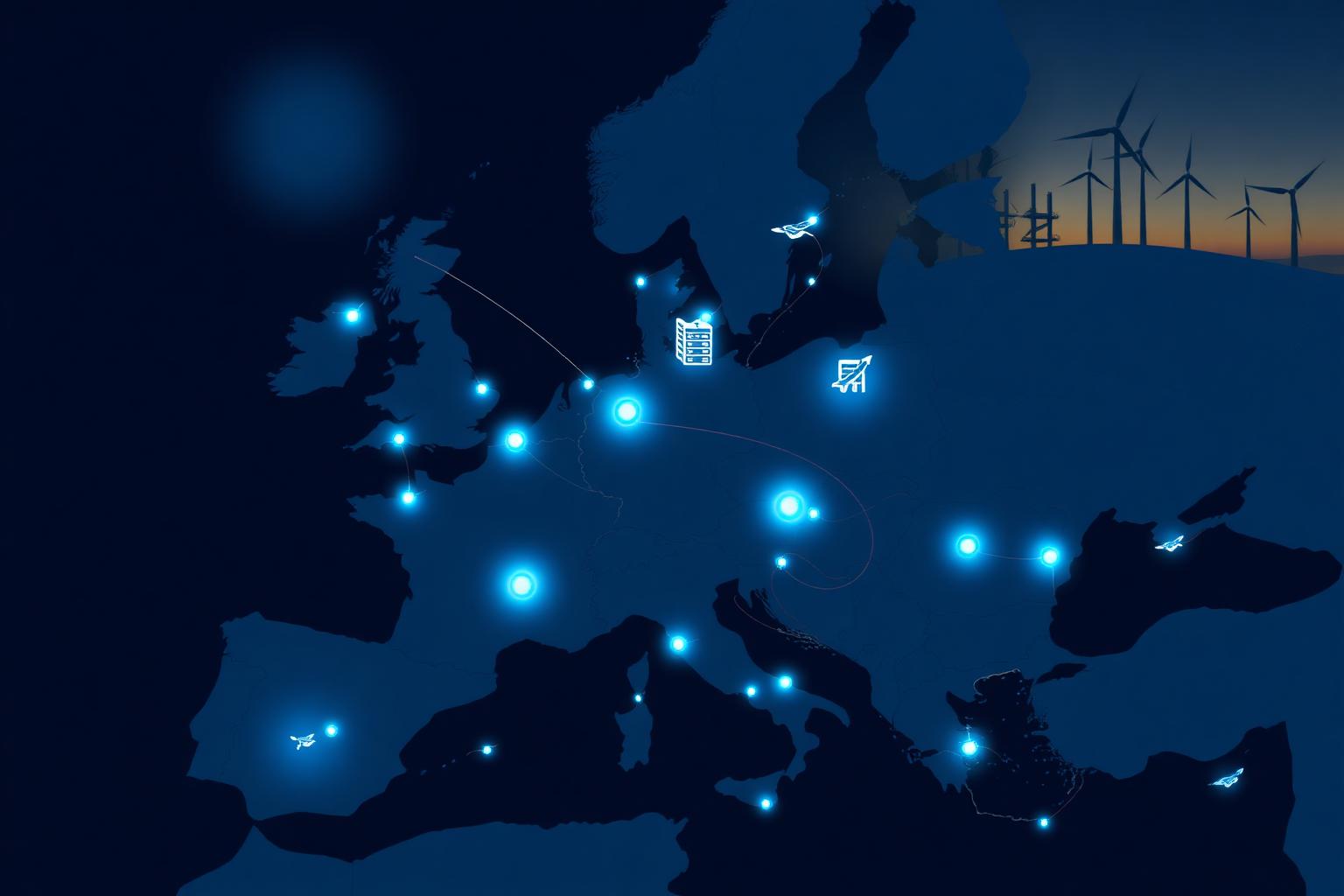
The main interface of Voltarione is a map of Europe listing production sites with surplus capacity for sale – solar, wind, hydro, nuclear, geothermal, biomass. Each site shows its available capacity in MW, its indicative price in €/MWh, and its energy type. Data centers can filter by geographic area, technology, and price ceiling.
The approach is deliberately transactional. Voltarione does not act as a electricity supplier – which would require heavy regulatory approval – but as a facilitator of connections, a broker role enhanced by technology. The model is consistent with the European legal framework: supply remains the responsibility of licensed players (Iberdrola, Vattenfall, EDF…), with Voltarione accelerating the discovery and due diligence phase.
The market in figures – 2026
- 6 to 18 months to sign a PPA through traditional channels.
- 3 to 6 weeks targeted by Voltarione, from matching to term sheet.
- 39 producers and data centers already registered on the waitlist at launch.
The PPA, the only real safeguard against spot volatility
The European spot market – EPEX SPOT, Nord Pool – allows electricity to be purchased a day in advance or even intra-day. Liquidity is real, but so is the price: hyperscale data centers consume hundreds of megawatts continuously, and unhedged exposure to the spot market can represent tens of millions of euros in annual variance depending on climatic and geopolitical conditions.
The Power Purchase Agreement (PPA) offers a structuring alternative: a direct bilateral contract between producer and buyer, lasting 3 to 25 years, at a fixed price or semi-indexed for a defined volume. For data centers, the advantage goes beyond price: the PPA comes with guarantees of origin (GO), certificates that trace each green MWh produced, essential for the ESG reporting of Google, AWS, or Microsoft in their 24/7 net-zero commitments.
> “The real question is not whether a data center wants green energy. It’s whether it can secure its supply at a predictable price, at scale, for twenty years.” — *Théodore Mécanis, OrChair*
An economic model aligned with signed deals
For producers, registration on Voltarione is free – consistent with a market where surplus supply actively seeks an outlet. For data centers, three plans are offered (Discovery, Pro, Enterprise), with a 2% commission only on concluded transactions. This success-based model is common in specialized B2B brokerage and reassures about the alignment of interests: Voltarione only generates revenue if its clients sign.
The announced geographical coverage is ambitious: the 27 EU member states, plus the United Kingdom, Norway, and Switzerland – encompassing all networks synchronized with ENTSO-E, the European association of transmission system operators. The physical transport of electricity is carried out via national TSOs (RTE in France, TenneT in Germany and the Netherlands, REE in Spain), with grid fees (TURPE and equivalents) integrated into contractual negotiations.
Physical or virtual PPA: two architectures for different needs
Voltarione distinguishes between two main contractual configurations. A physical PPA applies when the producer and buyer are in the same TSO price zone: the electricity truly flows from source to destination. A virtual PPA (vPPA, financial swap) is suitable for multi-site or cross-border buyers: financial flows are separated from physical dispatch, allowing for price hedging without location constraints.
For hyperscale data centers operating simultaneously in Ireland, Sweden, and Poland, vPPAs often remain the only viable architecture in the short term – while waiting for the European single electricity market to progress towards deeper harmonization of price zones.
A pre-production launch, deliberately
The site is transparent about its status: the data on the interactive map is currently fictitious, for demonstration purposes. Voltarione is collecting waitlist registrations – 39 entities as of the publication date – before opening access to the platform under real conditions. This fake-door testing approach is now standard in B2B SaaS: it allows for validating demand, calibrating priority segments, and engaging initial partner producers before mobilizing data integration resources.
What is happening here goes beyond a simple prospecting tool. If Voltarione succeeds in aggregating a sufficient volume of verified surpluses and automating qualification steps – load curve, TSO zone, additionality, guarantees of origin – it could become an infrastructure layer for the European PPA market, whose annual volumes are now in the tens of billions of euros.
Key takeaways
- Voltarione targets renewable energy producers with surplus capacity and European data center operators.
- Targeted PPA signing time: 3 to 6 weeks, compared to 6 to 18 months through traditional channels.
- Economic model: free for producers, 2% commission for buyers only on concluded deals.
- Coverage: 27 EU member states, UK, Norway, Switzerland – ENTSO-E perimeter.
- Two contractual architectures: physical PPA (same TSO zone) or vPPA (multi-site/cross-border).
- Platform in pre-launch with an open waitlist; fictitious demonstration data.
*Sponsored content · Voltarione partnership. OrChair's editorial line remains independent of its commercial partners. OrChair Ethics Charter.*