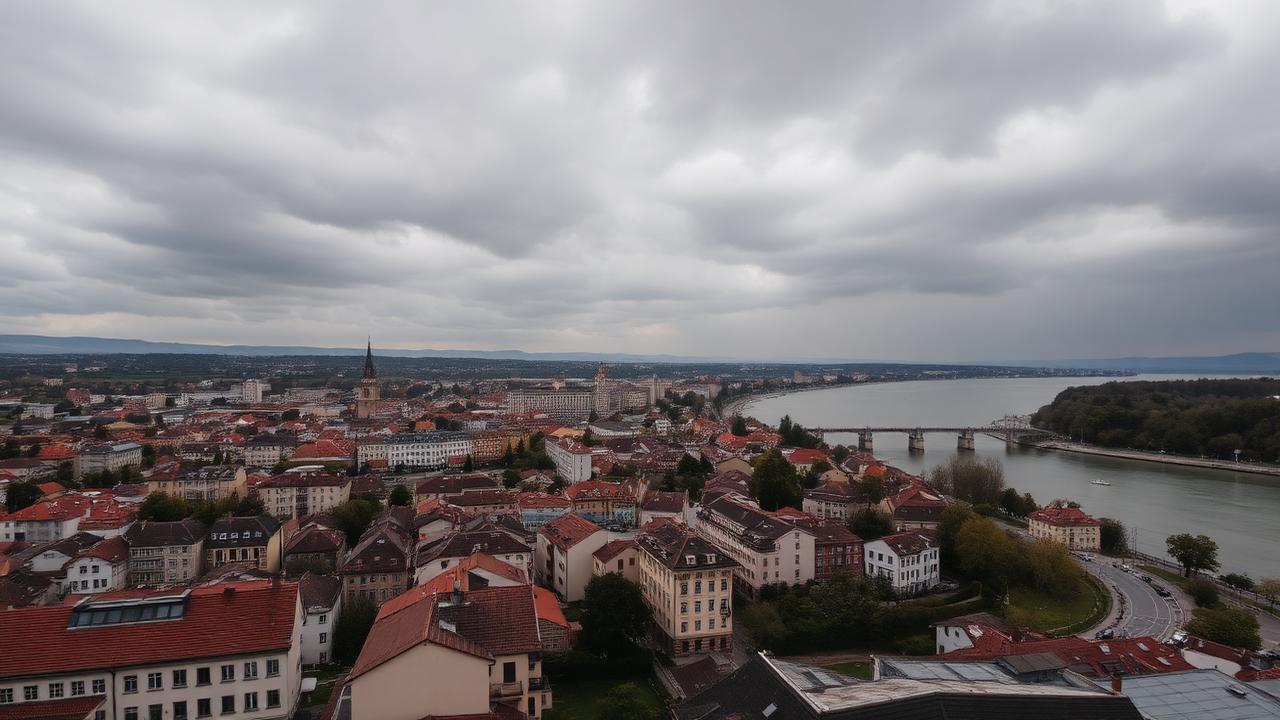
The city of Galați, a Romanian industrial port of 250,000 inhabitants at the confluence of the Danube, Prut, and Siret rivers, did not expect to become yet another overwhelmed border of the war in Ukraine. Yet, this is what happened on the night of Thursday, May 28 to Friday, May 29, 2026, when a Russian drone crashed into the facade of a residential building, injuring two people. The incident, the most serious since the beginning of repeated cross-border incursions into Romanian territory, occurs as Bucharest has immediately approached NATO to request the strengthening of its anti-drone capabilities.
A strike on the sidelines of a massive offensive on Ukraine
The drone that hit Galați was part of a night of intense Russian bombings on neighboring Ukrainian territory, with dozens of Shahed drones and missiles launched towards the Danube ports. According to the Romanian army, cited notably by BFMTV, 'there was no realistic possibility of safely intercepting' the aircraft that crossed the border. General Gheorghe Maxim, cited by the Romanian media, spoke of a lack of time and technical conditions 'not met' for interception, raising questions about the country's air defense doctrine.
Romania asks NATO for 'additional means'
In an official statement relayed by Euractiv, Romanian President Nicușor Dan indicated that Romania is formally asking NATO 'to deploy additional means for combating drones to strengthen our defense and that of the Alliance's eastern flank'. NATO spokesperson Allison Hart condemned 'Russia's irresponsibility' on X and confirmed that Secretary General Mark Rutte was in direct contact with Bucharest. Rutte reiterated, according to Euronews, that the Alliance was ready to defend 'every inch of allied territory'.
Von der Leyen speaks of 'a new line crossed'
European Commission President Ursula von der Leyen was even more direct, speaking of 'a new line crossed' by Moscow and announcing a new package of European sanctions against Russia. Bucharest, through its Minister of Defence Radu Miruta, denounced 'a grave and irresponsible escalation'. For his part, Vladimir Putin remained true to his line of strategic ambiguity: he asserted that 'no one can say' what the origin of the drone that fell on Romanian soil was - a stance already adopted during similar incidents in 2024 and 2025, aimed at avoiding any invocation of Article 5 of the NATO treaty.
A structural vulnerability on the Eastern Flank
Romania, which shares a long border with Ukraine along the Danube, and whose city of Galați is only about twenty kilometers from the areas bombed along the river, is structurally exposed to these spillover effects. Bucharest has strengthened its air defense since 2022, notably with the acquisition of Patriot systems, but military experts acknowledge that the saturation of Ukrainian defenses during major offensives creates unavoidable windows of vulnerability for neighboring countries. Several incidents involving drones or debris had already occurred on Romanian soil in 2023, 2024, and late 2025 - without direct military consequences.
The doctrinal issue: how far can Moscow go?
The real question posed by Galați is that of the allied response doctrine. Each incident has so far been classified as an 'accident' or 'irresponsible provocation,' never an attack triggering Article 5. But with repetition, this line is beginning to show its political limits. Warsaw and the Baltic capitals are calling for a firmer response. Poland, in parallel, is set to sign a defense treaty with the United Kingdom this week, following the Nancy treaty with France. A European rearmament dynamic is emerging, in direct response to the persistence of Russian aggression.
Editorial Opinion
The Galați incident is not an ordinary war accident: it is a test of Western resolve, calibrated in its ambiguity. Moscow perfectly masters the rhetoric of 'no one knows' to maintain maximum pressure without triggering retaliation. The real danger is not military - two light injuries are tragic but limited; it is political: each incident without a firm response pushes the red line of the unacceptable a little further. Europe, finally rearming through the Franco-Polish and British-Polish treaties, must also adopt a coherent doctrine in the face of this hybrid war that is now playing out on its own soil. As long as it does not do so, Moscow will continue to test its borders.
Key Takeaways
- A Russian drone struck a residential building in Galați, Romania (NATO member), causing 2 light injuries on May 29, 2026.
- The incident occurred during a vast Russian drone and missile offensive on Ukraine.
- Romanian President Nicușor Dan requested additional anti-drone capabilities from NATO.
- NATO (Mark Rutte) and the EU (Ursula von der Leyen) unanimously condemn; a new package of European sanctions announced.
- The Romanian army acknowledges that no 'realistic and safe' interception was possible due to lack of time.
- Putin denies the origin of the drone, avoiding any invocation of Article 5.