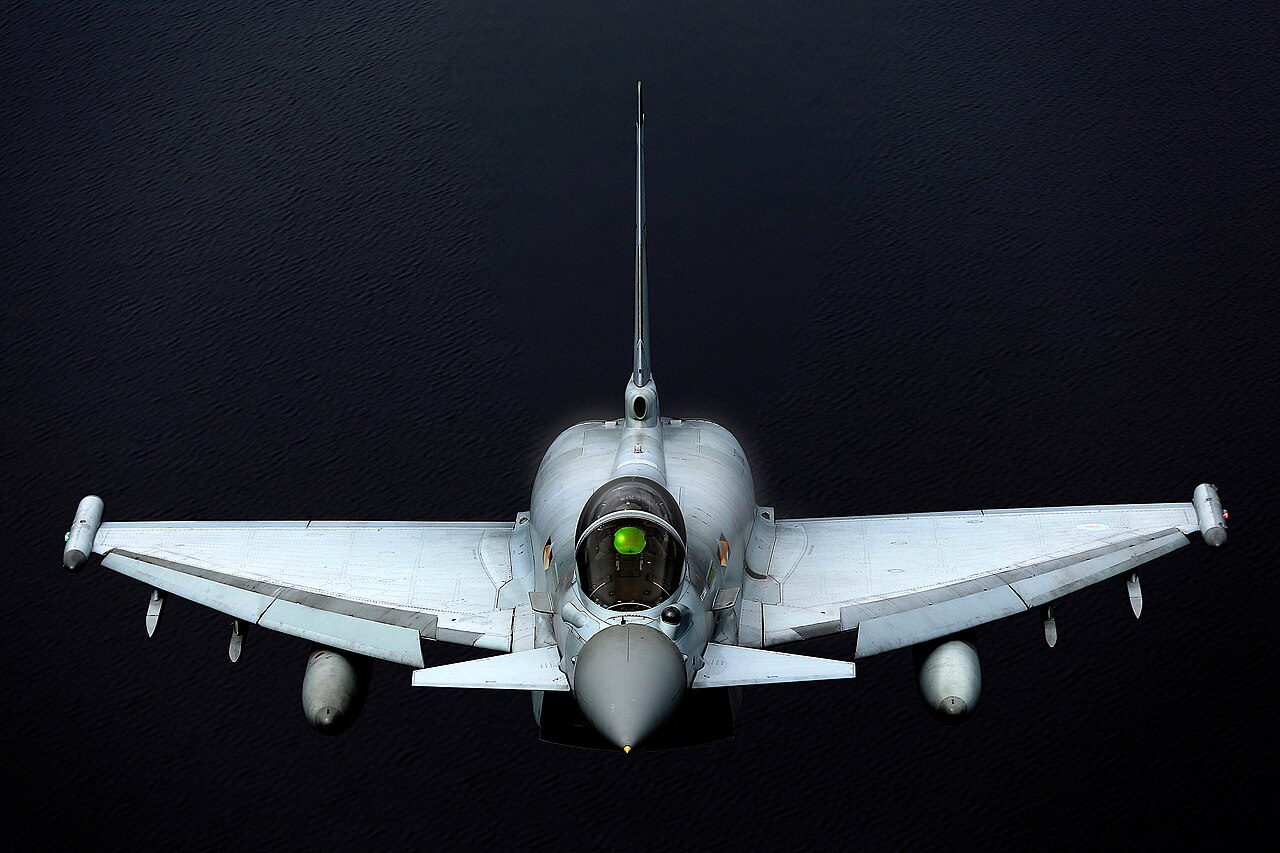
It was around 2:40 a.m. on Saturday, April 25, 2026, when Romanian air defense radars detected a wave of Russian drones approaching the border. The aircraft, Iranian-designed Shahed-136s manufactured under license at the Alabuga factory (Tatarstan), were targeting Ukrainian ports on the Chilia branch, particularly Izmail and Reni—two vital hubs for grain exports. Two Royal Air Force Eurofighter Typhoon FGR4s, on permanent alert at the Romanian base of Borcea as part of NATO's enhanced Air Policing mission, were scrambled in less than eight minutes. A few moments later, the British pilots destroyed two drones over Ukrainian territory—a historic first for an Atlantic Alliance aircraft.
An Operational Threshold Crossed
Since the start of the war in February 2022, NATO had always taken care to confine its interceptions to its own airspace. Poland had thus shot down about twenty Russian drones that had penetrated its border in September 2025, but without ever crossing the Ukrainian line. This time, according to the British Ministry of Defence, the engagement took place "over Ukrainian territory, at the explicit request of Kyiv and on the basis of Article 51 of the United Nations Charter"—in other words, as part of defensive assistance requested by a sovereign state under attack. The legal nuance is significant: London does not claim to have "fought Russia," but to have "protected a partner."
The Massive Attack on the Danube Ports
During the night, Russian aviation fired 87 missiles and drones, according to the toll released on Sunday by Ukrainian air defense, of which 71 were intercepted. The Danube ports bore the brunt of the attack. In Reni, fires affected a grain terminal, with no casualties. In Izmail, a sunflower oil refinery was partially destroyed. On the Romanian bank, in Galati, the Ministry of Defence confirmed that fragments of a downed drone had been recovered about 800 meters from homes. It was this proximity to allied territory that triggered the British scramble: NATO doctrine now considers a threat directed towards the border area to justify a preventive interception upstream.
London's Reaction and Moscow's Silence
The British Prime Minister on Saturday morning praised the "professionalism and composure" of the RAF pilots, while emphasizing the "purely defensive" nature of the operation. Defense Secretary John Healey specified that "the United Kingdom is not seeking escalation, but will not tolerate armed drones threatening its allies and partners." In Brussels, NATO Secretary General Mark Rutte spoke of a "proportionate response in accordance with international law." On the Russian side, silence was total until midday. The Kremlin published only a brief statement on the night strikes, without mentioning the British engagement. This restraint is reminiscent of Vladimir Putin's strategy after the Polish incident in September 2025: refusing to overcomment so as not to validate the event.
Towards a New Allied Interception Doctrine?
The incident could mark a turning point. Several European allies—France, Germany, the Netherlands—have been calling for months for an "interception bubble" covering western Ukraine, particularly Lviv Oblast and the Danube corridor. Paris has already discreetly deployed Rafales in Romania at the Mihail Kogălniceanu base; Berlin has sent six Eurofighters to Poland. If the British operation on April 25 does not trigger Russian reprisals, it could become the informal precedent for a new phase of the conflict, where NATO actively protects Ukrainian skies without deploying ground forces. For Kyiv, this would be a major relief: Volodymyr Zelensky thanked "the courage of the United Kingdom on Saturday, which proves that Europe is defending Europe."
Editorial Viewpoint
The engagement on April 25 is undoubtedly the most symbolically charged military event since the start of the Russian invasion. For the first time, an allied combat aircraft destroyed a Russian vector over Ukrainian soil—and it did so without triggering immediate escalation, which is a strategic factor in itself. Three interpretations are possible. First interpretation: London tested a threshold that it knew Moscow was incapable of confronting directly, due to lack of means. Second interpretation: it is a concerted decision in Brussels, anticipating the gradual withdrawal of the United States from the Ukrainian dossier and organizing a silent "Europeanization" of Kyiv's air defense. Third, more worrying interpretation: it is the beginning of a logic where every Russian attack will be intercepted by NATO over Ukraine, until a serious incident—a downed Typhoon, a Russian missile hitting allied soil—pushes the conflict into a new dimension. The three hypotheses are not mutually exclusive. What is certain is that NATO's strategic caution, which had prevailed since February 2022, has just given way a decisive notch.
To Remember
- Night of April 24-25, 2026: two Eurofighter Typhoon FGR4s launched from Borcea (Romania).
- Two Russian Shahed-136 drones shot down over Ukrainian territory— a NATO first.
- Massive Russian attack on Danube ports: 87 vectors fired, 71 intercepted.
- British justification: Article 51 of the UN Charter, at Kyiv's request.
- Prolonged silence from Moscow; no immediate Russian retaliation.