
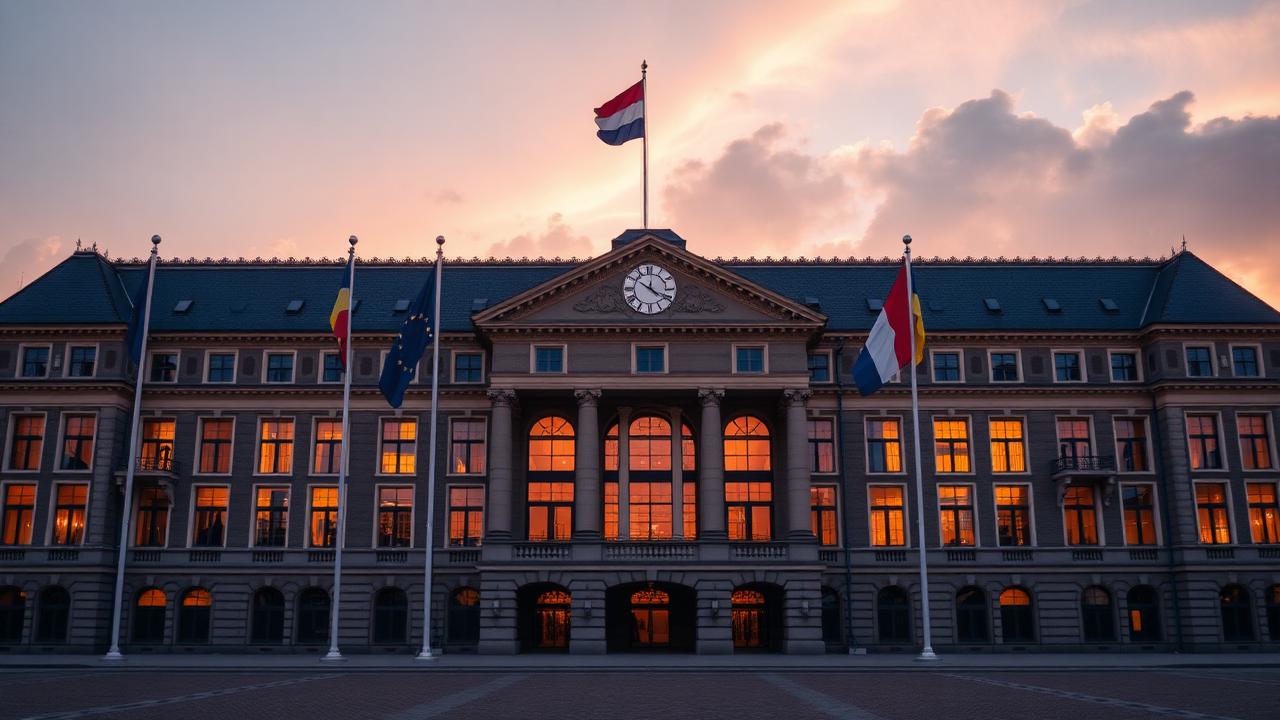
The Netherlands became the first euro zone member state on Monday, April 20, 2026, to present a quantified support plan to cushion the rise in energy prices caused by the closure of the Strait of Hormuz. Dick Schoof's cabinet announced the release of €950 million — €627 million in direct aid and €340 million in tax relief — to support households, motorists, fishermen, and farmers. The information was confirmed on Monday morning by Le Monde, in an article republished by Yahoo Actualités, and detailed by the ANP agency via Zeelandnet.
€627 million in targeted direct aid
The bulk of the Dutch plan consists of €627 million in direct aid. The most modest households will receive, according to the terms specified by ANP, a compensatory energy check whose amount will vary based on household composition. Fishermen, particularly exposed to the surge in maritime diesel prices, will benefit from a sector-specific envelope estimated at €80 million, while farmers will see their agricultural fuel costs partially reimbursed. A specific measure is also planned for road hauliers, a sector severely hit by the price of reference Rotterdam diesel exceeding €1.90/liter last week.
€340 million in targeted fuel tax cuts
The second component — €340 million — consists of a temporary reduction in excise duties on diesel and gasoline, extending a mechanism already in place since late 2022. According to ANP, the loss of revenue will be offset by a parallel increase in other levies, notably excise duties on alcohol, in a logic of budget reallocation at no net cost to the public deficit. This linkage is crucial: the Netherlands, which historically has a very contained deficit, refuses to worsen its budget trajectory even as the European Commission reviews the 2026-2030 trajectory this year within the framework of the new Stability and Growth Pact.
A swift response to an ongoing shock
Business AM recalled as early as April 15 that an initial plan of approximately €1 billion had been prepared by The Hague in response to the Israeli-Iranian conflict, with the political agreement reached within the Schoof coalition — a minority but occasionally supported by Geert Wilders' PVV. The rise in oil prices since the end of March, exacerbated by the closures of the Strait of Hormuz on April 14 and 18, caused the Brent crude price to jump from $65 to over $95 a barrel in less than three weeks. For an economy as open as the Netherlands, whose port of Rotterdam is the main European energy hub, the shock is cascading through all sectors.
Brussels is watching: who will follow?
The European Commission and the European Central Bank are closely monitoring the initiative. According to Le Monde, several member states — Italy, Spain, Belgium — are studying comparable measures, but none have yet quantified their intervention. The French Minister of the Economy, whose office recalled last week to BFMTV that the Middle East war had already cost the French state €4 billion, has not yet made a decision. The Dutch precedent could serve as a template, particularly on the direct aid/excise tax cut ratio (66/34) and the principle of budgetary neutrality. In Brussels, the issue is also political: allowing each state to react alone fragments the internal energy market.
Editorial opinion
The Netherlands has just laid the first cornerstone of a European response to the energy crisis caused by Hormuz. The calibration is intelligent: targeting those most exposed, no increase in the deficit, extension of proven mechanisms. But The Hague alone can do nothing: if each capital invents its own plan, fragmentation will loom as in 2022, with its attendant discriminatory aid and competitive distortions. The Danish presidency of the Union should quickly put a common framework on the Council's agenda, based on three pillars: joint oil purchases, a European cap on wholesale prices, and an intervention fund financed by exceptional revenues. Without this, the Twenty-Seven will pay twice: at the pump, and in political cohesion.
Key takeaways
- The Netherlands is releasing €950 million to offset the oil price increase.
- €627 million in direct aid (households, fishermen, farmers, hauliers) and €340 million in fuel excise tax cuts.
- Plan with no net cost to the public deficit, financed by increasing other levies (alcohol excise duties).
- Brent crude rose from $65 to $95/barrel in less than three weeks since the closure of Hormuz.
- Italy, Spain, and Belgium are studying comparable plans; France has not decided.