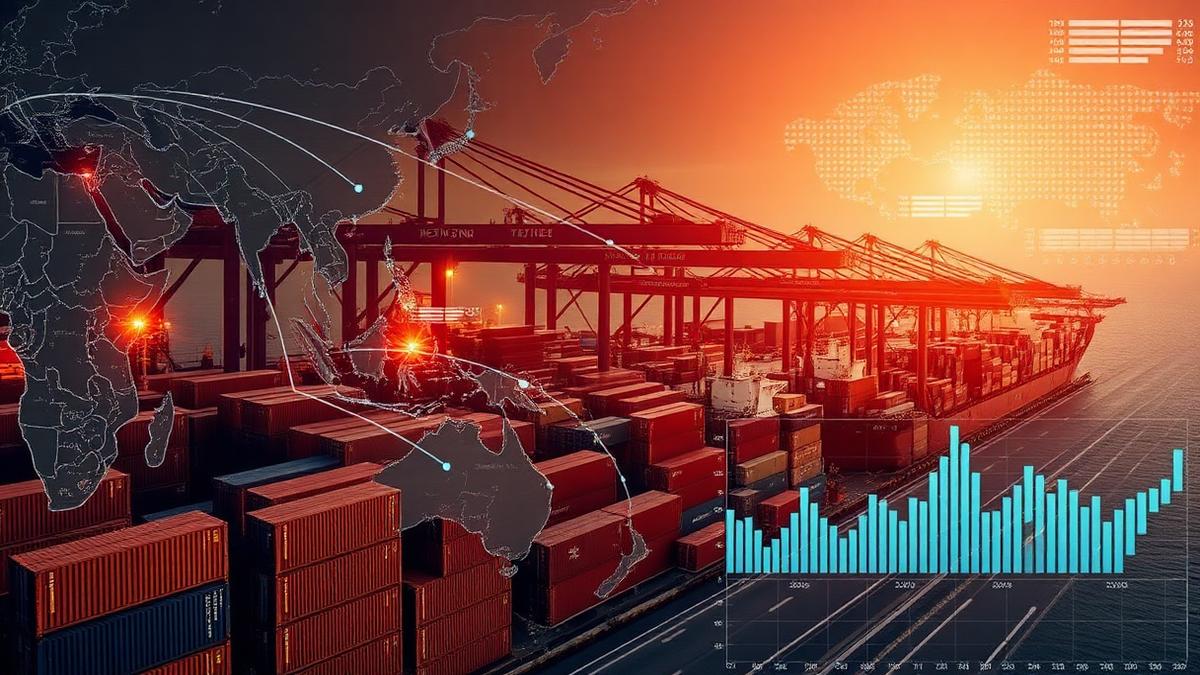
The report “Geopolitics and the Geometry of Global Trade: 2026 Update,” published by the McKinsey Global Institute on March 19, 2026, should be a wake-up call for anyone who thought trade wars would reduce global exchanges. The opposite has happened. In 2025, US imports and Chinese exports reached historic levels. Global trade has not receded — it has reconfigured. And this reconfiguration has clearly identified winners and losers.
The winners are the countries of Southeast Asia — Vietnam, Indonesia, Malaysia, Thailand — which have positioned themselves as pivots in the new global trade architecture. When Washington imposes 60% tariffs on Chinese imports, production doesn't disappear: it shifts. Chinese factories open subsidiaries in Vietnam, components transit through Malaysia, and final assembly arrives in the United States with a certificate of origin that circumvents the barriers. McKinsey documents this phenomenon under the name of “connector economies” — economies that prosper precisely because they are located between blocs, without fully belonging to either.
The structural loser is Europe. The McKinsey report states it with the coldness of numbers: Europe's share in global goods trade continues to decline. Germany, the continent's industrial engine, is suffering a triple fracture: cheap Russian energy no longer exists, the Chinese market is progressively closing to European exports, and American security protection comes at an ever-higher price in trade concessions. The German model — producing in Europe, selling in China, heating with Russian gas — is dead. And no replacement model has emerged. (
The other major takeaway from the report is the growing role of AI in the reconfiguration of value chains. Companies that integrate artificial intelligence into their logistics, inventory management, and customs compliance navigate the tariff chaos with an agility that others cannot match. AI does not eliminate tariffs — it allows them to be circumvented faster, to reorient flows more effectively, to optimize trade routes in real time. It is a self-reinforcing competitive advantage: the more a company uses AI to adapt, the more data it accumulates, making its future adaptation even better.
The fundamental lesson is uncomfortable but clear: protectionism does not reduce trade, it redirects it. Trump's tariffs did not bring factories back to America — they shifted production to countries that were not on the radar five years ago. European sanctions did not isolate Russia — they accelerated the Moscow-Beijing rapprochement and the emergence of alternative financial circuits. The world is not deglobalizing. It is re-globalizing around new axes, new corridors, new players. And those who refuse to see this reality — out of ideology, comfort, or inertia — will find themselves marginalized in a system they no longer understand.