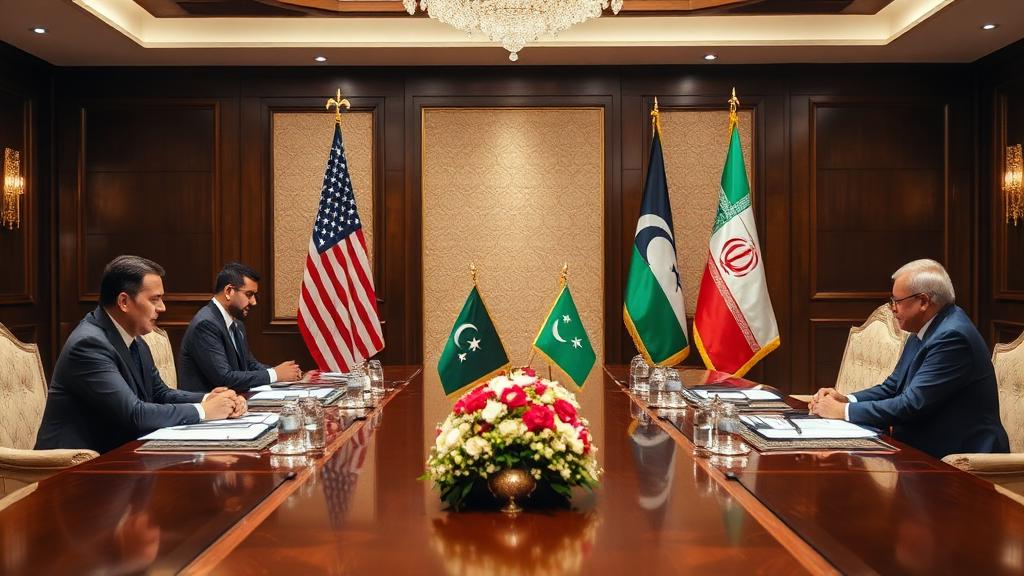
The world's eyes are on Islamabad this Saturday, April 11, 2026. Four days after the entry into force of a precarious ceasefire between the United States and Iran, delegations from both countries are meeting in the Pakistani capital for talks described by Reuters as "all or nothing" discussions. U.S. Vice President JD Vance, accompanied by Jared Kushner, leads the American delegation. On the Iranian side, the Minister of Foreign Affairs is heading the negotiations. Pakistan, the host country, plays a mediating role in a conflict that has disrupted the geopolitical balance of the Middle East.
The stakes are colossal. Washington demands the return of Iran's enriched uranium, the dismantling of its ballistic missile program, and the unconditional reopening of the Strait of Hormuz, a vital artery for global oil trade through which approximately 20% of the world's oil passes. Israel's Ambassador to France, Joshua Zarka, warned in an interview with L'Express: "If Iran does not return the uranium, the ceasefire will be very short." For his part, Donald Trump has threatened Iran with resuming bombing if the negotiations fail, adding further pressure to already extremely tense discussions.
The military context remains explosive. According to an exclusive CNN investigation published on April 10, U.S. intelligence has detected that China is preparing to deliver new air defense systems to Iran in the coming weeks – a move described as "provocative" by the Pentagon even as the ceasefire has just entered into force. Furthermore, according to the site 19FortyFive and satellite imagery analysis, five Chinese ships have already delivered sodium perchlorate – a key component of solid rocket fuel – to Iranian ports, fueling suspicions of active assistance from Beijing in rebuilding Iran's ballistic missile program.
The conflict has already caused considerable humanitarian and economic consequences. Lebanon suffered one of the deadliest days in its recent history on April 10, with Israeli strikes in the southern suburb of Beirut killing 13 members of the security forces, according to Le Télégramme. The price of oil remains above $100 a barrel, and inflation in the United States accelerated in March under the effect of the energy shock. The Associated Press notes that "the conflict has left the Middle East destabilized, alliances weakened, and the world facing uncertain changes in the balance of power."
Iran has agreed to negotiate for two weeks in Islamabad, according to France Info, and has announced the reopening of the Strait of Hormuz as a gesture of good faith. However, analysts remain cautious. Courrier international speaks of an atmosphere of "tension and uncertainty" on the eve of the talks. The international community holds its breath: failure could restart a military escalation with unpredictable consequences for the entire region and the global economy.