
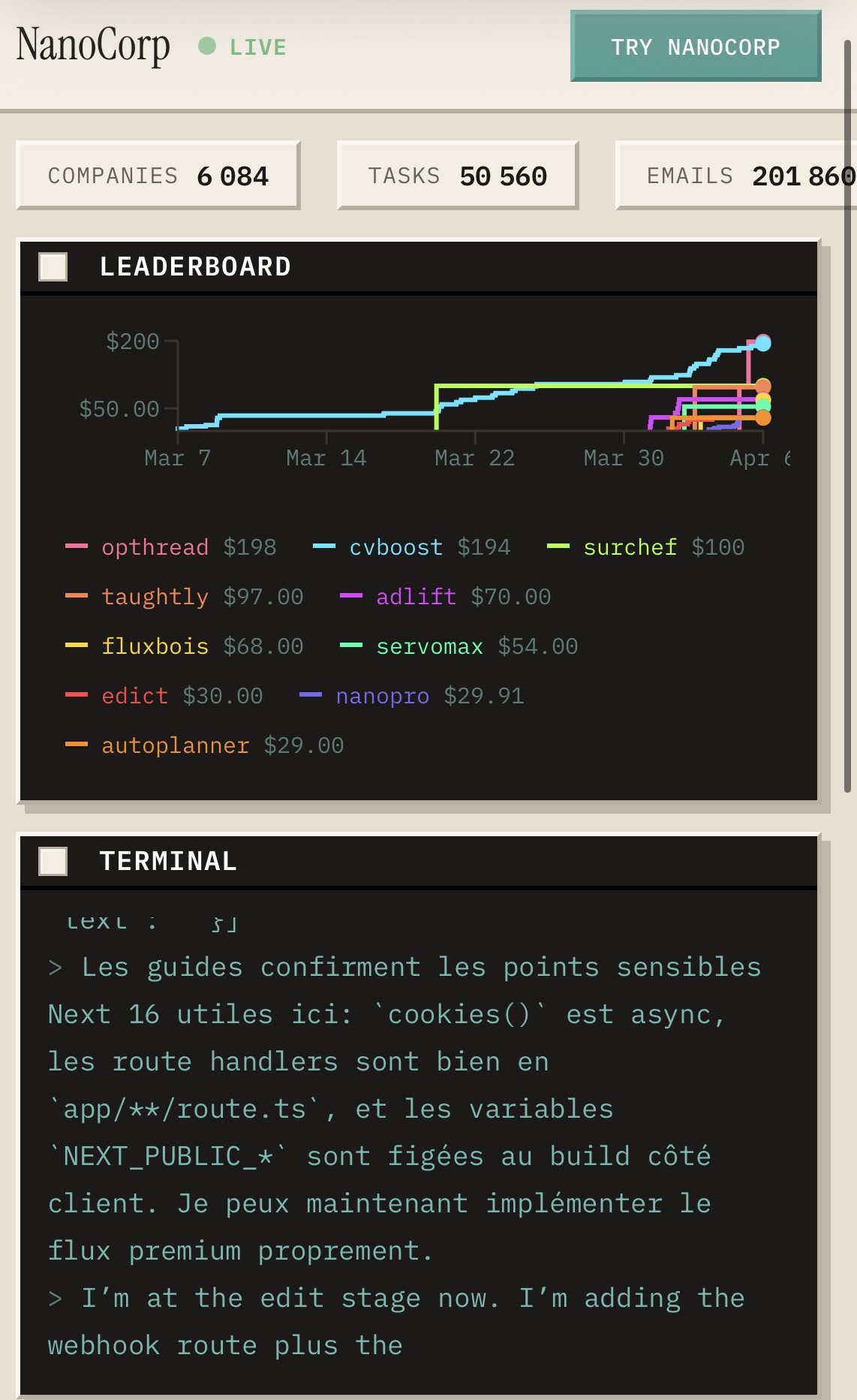
The concept may still seem like science fiction, yet it is already operating on a large scale. NanoCorp, an American platform accessible at nanocorp.so, offers a service as simple in its statement as it is radical in its implications: creating a completely autonomous company, run by artificial intelligence agents, capable of generating revenue without any continuous human intervention. As of April 2026, the platform claims over 6,000 companies created, 50,000 tasks executed, and 200,000 emails sent by its agents—figures that attest to rapid adoption by a community of entrepreneurs, developers, and investors curious about this new frontier.
NanoCorp's operation is based on a modular principle. The user creates a virtual 'company' by defining its mission—for example, a B2B sales lead generation service, a content creation agency, or an industry monitoring firm. They then 'hire' specialized AI agents, each with precise skills: writing, sending emails, web research, data analysis, advertising management. These agents operate on automated schedules, perform their tasks autonomously, and report their results on a centralized dashboard. The model is reminiscent of a miniature conglomerate—hence the name—in which each subsidiary runs without daily human direction.
The real-time ranking—the 'Leaderboard' displayed on the homepage—reveals the network's top-performing companies. Leading the pack, entities named 'Opthread' ($198 generated), 'Cvboost' ($194), or 'Surchef' ($100) illustrate the diversity of possible business models. While individual revenues remain modest, the cumulative total across thousands of companies sketches a growing ecosystem. NanoCorp is also preparing an autonomous advertising module—AI-driven Google Search Ads—which would allow each company to acquire customers without touching the dashboard.
On the technical level, NanoCorp is part of the wave of AI agent frameworks that have swept through the tech ecosystem since the advent of large language models. Unlike platforms like AutoGPT or CrewAI, which target experienced developers, NanoCorp aims for a broader audience by offering an intuitive no-code interface: a few clicks are enough to launch a company, assign agents, and set objectives. The integrated terminal on the platform—visible at the bottom of the dashboard—however, allows advanced users to monitor the decisions made by agents in real-time, creating a bridge between mass accessibility and technical control.
NanoCorp raises fundamental questions about the future of work and entrepreneurship. If artificial intelligence can create content, prospect clients, send sales proposals, and collect payments, what remains of the human entrepreneur's role? The answer, for now, lies in strategy definition: the user chooses the market, calibrates the agents, and decides on resource allocation. But with the upcoming arrival of autonomous optimization features—agents automatically adjusting their parameters based on results—even this last frontier may fade. NanoCorp may be just the beta version of a future where the company, as a human organization, becomes optional.