For a long time, we talked about oil. We are only just beginning to understand that for the next two decades, we will need to talk about lithium, cobalt, nickel, rare earths, and graphite. The energy transition — electric vehicles, stationary batteries, wind, solar, new-generation nuclear — relies on a few families of minerals whose production and, even more so, refining are concentrated in a very limited number of countries.
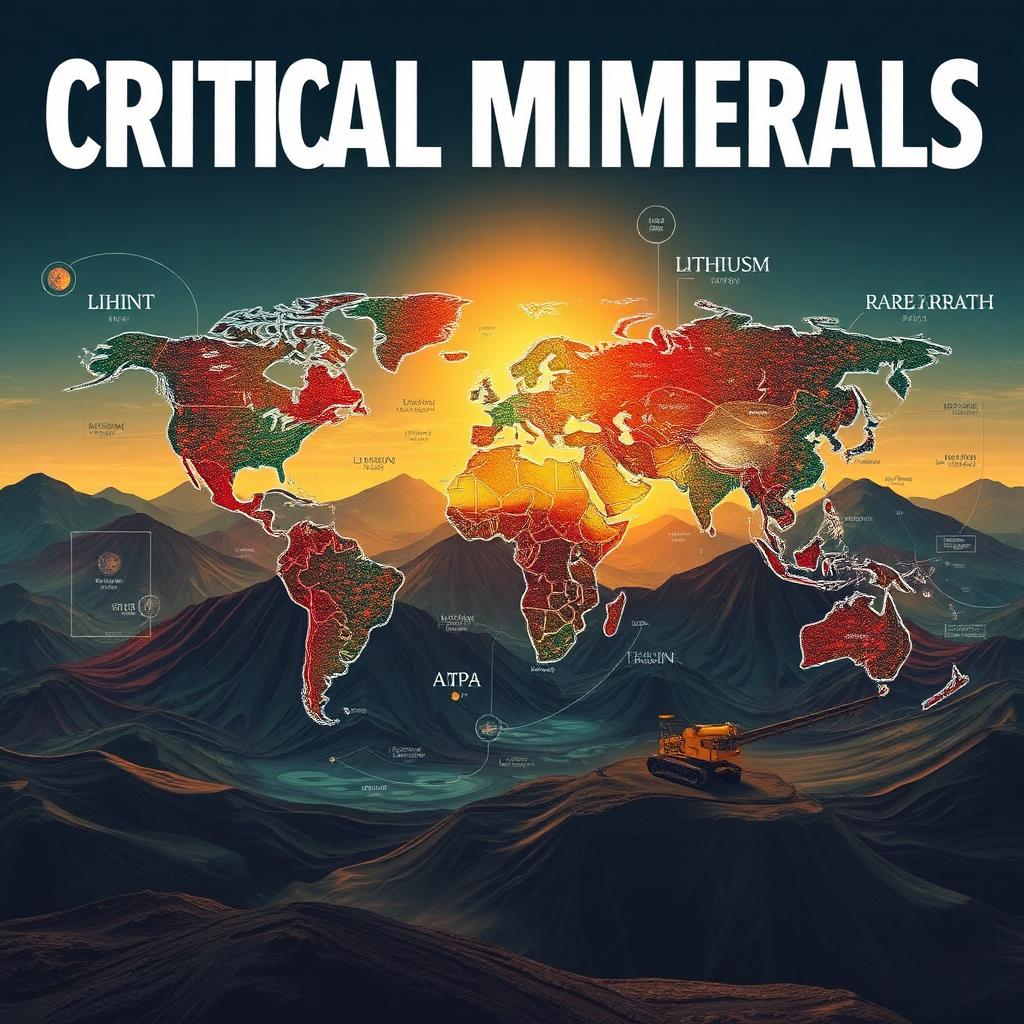
The World Map of Strategic Materials
The Democratic Republic of Congo produces about 70% of the world's cobalt. Indonesia doubled its market share of nickel in five years to exceed 55%. Australia and Chile share most of the lithium extraction, but it is China that dominates its refining (over 60%). For rare earths, China still accounts for 70% of mining production and 90% of global refining, despite efforts by the United States (Mountain Pass) and Australia (Lynas).
This geography creates unprecedented dependencies. The European Union remains dependent on over 95% for rare earths, 86% for refined lithium, and 63% for refined cobalt, primarily vis-à-vis China. These orders of magnitude, published by the European Commission in its April 2026 report on the state of the *Critical Raw Materials Act* (CRMA), motivate the mineral autonomy strategy launched in 2023 and accelerated since then.
Key Figures for Critical Metals 2026
- 70%: DRC's share in global cobalt production.
- 55%: Indonesia's share in global nickel production.
- 60%: China's share in global lithium refining.
- 90%: China's share in global rare earth refining.
- 34: number of raw materials classified as 'critical' by the EU in 2025 (up from 27 in 2020).
- 10%: target for extraction on European soil by 2030 (CRMA).
- 40%: target for processing on European soil.
- 25%: target for internal recycling.
The European CRMA: A Compass, Not a Magic Wand
The *Critical Raw Materials Act*, which entered into force in May 2024, sets three goals for 2030: 10% extraction, 40% processing, and 25% recycling of strategic materials on European soil. More importantly, it establishes a mechanism for strategic projects: accelerated selection, priority EIB financing, and regulated procedural derogations (mining permits, impact studies).
Around forty strategic projects have been designated since 2024: Eramet (lithium in France), KGHM (copper/cobalt in Poland), Vulcan Energy (geothermal lithium in Germany), Talga (graphite in Sweden), Mineracao Norte Mineira (rare earths in Portugal via EU-Brazil consortium). However, several of these projects face the same obstacles: local opposition, environmental litigation, and difficulty attracting private capital for 10-15 year mining cycles.
The New Southern Routes
Europe will not be able to achieve its objectives without strategic partnerships. In 2024-2025, the Commission signed agreements with Serbia (lithium), Chile (lithium, copper), Argentina (lithium), Zambia and the DRC (cobalt, copper), Kazakhstan (rare earths), and Greenland (rare earths, graphite). These partnerships are as much economic as they are diplomatic: they aim to offer producing countries a credible alternative to Chinese investments, whose footprint has become dominant in sub-Saharan Africa and Latin America.
The American strategy, via the Minerals Security Partnership launched in 2022 with a dozen partners (EU, Japan, South Korea, UK, Canada, Australia), pursues the same logic. The competition between Washington, Brussels, and Beijing to secure supply chains is now open, structuring, and likely irreversible.
> “Whoever masters refining masters the chain. Today, for rare earths, that's China. And it will take us at least ten years to catch up.” — *Christel Bories, CEO of Eramet, French Senate hearing, March 2026.*
To Remember
- The EU remains 95% dependent for rare earths and 86% for refined lithium.
- The CRMA sets 2030 targets: 10% extraction, 40% processing, 25% recycling.
- Around forty strategic projects designated since 2024.
- China dominates refining: 60% for lithium, 90% for rare earths.
- EU-Chile, EU-Serbia, EU-DRC partnerships: mining diplomacy is structuring the 2026-2030 years.
- Mining industry lead times (10-15 years) require decisions now to deliver in 2035.