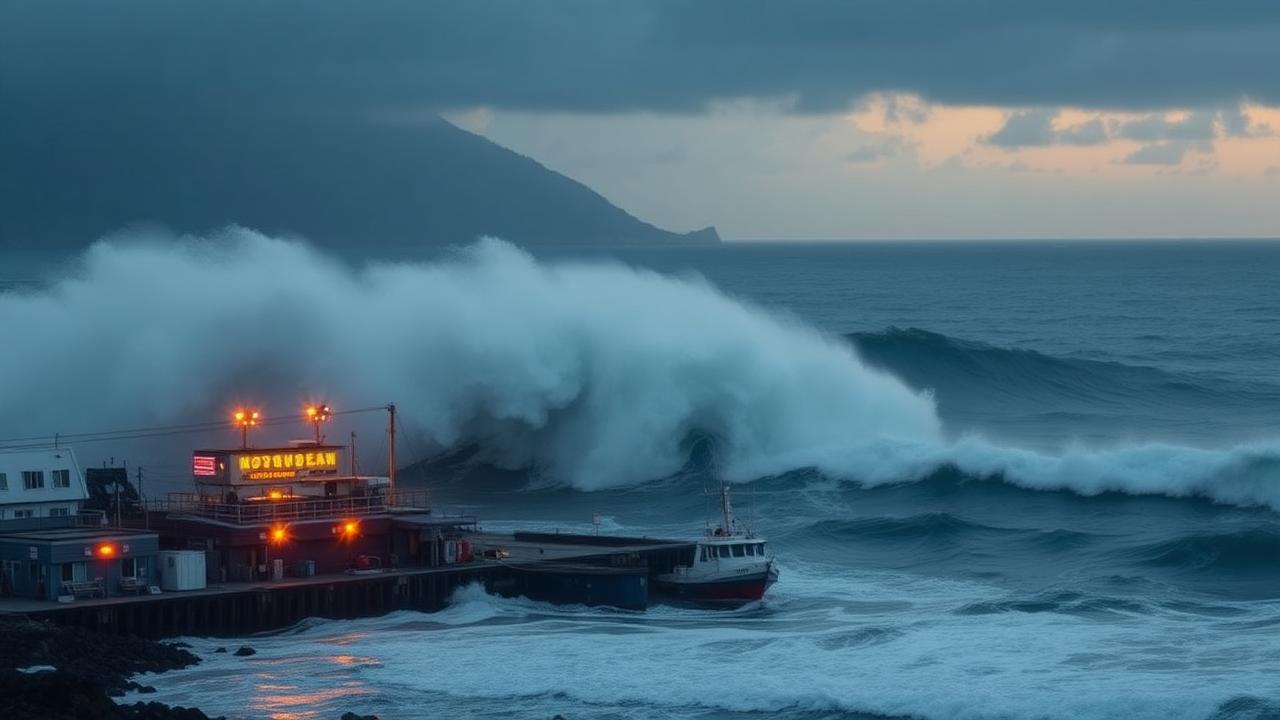
The Japanese archipelago woke up on Monday, April 20, 2026, to a rare violent tremor. An earthquake estimated between 7.4 and 7.7 according to initial measurements, with a definitive magnitude set at 7.7 by the Japan Meteorological Agency (JMA) and later reported by Mediapart, Associated Press, and La Voix de l'Est, struck the waters off the northeastern coast, near the Iwate prefecture, early in the morning. The tremor immediately triggered a tsunami advisory for the coasts of Tohoku and Hokkaido, with waves anticipated to reach up to three meters, according to a bulletin released by Presse-citron based on JMA data.
Tremor Felt as Far as Tokyo
The shallow tremor was felt as far as the megacity of Tokyo, over 600 kilometers from the epicenter, according to Mediapart. No casualty figures were available by mid-afternoon, but public broadcasters NHK and TBS, cited by AFP, reported massive evacuations in the coastal areas of Iwate, Miyagi, and Aomori. Power outages were recorded in over 20,000 households, while Shinkansen rail links to the north were suspended as a precaution. The first images broadcast by Japanese channels showed waves already reaching 1.5 meters in the port of Kuji at 1:10 PM local time.
JMA Issues "Major" Seismic Alert
This is the most worrying element of the sequence. Following the initial tremor, the JMA issued a "Major Earthquake" warning (Megathrust Earthquake Advisory) for the north of the country in the Japanese evening, indicating that the probability of a major aftershock had significantly increased for the next seven days. According to Mediapart and Le Monde, citing the JMA's statement, this highest-level alert had only been triggered once before, in August 2024, after a magnitude 7.1 earthquake in the south of the archipelago. Residents in the affected prefectures are advised to keep an evacuation bag readily accessible and to avoid the coastline.
Nuclear Power Plant Under Surveillance
The Onagawa nuclear power plant, operated by Tohoku Electric and located on the frontline of Miyagi's coast, has been placed under enhanced surveillance, but no incidents have been reported, according to a statement from the Japanese Nuclear Regulation Authority released in the early afternoon and relayed by Reuters. The reactors, including unit 2 which had just restarted in March 2026, were automatically put into reduced operating mode. At Fukushima Daiichi, ongoing dismantling work was temporarily suspended, and workers were evacuated from low-lying areas. Tepco confirmed that the spent fuel pools remained stable.
Memories of 2011 and 2024 Revived
The memory of the March 11, 2011, disaster—magnitude 9.1, nearly 19,000 deaths, Fukushima accident—remains obviously in everyone's mind. However, the JMA emphasizes that the magnitude 7.7 recorded on Monday is still significantly lower than that of the Great Tohoku Earthquake, and that the associated tsunami, while serious, is not expected to reach the cataclysmic heights of fifteen years ago. The Japanese Prime Minister convened an emergency crisis meeting at the Kantei within an hour of the tremor and called on X for "all residents of evacuated areas to strictly follow the instructions of local authorities."
Editorial Opinion
Japan, better prepared than any other country in the world for seismic risks, has once again demonstrated the effectiveness of its early warning system: the population was alerted by phone, television, and public loudspeakers within seconds of the fault rupture. This is a model that Europe, and particularly France, would do well to emulate in exposed regions like the Antilles or the Mediterranean coast. The sword of Damocles of a "major" earthquake alert remains: an aftershock of magnitude greater than 8 in the next seven days is no longer a theoretical scenario. The world's eyes will remain on Tohoku throughout the week.
Key Takeaways
- Magnitude 7.7 earthquake off the coast of Iwate (Tohoku) on Monday, April 20, 2026.
- Tsunami alert issued by the JMA, waves expected up to 3 meters.
- "Major" earthquake alert triggered for the next seven days.
- Onagawa power plant under enhanced surveillance, no nuclear incidents.
- Evacuation of coastal areas of Iwate, Miyagi, and Aomori; North Shinkansen suspended.