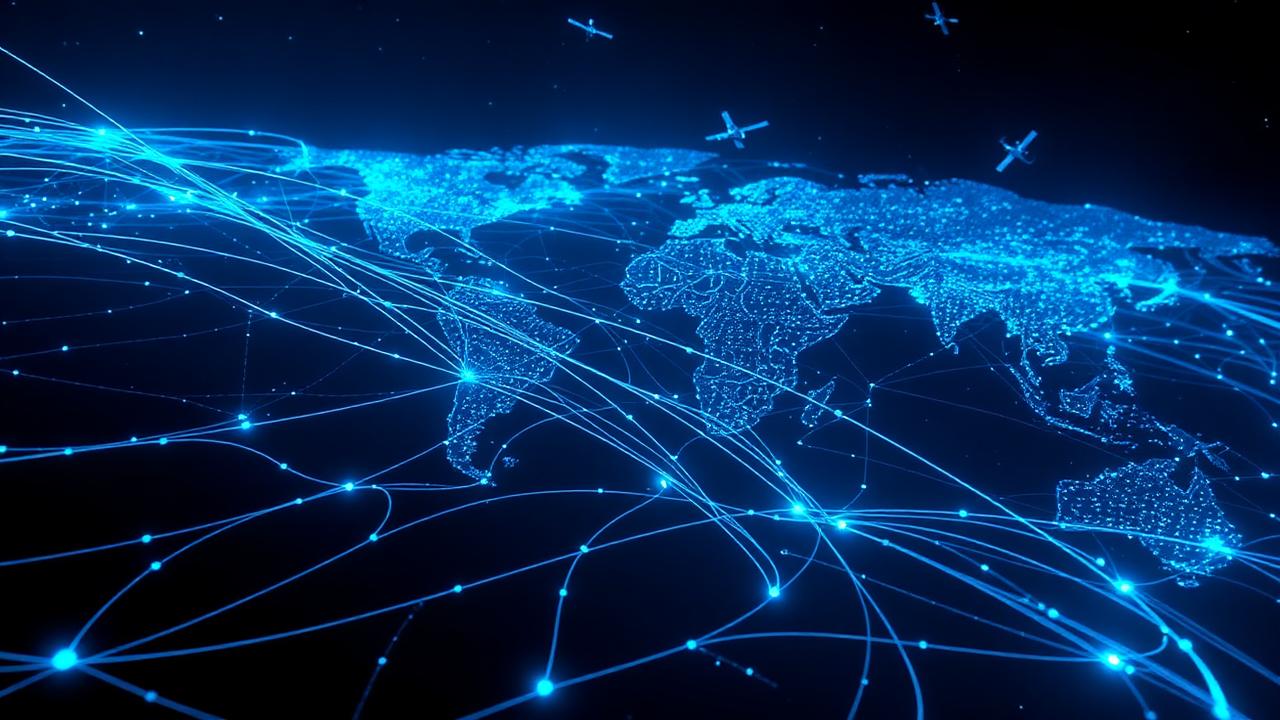
Beneath the ocean's surface, a silent war is raging for control of global Internet infrastructure. By 2026, 97% of intercontinental data traffic will transit through 552 submarine cables totaling 1.4 million kilometers—35 times the Earth's circumference. Google has invested $4.2 billion in its own cables since 2020, including 'Firmina' connecting the United States to Brazil and 'Apricot' crossing the Pacific. Meta, Amazon, and Microsoft have followed suit, with the GAFAM companies now directly or indirectly owning 72% of transatlantic submarine capacity.
Starlink, SpaceX's satellite constellation, surpassed the 8,000 operational low-Earth orbit satellites milestone in March 2026, covering 98% of the Earth's surface. With 6 million subscribers and an estimated revenue of $11 billion, Starlink has become an indispensable—and controversial—player in global connectivity. In Ukraine, the network has been dubbed the 'digital backbone' of the war effort. In Iran, opponents of the regime use it to bypass censorship. However, dependence on a private American company for critical infrastructure raises sovereignty issues that many governments prefer to ignore.
China has retaliated with the 'SkyNet-2030' program, a constellation of 13,000 low-Earth orbit satellites operated by China Satellite Communications. Concurrently, the 'Peace Cable' consortium—funded by Hengtong Group and Huawei Marine—has laid 16,000 kilometers of cable between China, Pakistan, East Africa, and France, offering an alternative to routes controlled by American operators. The European Union, aware of its dependence, has launched the IRIS² program: a sovereign constellation of 170 satellites planned for 2028, but whose €6 billion funding remains uncertain.
Incidents are multiplying and revealing the system's vulnerability. In January 2026, the simultaneous rupture of two submarine cables in the Red Sea—attributed to Yemen's Houthis—reduced Internet capacity between Europe and Asia by 25% for eleven days. In February, a cable connecting Taiwan to the Philippines was severed under suspicious circumstances, causing a 40% drop in data rates in the region. NATO navies have increased their surveillance, but the 552 global cables, often laid at shallow depths in international waters, remain practically indefensible.
The stakes go beyond technology; they are fundamentally geopolitical. Whoever controls Internet infrastructure controls the flow of information, commerce, and intelligence. The United States still dominates thanks to its lead in cables and satellites, but China is catching up at an alarming rate. Europe, true to form, is regulating more than it is building. And the Global South—which represents 60% of Internet users but owns only 8% of the infrastructure—remains dependent on decisions made in Washington, Beijing, or Brussels. Digital sovereignty is not an abstract concept: it is the new battleground for great power rivalry.