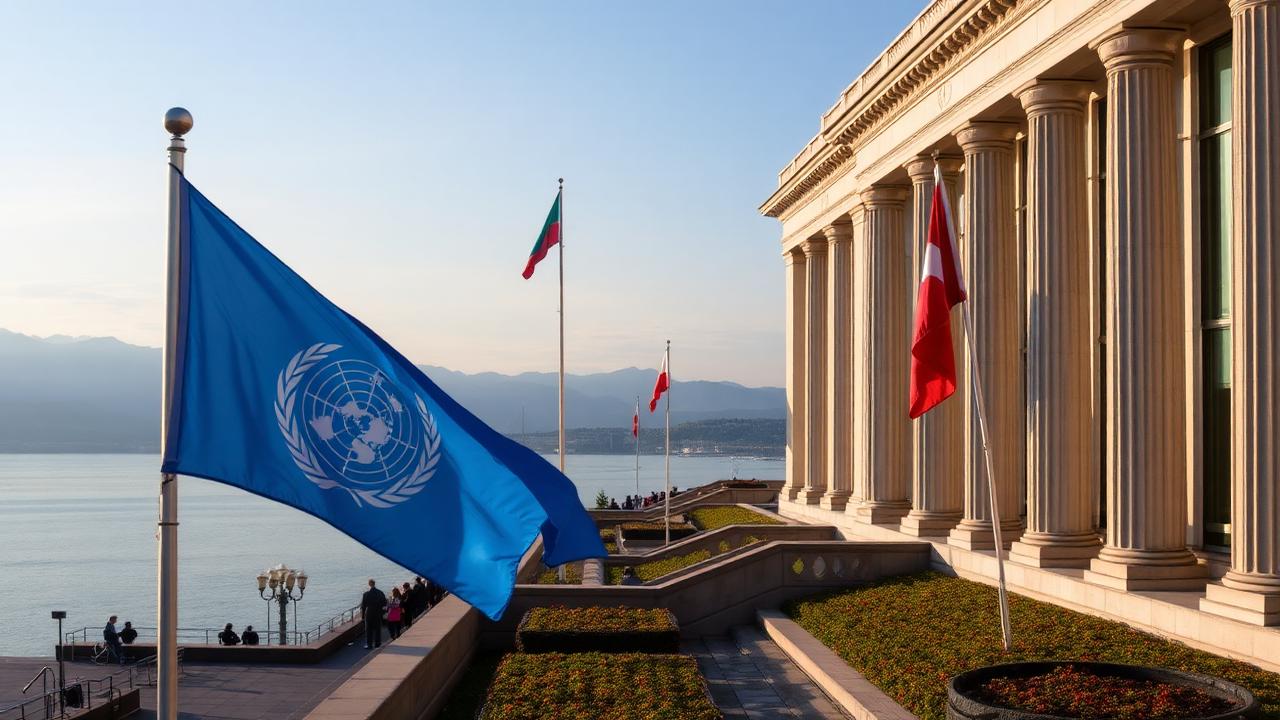
Without prior official announcement, without an opening ceremony for the press, but under discreetly reinforced guard by cantonal and federal police: Room XII of the Palais des Nations in Geneva hosted a meeting on Friday, June 5, 2026, that none of the participants wished to announce in advance. Around the table were representatives of the Islamic Republic of Iran, the three European nations of the E3 format (France, United Kingdom, Germany), a special envoy dispatched by the US State Department, and—a rare detail—an observer from the International Atomic Energy Agency (IAEA).
Why Geneva, Not Vienna
The choice of Geneva is not trivial. Vienna, the traditional venue for negotiations on Iran's nuclear program since 2013, has become politically difficult since the 2018 rupture and even more so since the Israeli strikes on South Pars facilities in April 2026. Switzerland, which has represented US interests in Tehran since 1980 as a protecting power, possesses unique diplomatic capital: no other Western country maintains such a continuous channel with the Islamic Republic.
The Swiss federal authorities, through the voice of the Head of the Federal Department of Foreign Affairs, Ignazio Cassis, confirmed their role as a "logistical facilitator" without committing to the substance of the discussions. The format remains informal: no official pre-negotiation, no calendar announcement, but an expressed desire by the Europeans to reopen a technical channel before Iran's acceleration of enrichment makes any relaunch politically impossible.
The Figures Dictating Urgency
- 60%: The enrichment level of Iranian uranium certified by the IAEA in May 2026.
- 90%: The level considered militarily significant (highly enriched uranium).
- 300 kg: The total stock of uranium enriched to over 20% now held by Tehran.
- 0: The number of IAEA inspections at Fordo since October 2025.
- 45 days: The duration of the last informal ceasefire proposed between Iran and Israel in April 2026.
What the Europeans Want—and What Iran Demands
The Europeans are seeking a minimal objective: to restore a framework for credible inspections, cap the stock of uranium enriched beyond 20%, and set this all on a trajectory that prevents a nuclear arms race. Tehran, in turn, demands tangible guarantees: partial lifting of secondary US sanctions, unblocking of assets frozen abroad (estimated at over $100 billion according to Iranian sources, around $60 billion according to Western estimates), and a written commitment from the United States and Israel not to use force during the talks.
The US envoy has not, at this stage, been mandates to negotiate the latter demand. This is where, more than on the technical front, the outcome will be decided: without a minimal commitment from Washington on a non-aggression guarantee, Tehran considers there is "nothing to protect by signing."
Israel in the Background
Israel is not at the table, but its presence is everywhere. The Netanyahu government has made it known, through diplomatic channels, that it would "not be bound by any agreement that does not include the effective dismantling of the enrichment program." This maximalist stance, unchanged since 2018, structurally closes the negotiation space for the Europeans, who are now walking a tight diplomatic rope between Tehran, Washington, and Jerusalem.
"> ‘Geneva will not solve the Iranian nuclear issue. But it can, perhaps, delay the worst. At this stage, that is already a lot.’ — *European source participating in the discussions, cited anonymously.*"
Key Takeaways
- Unprecedented technical meeting in Geneva between Iran, E3, US envoy, and IAEA observer, opened on June 5, 2026.
- Switzerland, representing US interests in Tehran since 1980, is playing the role of facilitator.
- Iranian enrichment at 60%, IAEA inspections suspended at Fordo since October 2025.
- No US commitment at this stage on a non-aggression guarantee.
- Israel remains off the table but conditions any political outcome.