
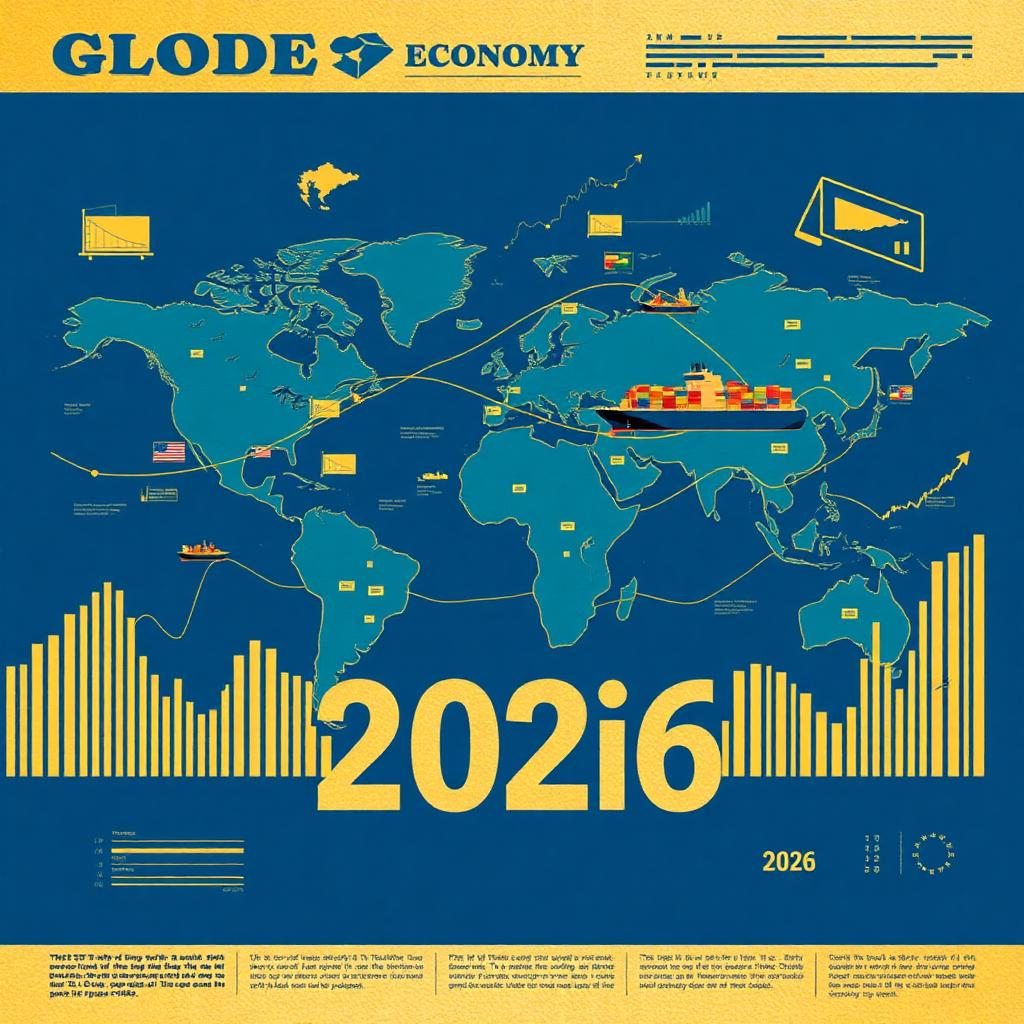
There was a time when the global economy could be summarized in a single sentence: “globalization drives growth.†This phrase, repeated hundreds of times between 1995 and 2018, no longer describes 2026. The June 2026 report from the International Monetary Fund, presented by Managing Director Kristalina Georgieva in Washington, forecasts 2.9% global growth this year—a figure seemingly close to the historical average, but which conceals a profound reshaping of economic drivers.
Three Worlds, One Average
The first world is American. The United States is expected to post 2.1% growth in 2026, driven by still robust domestic demand, massive investments in semiconductors and AI (CHIPS Act, Inflation Reduction Act partially preserved), and a tight labor market despite the post-2025 slowdown. Donald Trump's tariff policy, with duties ranging from 10% to 60% depending on origin, has not—yet—pushed inflation above 3.5%, but it is profoundly reshaping North American supply chains.
The second world is Chinese. Beijing now officially targets 4.5% growth, below the historical 5% objective, but accompanied by a declared industrial transformation: electric vehicles (BYD, Geely, Xiaomi Auto), batteries (CATL), solar panels, robotics, and generative AI in Mandarin. The property crisis, long feared as a "Lehman moment," has been contained by massive fiscal efforts and the creeping nationalization of several developers.
The third world is European. The eurozone, with an expected 1.1% growth, is struggling to regain its tempo. Germany is slowly emerging from two years of industrial stagnation, France is absorbing the dual shock of fiscal consolidation and debt reduction, and only the South (Spain, Portugal, Greece) and Poland are truly pulling the average upward.
Key Figures of the World Economy 2026
- 2.9%: Global growth projected by the IMF (June 2026).
- 2.1%: US growth.
- 4.5%: Official Chinese growth.
- 1.1%: Eurozone growth.
- 6.4%: Indian growth, the highest in the G20.
- 3.1%: Average global inflation, down from 5.7% in 2023.
- $2,500 billion: Global foreign direct investment flows, down 12% over two years.
- 17%: Share of world trade now subject to explicit tariff restrictions (vs. 4% in 2018).
The End of Zero Rates, The Return of Margins
The US Federal Reserve has brought its rates back to the 3.25%-3.50% range, the European Central Bank to 2.25%, the Bank of England to 3.75%, and the Swiss National Bank to 0.25%. This monetary landscape—controlled disinflation, positive but moderate real rates—structurally favors players with solid margins and balance sheets, and disadvantages zombie companies that survived the 2010-2022 cycle.
The consequence is visible in the markets: the risk premium on high-yield bonds has widened, intra-sector dispersion has returned to pre-Covid levels, and selection based on fundamentals—"stock picking," as it was called before—is regaining relevance for the first time in fifteen years.
The Three Fractures Structuring the Decade
Behind the aggregates, three fault lines are durably structuring the decade from 2025 to 2035. First, the trade fracture: globalization as it was built since 1995 has given way to regional blocs whose borders depend as much on geopolitics as on comparative advantages. Second, the technological fracture: generative AI, quantum computing, advanced semiconductors, and biotechnologies are redrawing the productivity map, with gain differentials that can reach 20 to 30 points between companies in the same sector. Third, the energy fracture: a world decarbonizing at very different paces—Europe accelerating, Asia diversifying, the United States fragmenting its policy between federal and state levels—creates industrial electricity costs that now vary by a factor of three depending on the jurisdiction.
> "We are not exiting a cycle, we are changing regimes. Macroeconomic models calibrated for 1995-2019 no longer describe the world in which we operate." — *Pierre-Olivier Gourinchas, IMF Chief Economist, June 2026.*
Key Takeaways
- 2.9% global growth forecast by the IMF in 2026.
- Three worlds: United States (2.1%), China (4.5%), Eurozone (1.1%).
- India remains the fastest-growing G20 economy (6.4%).
- Disinflation achieved (3.1% globally), positive real rates, return of financial selectivity.
- Trade fragmentation: 17% of global trade under tariff restrictions.
- Three structuring fractures: trade, technological, and energy.