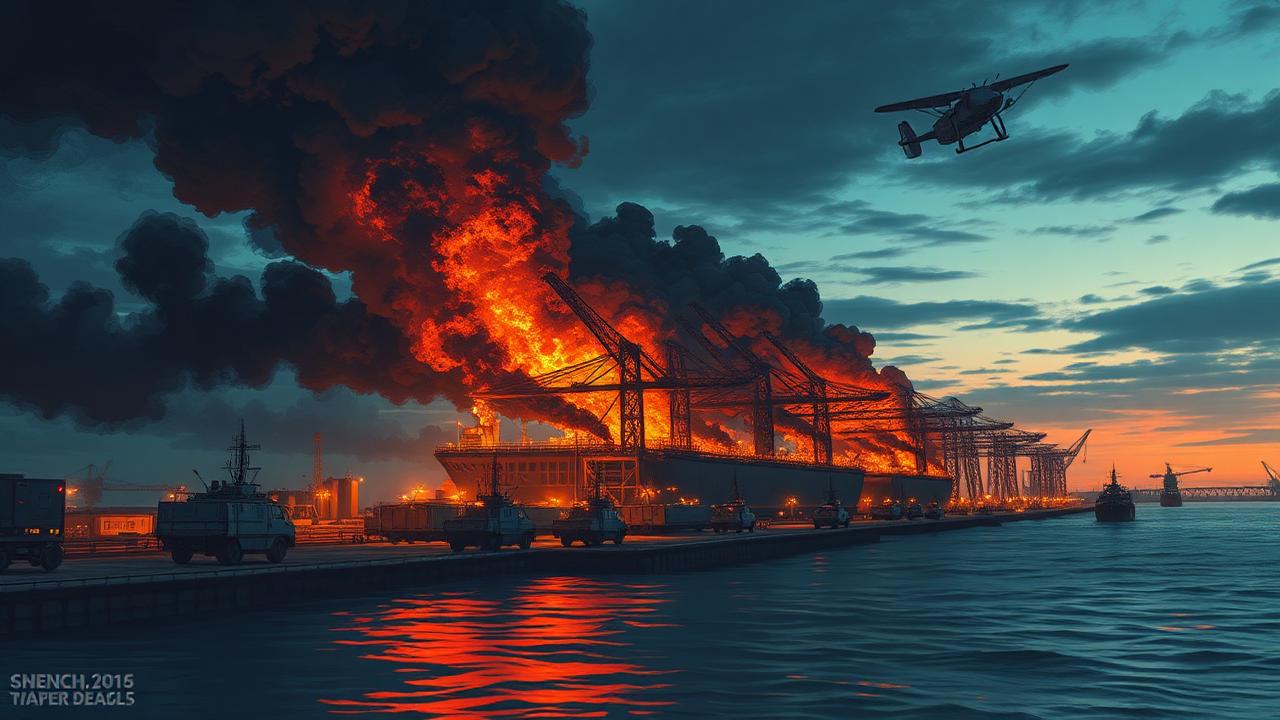
Among the images that will remain from this busy geopolitical week: the black smoke from the Saint Petersburg oil terminal unfurling in the background for the photographers and delegates gathered for the Saint Petersburg International Economic Forum (SPIEF 2026)—the event the Kremlin has presented for twenty years as its equivalent of the Davos Forum. Ukraine struck hard, precisely where Vladimir Putin wanted to show strength and stability.
Over 1,000 km traveled to reach the Russian president's hometown
On the night of June 2-3, Ukrainian long-range drones traveled over a thousand kilometers to reach Vladimir Putin's hometown. Volodymyr Zelensky claimed responsibility for the strikes on the Saint Petersburg oil terminal—the *Petersburg Oil Terminal*—as well as a nearby naval base, damaging a Russian warship. The Russian Ministry of Defense claims to have intercepted over 350 drones in border regions and deep within the territory.
SPIEF under smoke: a calculated humiliation
The governor of Saint Petersburg, Alexander Beglov, acknowledged damage to "infrastructure" in the Kronstadt, Kirovsky, and Krasnoselsky districts, as well as several injuries. The city's airport temporarily closed its airspace before resuming operations midday. SPIEF, held from June 3 to 6 at the ExpoForum exhibition center, still opened its doors as scheduled. Notable attendees include far-right American commentator Candace Owens, Rodney Mims Cook Jr. (Chairman of the US Commission of Fine Arts, appointed by Donald Trump, and the first US official at SPIEF since 2017), and the controversial Andrew Tate.
Putin responds on June 5
During his speech at SPIEF this Friday, Vladimir Putin stated that Russia would strengthen its air defenses in response to Ukrainian attacks, which are penetrating deeper and deeper into Russian territory. He also addressed the country's economic challenges—persistent inflation, double-digit interest rates, declining investment—without convincing observers that Moscow has a credible growth strategy for the post-war era. Economist Oleg Vyugin, former deputy governor of the Russian central bank, had warned before the forum: "The government essentially has nothing to offer for a return to growth."
Zelensky in Paris on Sunday
In parallel, France announced that Ukrainian President Volodymyr Zelensky will meet with Emmanuel Macron, German Chancellor Friedrich Merz, and British Prime Minister Keir Starmer on Sunday, June 7. This four-way meeting takes on particular strategic importance in the context of deep strikes on Russian soil: Kyiv wants to secure reinforced European support while American aid remains dependent on the erratic arbitration of the White House.
Editorial opinion
"Putin's Davos" under a column of black smoke: it is hard to imagine a more disastrous communication for a regime that relies on the prestige of its major economic gatherings. Ukraine is now targeting symbols as much as infrastructure—and this week, the symbol was perfect. However, the war itself is becoming prolonged, and Moscow's economic discourse sounds as hollow as the Saint Petersburg sky on Tuesday morning.
Key takeaways
- Night of June 2-3: Ukrainian drones strike Saint Petersburg oil terminal and a naval base.
- Over 350 drones intercepted by Russia; confirmed damage in Saint Petersburg.
- SPIEF 2026 (June 3-6) opened despite everything; first US official (R. Mims Cook Jr.) present since 2017.
- Putin, June 5: announces strengthening of Russian air defenses.
- Zelensky to meet Macron, Merz, and Starmer in Paris on Sunday, June 7.
- Russian economy: double-digit interest rates, declining investment, no discernible growth strategy.