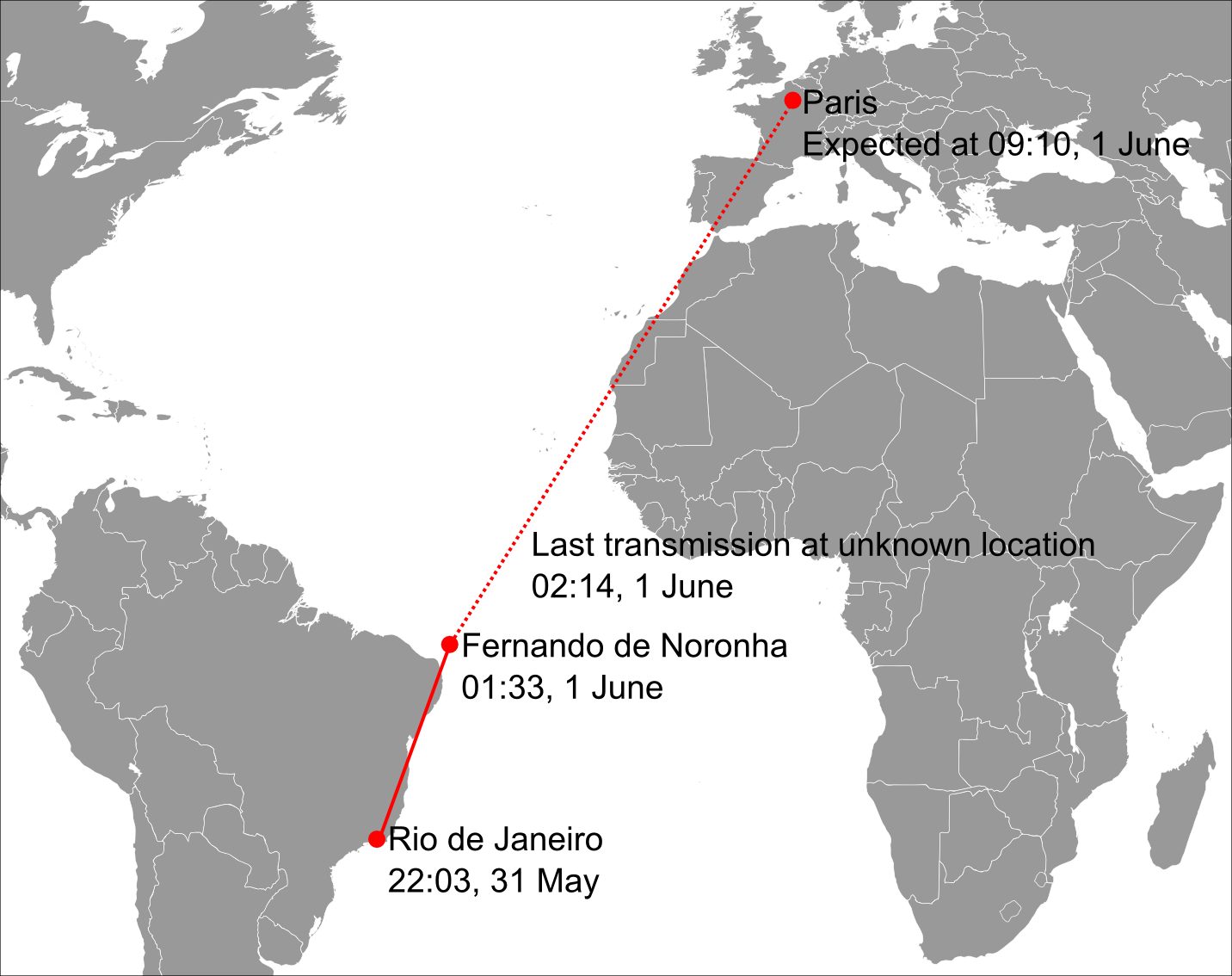
Seventeen years, almost to the day. On June 1, 2009, at 2:14 AM Paris time, Air France flight 447 en route from Rio de Janeiro to Paris-Charles-de-Gaulle crashed into the Atlantic off the Brazilian coast, taking with it its 216 passengers and 12 crew members. This Thursday, May 21, 2026, at 9:30 AM, in courtroom number 2.10 of the Paris Courthouse, the presiding judge of Chamber 4-1 of the Court of Appeal, Anne-Sophie Dubois, delivered a word that the victims' families had been awaiting for nearly a decade: "guilty." Air France and Airbus are convicted of involuntary manslaughter and each fined 225,000 euros – the legal maximum for a legal entity at the time of the events.
A Decision Reversing the First Trial
The decision rendered this Thursday marks a spectacular turnaround from the first-instance judgment of April 2023. At that time, the Paris Criminal Court had acknowledged that Air France and Airbus had committed "imprudences" and "culpable negligence," but concluded there was no certain causal link between these faults and the accident, acquitting both companies criminally while recognizing their civil liability. The Prosecutor General appealed, followed by the victims' families association Entraide & Solidarité AF447, presided over by Danièle Lamy.
The Court's Reasoning: A Chain of Faults
The Court of Appeal cited, for Airbus, the failure to diligently replace the Thales AA Pitot probes, whose failures at high altitude had been documented since 2008 in 32 recorded incidents. "The manufacturer had sufficient cumulative information to identify the risk and initiate systematic replacement. The choice not to do so constitutes a culpable negligence directly linked to the accident," the presiding judge read. For Air France, the inadequacy of operational instructions provided to crews on how to handle probe icing was the determining factor. Both companies announced after the hearing that they reserved the right to appeal to the Court of Cassation.
Families' Emotion
Outside the Palace of Justice, Daniel Robert, brother of co-pilot David Robert who disappeared in the accident, did not hide his emotion. "My brother will not come back. But today, judicial truth finally aligns with technical truth. For seventeen years, we were told it was the pilots' fault. The court now recognizes that these pilots were placed, by their employers and the manufacturer, in an impossible situation." Danièle Lamy, founder of the families' association, spoke of "immense relief, but tinged with bitterness: it took seventeen years of fighting."
Flight AF447: A Look Back at a Tragic Night
The fatal sequence began at 1:51 AM GMT, over the Intertropical Convergence Zone known as the "Doldrums." The Airbus A330-203, a 4-year-old aircraft, entered a convective zone. The Pitot probes, responsible for measuring air speed, successively froze. The autopilot disconnected. Co-pilot Pierre-Cédric Bonin, young and inexperienced in manual high-altitude flying, pulled the aircraft up, causing it to stall. In three minutes and thirty seconds, the A330 plummeted 38,000 feet into the Atlantic. The black box was not recovered until May 2011, at a depth of 3,900 meters, after four unsuccessful recovery campaigns.
A Precedent-Setting Ruling
The ruling issued on May 21, 2026, will set a precedent. It is indeed the first time in France that an aircraft manufacturer has been criminally convicted for a civil aviation accident. Several specialized lawyers interviewed by Le Devoir and Le JDD highlighted the potential consequences: the decision could inspire other ongoing proceedings, particularly those related to the crashes of the Boeing 737 MAX in 2018 and 2019. In Toulouse, Airbus confirmed that the conviction did not entail additional provisions in its accounts, as the fine was less than one million euros, but acknowledged an "obvious reputational impact."
The Issue of the Fine Cap
The legal maximum of 225,000 euros per legal entity at the time of the events is shocking. Such a sum, for groups collectively worth over 150 billion euros, seems like a mockery. Several parliamentarians, including Green Party MP Sandrine Rousseau and LR Senator Olivier Cigolotti, announced on Thursday noon the submission of a bill to make criminal fines applicable to legal entities proportionate to their turnover, similar to the European DSA regulation. The Minister of Justice, Élisabeth Borne, stated she was "open to discussion."
Editorial Opinion
We must grasp the significance of what unfolded this Thursday, May 21, 2026, in courtroom 2.10. For seventeen years, the BEA's technical investigation unequivocally established that the tragedy resulted from a combination of faulty probes, inadequate procedures, and an inappropriate crew reaction. However, criminal justice, with its higher burden of proof for causality, struggled to reach the threshold of responsibility. The Court of Appeal's reversal is, above all, a victory for the families, who never gave up. Beyond the symbolism, this ruling sends a clear message to all high-risk industries: knowledge of a defect creates an obligation to act. It is now up to the state to draw financial lessons: a fine cap of 225,000 euros for global giants no longer makes sense in 2026. This must be addressed, quickly.
Key Takeaways
- Thursday, May 21, 2026: The Paris Court of Appeal finds Airbus and Air France guilty of involuntary manslaughter in the AF447 crash (June 1, 2009, 228 deaths).
- Maximum fine imposed: 225,000 euros for each company.
- Reversal from the acquittal pronounced in the first instance in April 2023.
- Fault attributed to Airbus: failure to replace defective Thales AA Pitot probes.
- Fault attributed to Air France: inadequacy of crew instructions.
- Appeal to the Court of Cassation considered by both companies.
- Debate reopened on the capping of criminal fines applicable to legal entities.