
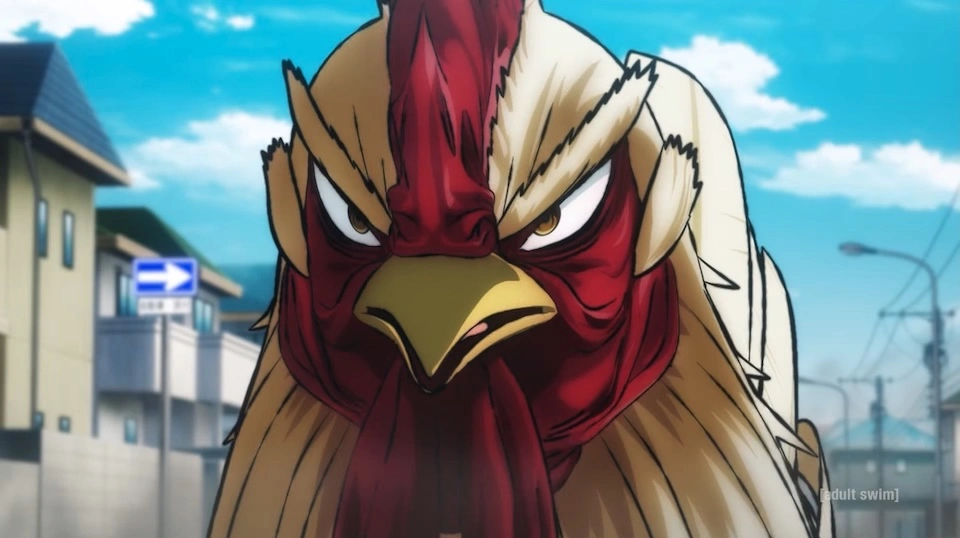
We thought we had seen everything in the absurd shōnen genre. Then came Keiji – a rooster with a steely gaze, samurai feathers, and a fighting technique called "cock-a-doodle-KO," capable of making his opponents explode through sonic resonance. Welcome to the universe of Rooster Fighter: Coq de baston, the seinen manga created by Shū Sakuratani in December 2020 on the Comiplex platform, whose anime adaptation, broadcast since March 15, 2026, on Crunchyroll and Tokyo MX, is set to become the most improbable cultural phenomenon of the year.
The premise is disarmingly simple. For three years, mutant demons – kijū – have been appearing in Japan, born from the emotional distress of humans. Most are harmless, but some become devastating monsters. A wandering rooster named Keiji, self-proclaimed "migratory bird," confronts them alone, town after town, on a vengeful quest: to find and eliminate the "White Demon" who killed his sister. Accompanied by Piyoko, a chick raised by a repentant yakuza, and Elizabeth, an aristocratic hen armed with an electric baton and phone skills, Keiji carves his path with an inflexible code of honor and cataclysmic striking power.
The anime adaptation, directed by Daisuke Suzuki and produced by Joseph Chou at Studio Sanzigen (known for Bubuki Buranki and D4DJ), gambles on hybrid 3D animation that perfectly captures the manga's graphic brutality while instilling breathtaking cinematic dynamism. Screenwriter Hiroshi Seko, a respected industry veteran (Attack on Titan, Mob Psycho 100, Jujutsu Kaisen), has managed to distill devastating black humor into the dialogues while preserving the dramatic intensity of the narrative arcs. Four episodes have already aired – "The Rare Bird," "The Caged Bird," "Parable of the Three Birds," and "Full of Crested Desires" – and the fifth, "Feathered Flight," is coming on April 12.
The success is global and far exceeds the traditional otaku sphere. The manga, published in France by Mangetsu (nine volumes available), has already sold over 3 million copies worldwide and has been translated into twelve countries. Spanish-speaking countries – Mexico, Spain, Argentina – are particularly enthusiastic. On social media, Keiji memes are flying: his merciless gaze, his iconic silhouette against skyscrapers, his cult line "I never stay longer than necessary" have gone viral. Adult Swim has acquired the broadcasting rights for North America, confirming the series' crossover potential.
What makes Rooster Fighter truly unique, beyond its absurd premise, is its ability to tackle profound themes – grief, redemption, the loneliness of the vigilante – with disarming sincerity. Beneath the parody of nekketsu and kaijū eiga codes, Sakuratani has built a narrative about the cathartic power of combat and the fragility of those who carry the weight of the world on their shoulders. Even when it's feathers. The OrChair editorial team, unanimously won over, places Rooster Fighter in the pantheon of works that prove manga remains the most audacious and free narrative medium of the 21st century. An absolute favorite.