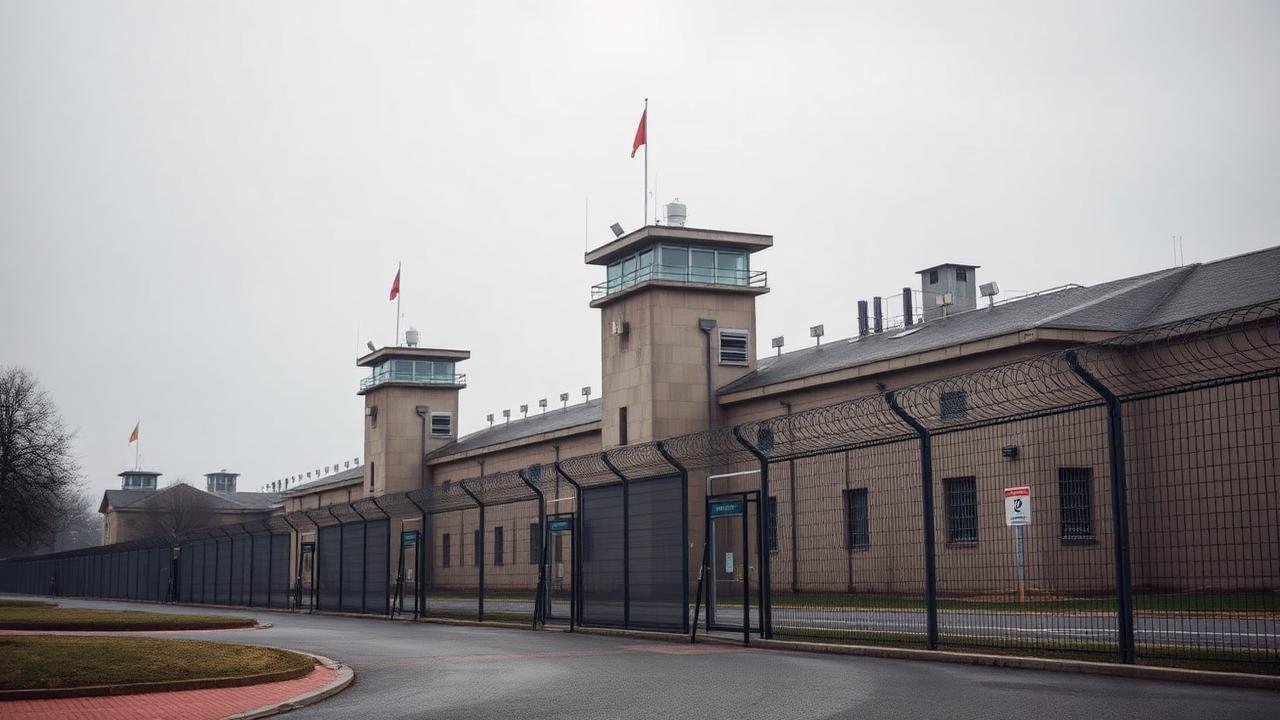
The standoff between the administrative court and the prison administration regarding Salah Abdeslam took an unprecedented turn on Monday, April 20, 2026. The summary judge, convened by the lawyers of the sole survivor of the November 13 commando operations, ordered the state, under penalty, to enforce the April 1st order relaxing his visitor conditions at the Vendin-le-Vieil prison center. The decision, made public mid-morning, was reported by BFMTV, Le Figaro, and 20 Minutes, which published its initial lines. La Libre Belgique had, on April 3rd, recounted the initial decision of the administrative court.
The context: the USB key affair
To understand the sequence of events, one must go back to 2025. Following what was called the 'USB key affair' – the discovery, during a search, of a digital storage device introduced into detention under controversial circumstances – the prison administration had considerably tightened the visitor conditions for Salah Abdeslam, who was sentenced in 2022 to an incompressible life sentence. Physical contact with visitors had been abolished, and visits were systematically conducted behind a glass partition, as highlighted by Fdesouche, citing La Voix du Nord. The detainee's lawyers had brought the case before the administrative court, arguing a disproportionate violation of the right to maintain family ties.
The April 1st order
It was on April 1st, 2026, that the administrative court ruled for the first time, ordering a progressive and controlled relaxation: the possibility of visits without a separation device for authorized visitors, under enhanced surveillance. La Libre Belgique specified at the time that Salah Abdeslam would 'once again be able to have physical contact with the people who visit him'. The prison administration, deeming this arrangement incompatible with the very high-security regime of Vendin-le-Vieil, did not implement the decision. It is this refusal that justified the new referral to the summary judge.
A penalty to force the State's hand
The new element in the April 20th decision is the penalty: for each day of delay in implementation, the state will have to pay a financial sum (the exact amount of which was not made public by midday), according to Le Figaro, citing AFP. This is an instrument rarely used in prison cases, but standard in administrative law when the administration delays in executing a judicial decision. According to 20 Minutes, Salah Abdeslam's lawyers hailed it as a 'victory for the rule of law,' while the FO-Justice prison union denounces a decision 'disconnected from the operational constraints of a highly secure unit.'
An emblematic case in the debate on incompressible life sentences
The case goes beyond Salah Abdeslam's situation. It illustrates the fragile balance in French law between security requirements related to terrorism and the fundamental guarantees granted to detainees, including those sentenced to incompressible life imprisonment. The Constitutional Council and the European Court of Human Rights have repeatedly stated that even the harshest life sentence must be compatible with a minimum of dignity and the maintenance of family ties. The April 20th decision aligns with this principle. The Ministry of Justice had not officially responded by mid-afternoon, simply stating that it was examining avenues for appeal.
Editorial opinion
The administrative court's decision is not a concession to Salah Abdeslam. It is a reprimand to the prison administration: one is not allowed to ignore a court decision, even if it is disturbing or difficult to implement. Public sentiment may be offended – and legitimately so – by the very idea of relaxing conditions for the sole survivor of the Bataclan commando. But the rule of law precisely means applying the rules to those we despise as well as to those we respect. If the administration believes the order creates a security risk, it should appeal to the judge, provide its evidence, and plead its case. Until then, it must comply. This is the only response worthy of a democracy.
Key takeaways
- The administrative court orders the state, under penalty, to implement the April 1st order.
- Salah Abdeslam, the sole survivor of the November 13 commando, is detained at Vendin-le-Vieil.
- The prison administration had refused to implement the decision after the 'USB key affair'.
- The order allows for visits without a glass partition, under enhanced surveillance.
- The Ministry of Justice is considering appeals; FO-Justice denounces a 'disconnected' decision.