
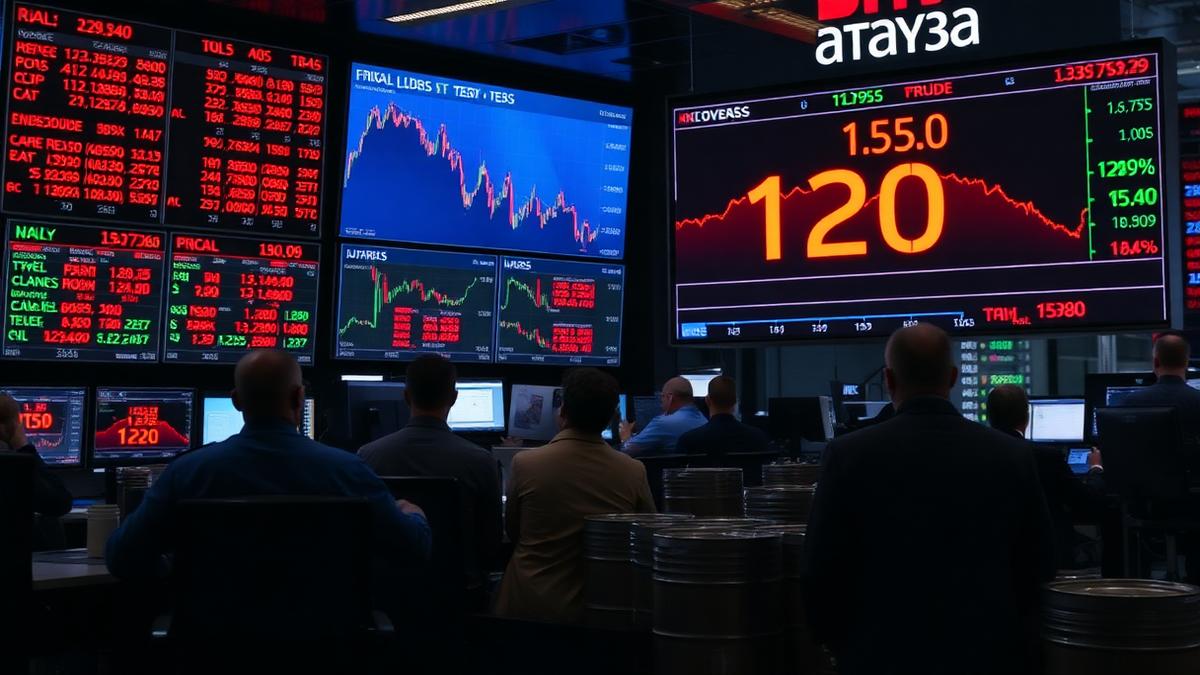
The Brent crude barrel crossed the symbolic threshold of $120 this Tuesday, April 7, 2026, a level not seen since the post-Ukraine invasion peak in June 2022. At the opening of European markets, Brent was trading at $121.40, up 5.2% for the session, while U.S. WTI rose 4.8% to $117.60. This surge is directly attributable to the confluence of two factors: the closure of the Strait of Hormuz since February 28 – which deprives the market of 17 million barrels daily – and the imminent expiration of Trump's ultimatum to Iran, which raises fears of the destruction of Iranian oil infrastructure.
The International Energy Agency (IEA) has called an emergency meeting of its twenty-eight member countries to coordinate a massive release of strategic reserves. According to information obtained by the Financial Times, the United States is considering drawing 60 million barrels from its Strategic Petroleum Reserve (SPR), already reduced to its lowest level in forty years. Europe and Japan are also preparing unprecedented withdrawals from their stocks. However, Goldman Sachs analysts believe these measures will not be enough to offset the supply loss if the conflict intensifies: "A $150 barrel is no longer an extreme scenario, it is a realistic short-term possibility."
The consequences for the global economy are already palpable. Inflation, which had been brought back below 3% in the Eurozone in early 2026, has started to rise again under the effect of soaring transport and energy costs. Jet fuel prices have jumped 40% since the beginning of the conflict, forcing several European airlines to implement fuel surcharges. The most energy-intensive sectors – chemicals, steel, cement – are warning of production stoppages if natural gas prices, partly indexed to oil, continue their ascent.
OPEC+ producing countries are observing the situation with a mixture of caution and opportunism. Saudi Arabia, which has increased its production by 500,000 barrels per day to partially compensate for the Iranian loss, is resisting U.S. pressure for a more massive effort. Riyadh fears that overproduction could crash prices if a ceasefire is reached quickly, leaving the kingdom with unprofitable excess capacity. Russia, for its part, is taking advantage of the situation to renegotiate its supply contracts with China and India at higher prices.
For consumers, the bill is immediate. In France, a liter of unleaded 95 has crossed the €2.20 mark, its highest historical level. In the United States, a gallon of gasoline exceeds $5 in a majority of states. The French government has announced an extension of the fuel allowance for low-income households, while Germany is considering a temporary return to the "fuel discount" implemented in 2022. ECB economists warn that Brent remaining above $120 for more than three months would plunge the Eurozone into technical recession.