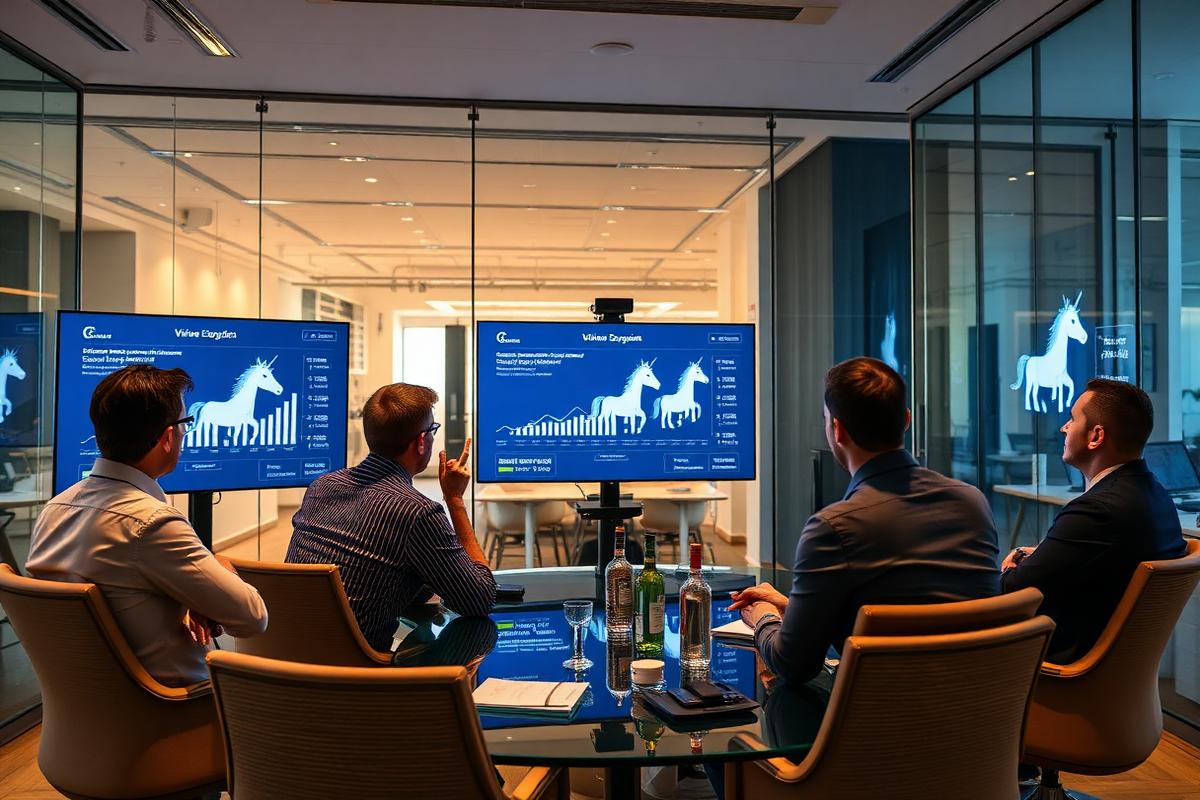
In the bustling global tech ecosystem, separating signal from noise has become an almost Olympic exercise. Over 50,000 startups are created each month worldwide, according to Crunchbase, but less than 1% will reach Series A. So how do you spot future champions before they land on the radar of major funds? The OrChair editorial team, in constant contact with the European and American VC ecosystem, applies a rigorous analysis grid inspired by the methods of top early-stage investors: quality of the founding team, addressable market size (TAM), defensible technological advantage, measurable early traction, and timing — that invisible factor that causes brilliant ideas to fail because they arrive too early or too late.
Our first gem: Lumière AI (Paris), founded by two former Mistral AI employees, is developing a language model specialized in legal analysis for European continental law. Where generalist LLMs struggle with the subtleties of civil codes and European jurisprudence, Lumière AI achieves 94% accuracy on legal reasoning tests — compared to 67% for GPT-5 on the same benchmarks. The startup has raised €8 million in seed funding from Partech and Elaia, and already counts 40 law firms among its clients. Second favorite: BioForge (Zurich), which uses synthetic biology to produce silk proteins on an industrial scale. Applications include high-performance textiles, biodegradable medical sutures, and aeronautical composite materials. A $22 million Series A was closed in January 2026 with Lux Capital.
Third selection: Kōdō Robotics (Tokyo/Berlin), a specialist in soft robotics for vertical farming. Their robotic arms, inspired by octopus tentacles, handle fragile fruits and vegetables without damaging them — a problem that has remained unsolved for twenty years. Fourth: Nuvem (São Paulo), a fintech company democratizing fractional real estate investment in Latin America, allowing people to buy shares of properties starting from $50 via blockchain. Fifth: Aegis Quantum (London), which develops post-quantum encryption algorithms already adopted by three European central banks to protect their communications against the threat of quantum computers.
How to spot these gems before everyone else? The best VCs share a few principles. First: follow the researchers, not the entrepreneurs. The most promising deeptech startups are born in labs — keep an eye on publications on arXiv, Nature, and Science. Second: observe where talent migrates. When senior engineers leave Google, Meta, or OpenAI to join an unknown startup, it's a strong signal. Third: analyze public tenders. Governments and large companies post contracts that reveal the technologies they will need in 3 to 5 years. Fourth: frequent niche communities — specialized Discords, local meetups, university hackathons — rather than large conferences where deals are already made.
Our conviction at OrChair: the greatest investment opportunities of 2026-2030 lie at the intersection of three mega-trends — AI applied to specific verticals (legal tech, climate tech, biotech), the energy transition (storage, green hydrogen, smart grids), and European digital sovereignty (cloud, cybersecurity, semiconductors). Startups that combine at least two of these axes, with a team possessing top-tier technical expertise and initial commercial traction, are the ones we are betting on. This selection will be updated monthly. Stay tuned — tomorrow's unicorns might be hiding in a garage just around the corner.