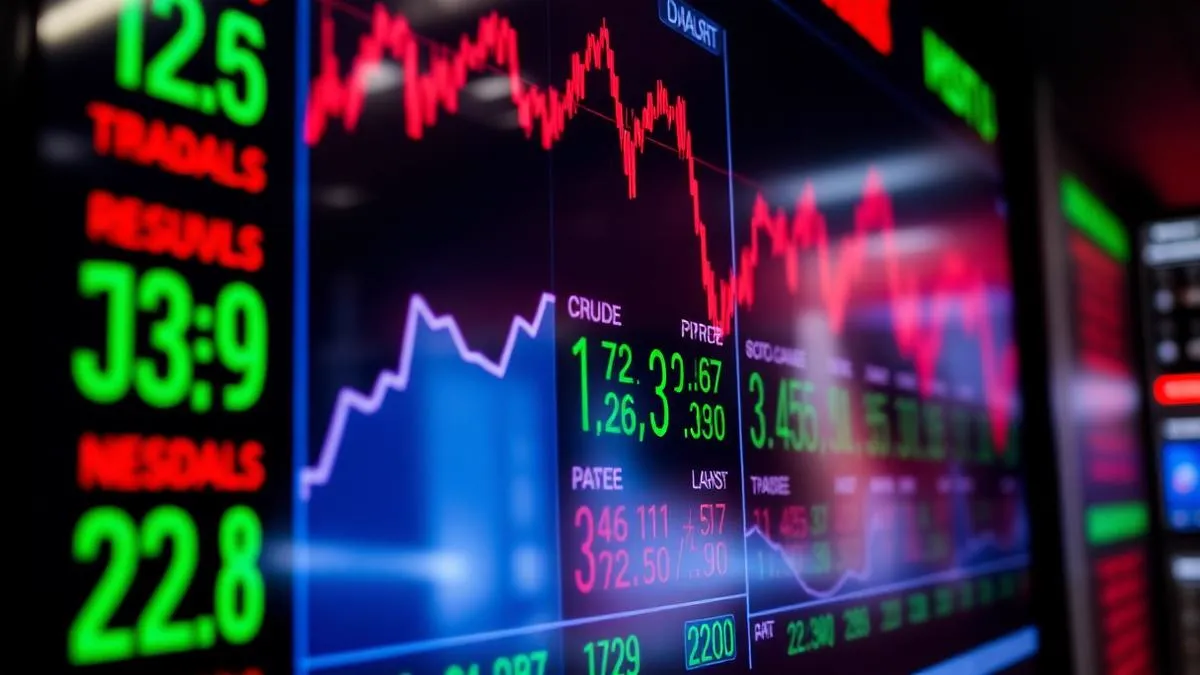
Financial markets opened in panic mode this Saturday – Gulf and Asian exchanges, open on weekends, recorded spectacular drops as soon as the American ultimatum to Iran was announced. The Brent barrel jumped by 4.7% to cross the symbolic threshold of $110 – its highest level since March 2022, the day after the Russian invasion of Ukraine. US WTI followed, at $107.40.
Gold, the ultimate safe-haven asset, reached a new historic record at $3,180 per troy ounce, up 2.3% in a single day on Friday. Since the beginning of the Iranian conflict in mid-February, the yellow metal has gained 18%, driven by geopolitical uncertainty and massive purchases by central banks – notably those of China, India, and Turkey.
Asian stock indices plunged: the Nikkei 225 lost 3.2%, the Hang Seng 2.8%, and the Saudi Tadawul 4.1% – its worst session since the pandemic. However, oil stocks saw gains: Saudi Aramco rose 5.2%, TotalEnergies 3.8%, and ExxonMobil 4.1% at Friday's close on Wall Street.
JPMorgan economists raised their oil price forecast for the second quarter to $120 per barrel in case of conflict prolongation, and to $150 if the Strait of Hormuz were to be completely closed. 'We are in a scenario of an oil shock comparable to 1973 or 1979,' warns Christyan Malek, head of energy strategy at JPMorgan. The impact on global inflation would be 'devastating'.
The European Central Bank held an emergency videoconference meeting to assess the risks to the financial stability of the Eurozone. Christine Lagarde called on European governments to 'immediately activate their strategic oil reserves' and to 'prepare energy rationing plans if the crisis were to extend beyond April'. European markets will open Monday in an atmosphere of extreme tension.