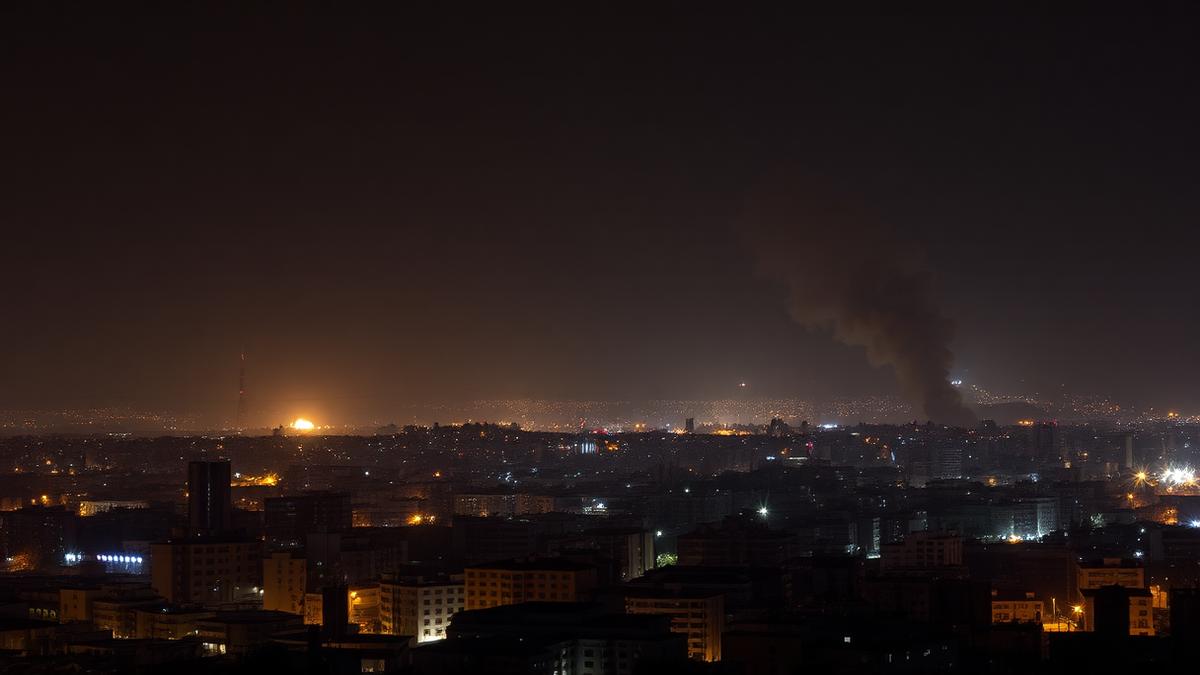
The Iranian capital was again shaken by violent explosions on the night of Monday, April 6, to Tuesday, April 7, 2026. According to testimonies gathered by AFP and France 24, detonations were heard in several districts of Tehran and its southern outskirts, causing plumes of smoke visible for miles. The Israeli armed forces claimed strikes against "strategic military targets," while Iran's Revolutionary Guards denounced "deliberate attacks against civilian infrastructure." At least six residential buildings were damaged by debris, causing about ten injuries according to the Iranian Red Crescent.
One of the most striking events of the night was the Israeli warning addressed directly to the Iranian population. Through digital flyers distributed via social networks and geolocated SMS messages, the IDF asked residents not to "travel by train" and to stay away from stations and railway hubs. This message, interpreted as an announcement of imminent strikes on the Iranian railway network, caused a panic movement in several cities, notably Isfahan, Shiraz, and Tabriz. The Iranian railway network has suspended all its long-distance services until further notice.
The military escalation comes as ceasefire negotiations continue in Islamabad, Pakistan. Pakistani, Egyptian, and Turkish mediators are trying to maintain their proposal for a forty-five-day armistice despite initial rejection from Washington and Tehran. The Pakistani Prime Minister called on "all parties to immediately cease hostilities" and offered to host a direct meeting between the American and Iranian envoys. France, Germany, and the United Kingdom reiterated their support for the tripartite mediation.
Iran responded by intensifying its missile and drone launches towards Israel. The Iron Dome system intercepted the majority of the projectiles, but several impacts were reported in Ramat Gan, a suburb of Tel Aviv, damaging vehicles and building facades without causing fatalities. The Iranian army warned that its next actions would go "beyond the region," a phrase interpreted by analysts as a possible extension of targets to American bases in Europe or the Indian Ocean.
On the 39th day of this conflict, which began on February 28 with US-Israeli strikes on Iranian nuclear facilities, the human toll is tragically increasing. Estimates converge on several thousand Iranian civilian victims, a figure impossible to verify independently due to restrictions on access imposed on international media. The UN Secretary-General described the situation as "an unprecedented humanitarian catastrophe in the Middle East for decades" and convened an extraordinary session of the Security Council for Wednesday.